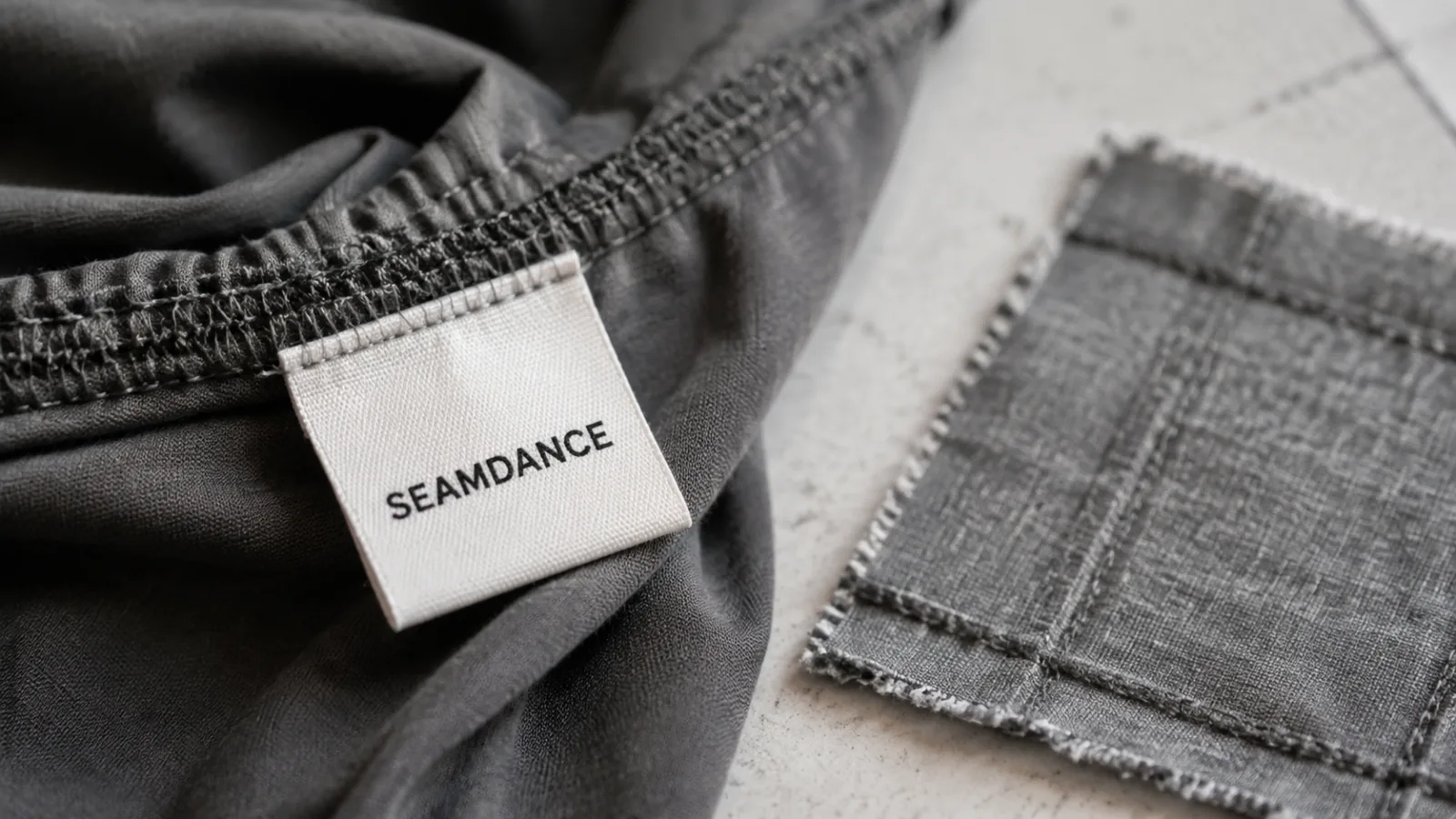
The care label is the one legal claim on your garment that almost nobody checks. Fiber content gets verified; country of origin is a fact. But “machine wash cold, tumble dry low” is a prediction about how your product will behave — and under the FTC's Care Labeling Rule you must hold evidence for it before the garment goes on sale. Copying that line off a factory's spec sheet is not evidence, and activewear is a risky thing to guess at. Here is what a reasonable basis is, why a legging is a harder case than a cotton tee, and how to get the evidence during sampling rather than after a complaint.
The short answer
- The FTC Care Labeling Rule, 16 CFR §423.6(c), puts the duty on the manufacturer or importer — your brand, not the overseas factory — to possess a reasonable basis for the care instructions before the product is sold.
- A reasonable basis means testing on the product or on a fair sample of it, or reliable evidence of current technical literature, past experience, or the industry expertise. A forwarded spec sheet is not obviously any of those.
- The duty runs both ways: the method you recommend, and any method you warn against. But silence is not a warning — a short label creates fewer obligations than a crowded one.
- Digital care labels are proposed, not permitted. The AAFA petitioned the FTC in February 2025; as of March 2026 no action had been taken. Do not plan a label around them yet.
The sentence nobody ever tested
Here is how it happens, and it is completely ordinary. The factory's spec sheet carries a care line — usually a default for that fabric family, sometimes carried over from a style written two years ago. It gets copied into the tech pack, onto the label artwork, into three thousand sewn garments and into the care tab on your product page. Nobody in that chain ever washed the garment.
None of it feels like a compliance decision; it feels like admin. That is why it survives review. Fiber content reads as a legal statement, so somebody checks it, while the care line reads as formatting. It is not formatting. It is the one claim on your label that predicts the future, and you published it under your own name.
It stays quiet until a customer follows your instructions and the print cracks, the waistband stops holding, or the black bleeds across a wash load. The question then is not whether the garment failed, but what you held, before you sold it, that made you say that. A spec sheet is a sentence, not a basis.
What the rule actually requires
The FTC's Care Labeling Rule, at 16 CFR §423.6(c), places the obligation on the manufacturer or importer. For a US brand producing overseas that is you: your company imports the goods, and the facility that wrote the spec sheet is not the party the rule addresses. Pointing at the source of the sentence does not move the duty there.
Two phrases do most of the work. You must possess, prior to sale, a reasonable basis for the care instructions you give. Possess means you hold it — not that it exists somewhere in your supply chain, and not that someone assured you it does. Prior to sale means before the product is on the market; evidence collected after a complaint arrives is a response, not a basis.
What counts is broader than most brands assume. It can be testing on the product or on a fair sample of it. It can also be reliable evidence of current technical literature, past experience, or the industry expertise — a genuine route, and how a great deal of legitimate labeling is supported. But the operative words are reliable evidence, and a spec sheet forwarded in an email is not obviously any of the three. The FTC treats failure as an unfair or deceptive act or practice, subject to civil penalties.
What the Care Labeling Rule asks of the party whose name is on the label
| Requirement | What it means in practice |
|---|---|
| A care instruction must be on the garment | Permanently attached and legible for the useful life of the product |
| The instruction must be reasonably based | You must hold evidence that the method you printed does not harm the product |
| Warnings where a common method would harm the product | Silence is not a warning; if a normal method would damage it, say so |
| The obligation follows the label, not the factory | The party whose name appears on the garment answers for the instruction |
It runs both ways — but silence is not a warning
The duty is symmetrical, which catches people out. You need a basis for the method you recommend — evidence that washing cold and tumbling low will not harm this garment — and a basis for any method you warn against. “Do not tumble dry” is not a free safety margin. It asserts that tumble drying causes harm, and that is a claim too.
The lever sits between them: you do not have to substantiate a method you simply did not mention. Silence is not a warning. A label reading “machine wash cold, tumble dry low” carries two substantiated claims. One that adds “do not bleach, do not iron, do not dry clean, wash with like colors, do not use fabric softener” has multiplied the statements you are answerable for, most of them added defensively.
That inverts the usual instinct, which treats the label as free space for advice. In substantiation terms it is the opposite of free: every extra line is another claim needing a basis, and a short, well-evidenced label is a stronger position than a long, cautious one. Two cautions, though. This is about what you must substantiate, not about what a label is otherwise required to carry — and it is no license to drop a warning you know to be true.
Why a legging is a harder case than a cotton tee
Much of the industry's confidence in the past-experience route comes from cotton. A cotton jersey tee is one fiber in one construction with decades of documented behavior behind it, so its care line is close to a known quantity. A performance legging is a composite: an elastane-blend knit, a bonded waistband, a silicone gripper, a heat-transfer or printed logo, sometimes reflective trim. All of it meets the same cycle. None of it responds the same way.
Elastane fails invisibly. Heat ages it — repeated hot washes and tumble drying degrade the filament. The garment does not tear; it stops coming back. Recovery loss appears neither at inspection nor on the first wash, but somewhere around wash fifteen, as knee bagging and a slack waistband. Your “tumble dry low” line is a claim about wash fifteen, which is why one trial wash proves less than it looks like.
The attached components fail visibly instead. Heat transfers and bonded seams rely on an adhesive engineered for a temperature range a domestic dryer can exceed, so edges lift and bonds open. Screen prints crack with heat and flexing. Silicone grippers lose tack. High-saturation dyes on synthetic knits — deep blacks, strong reds — are the standing crocking and bleeding risk. A fabric can pass every test on its own while carrying a trim that fails, and the fabric spec sheet describes none of it.
What “a fair sample” means, and what testing costs
A fair sample fairly represents what you are selling, which rules out most of what gets tested by default. Not a blank swatch — no print, no bonding, no gripper. Not a prototype in substitute fabric. Not the pale colorway that happened to be on the desk: if the range includes black and a saturated red, those carry the bleed risk, and white tells you nothing about them. It should be the construction and decoration you approved, in the colors you ship.
On cost, the honest answer has two tiers. A laboratory wash test returns a report with a named method, defined conditions, a date and a described sample — the form of evidence a retailer's compliance team or an attorney recognizes without argument. It is priced per test and per colorway, and across a full range it adds up fast enough that small brands quietly decide against it.
Home-laundering trials cost a fraction and can be genuinely informative, since most of these failures show up in a domestic machine. But a trial is worth what its record is worth: an untimed wash in someone's kitchen, unknown detergent, nothing written down, is a memory rather than evidence. The workable middle is lab testing the highest-risk constructions and shades, with documented multi-cycle trials on the rest. Whether any particular package is enough for your product is not something a supplier can tell you.
What counts as a reasonable basis, and what does not
| Evidence | Does it support the instruction? |
|---|---|
| A wash test on the actual fabric, run to the instruction you printed | Yes — this is the ordinary route |
| A test on a fair sample of the product or a component | Yes, where the sample genuinely represents the goods |
| Reliable industry experience for that construction and fibre | Sometimes — it depends on how close the match is |
| The mill's care recommendation, unverified | Not on its own; it is an input, not evidence |
| Copying the label from a similar product | No — a different fabric behaves differently |
| Nothing, because nobody asked | No — and this is the common case |
Make the wash test part of the sampling round
Brands that wash-test at all usually do it after bulk, once a complaint has landed. By then the labels are sewn in and the product page is live, and the test is no longer evidence held before sale — it is damage assessment. The cheap moment is the sampling round, when the garment you need already exists: the approved pre-production sample, in production quality, with the real trims and print, in the colors you are shipping.
What you record is what turns a wash into evidence. Identify the sample: style, colorway, fabric lot, trims and decoration. State the conditions: temperature, cycle, detergent, load, drying method and temperature, number of cycles. Record what was assessed after — dimensional change, stretch and recovery, print and trim condition, seam and bond integrity, color transfer onto a white companion cloth, appearance. Photograph before and after, note who ran it and when, then write which instruction the result supports and which it does not.
What to ask the factory for is narrow. Run the wash on the approved production quality with the actual trims, not a blank swatch, and report it in writing with the sample described and the conditions stated — a pass/fail email is not a record. Then ask which symbols on the proposed care label they can support with a result, and which are defaults carried over from the fabric supplier.
That is where we fit, and where we stop. SEAMDANCE can build a wash and appearance-after-wash step into the sampling round on the actual production quality with the real trims, and record the result in our own factory or obtain the record from the partner factory running the category, so the evidence exists before the label artwork is signed off. A custom first sample runs about seven days with us; the wash step adds days, not a development cycle. What we cannot do is hold the basis for you. We are not a laboratory, and the obligation sits with the manufacturer or importer — the name on the label.
What is not changing, and what is not here yet
One point to be clear about, because the opposite circulates: the Care Labeling Rule is not currently under review. The FTC ran its decennial review over more than a decade — an advance notice in 2011, a proposed rule in 2012, a supplemental notice in 2020 — and terminated the proceeding on 8 December 2023. The rule survived unchanged. Anyone telling you the substantiation requirement is about to be relaxed is describing a review that has closed.
The live item is narrower and concerns format, not substance. On 28 February 2025 the American Apparel & Footwear Association petitioned the FTC to permit digital care labels — a QR code or URL on a small tag, or stamped directly onto the garment, in place of a sewn-in label. Comments closed on 18 April 2025 and, as of legal commentary dated 12 March 2026, the FTC had taken no action. Proposed, not permitted: do not build a labeling plan around them yet. And note what it would change even if granted — where the instructions live, not whether you need a basis for them.
The summary is uncomfortable but small. For most independent activewear brands the care label is the least-evidenced claim on the product, and one of the cheapest to fix: one documented wash, on the right sample, at a moment when you were making a sample anyway. What you cannot do is buy the basis from your supply chain — the duty to possess it sits with the importer whose name is on the label. This article is general information about how the requirement works, not legal advice; whether your particular label and your particular evidence satisfy the rule is a question for a qualified attorney.
Building the evidence into the sampling round
The cheapest moment to generate the evidence is while samples are being made, because a garment already exists and a laboratory can run the wash procedure you intend to print. Doing it later means pulling production units, which nobody wants to do once the goods are packed.
Three things belong in the file beside the report: which care instruction was tested, which fabric lot the tested garment came from, and what the garment looked like after the specified cycles. Keep the tested garment. When a customer says the product was ruined by following the label, a sealed garment that went through the same cycles is the only answer that ends the conversation.
What to run, and what it answers
| Test | What it tells you about the label |
|---|---|
| Dimensional change after the stated wash procedure | Whether the garment still fits after the instruction is followed |
| Colourfastness to laundering | Whether the colour survives the cycle you printed |
| Appearance and skew after laundering | Whether panels twist or the surface changes in a way customers will call a defect |
| The same cycle repeated | Whether the failure appears on the fifth wash rather than the first |
Quick answers
Who is responsible for the care label — the brand or the factory?
The party whose name is on the garment. A factory can advise, and a good one will, but the obligation follows the label rather than the sewing machine.
Is the mill's care recommendation enough?
It is an input, not evidence. Mills recommend conservatively and for the fabric, not for your finished garment with its trims, prints and bonded seams. Test the product you are actually selling.
Can I just print the most cautious instruction?
Not without a basis, and over-caution has its own cost: an instruction nobody follows, or one that makes the product look fragile. The rule expects the instruction to be reasonable, which cuts in both directions.
What if a common washing method would damage the product?
Then say so. Where a normal method would harm the garment, the label is expected to warn about it; leaving the warning out is not neutral.
How many garments do I need to test?
Enough to be a fair sample of what you are selling. One garment from one lot supports a claim about that lot; it does not support a claim about a colourway knitted six months later on different yarn.
Does this apply outside the United States?
The rule described here is the US one. Other markets have their own labelling requirements and symbol conventions, so a label designed for one market should be checked against the rules of each market it will be sold in.
Are care labels required by law in the United States?
Yes. The FTC's Care Labeling Rule requires manufacturers and importers of textile wearing apparel to give care instructions on a label that stays attached and legible for the garment's useful life, with at least a washing or a dry-cleaning instruction [1]. Importers must attach it before sale in the US, though not at customs entry [2]. Fully reversible garments without pockets are exempt from the permanent label but still need the instructions on a hang tag or package [1].
Are care labels required by law in the UK?
Not under UK textile labelling law. The Textile Products (Labelling and Fibre Composition) Regulations 2012 enforce Regulation (EU) No 1007/2011, which covers fibre names and composition labelling [7][8]. In Great Britain that means a durable, legible, securely attached composition label in English, supplied by the manufacturer or, if it is based outside Great Britain, by whoever places the goods on the market [8]. Care instructions are not required. Australia differs: its care-labelling standard is mandatory [9].
What must a clothing label show in the United States?
Under the Textile Fiber Products Identification Act and the FTC's rules in 16 CFR Part 303: fibre content by generic name and percentage by weight, the country of origin, and the name or registered identification number (RN) of a business that makes or handles the product [3][6]. The Care Labeling Rule adds care instructions, and all of it may share one label [1][3]. On a garment with a neck, origin goes on a label at the inside centre of the neck [3].
What does the RN number on a clothing label mean?
RN stands for Registered Identification Number. The FTC issues it to US businesses that make, import, market or otherwise handle textile, wool or fur products, and it can replace the company name on the label [3][6]. It is not transferable, and the letters RN must precede the digits [3][6]. Businesses outside the US cannot get one, so imported goods carry the foreign maker's name or a US importer's, wholesaler's or consenting retailer's name or RN [6].
Why do care labels matter?
Care instructions often decide a purchase, and the FTC notes that consumers want washing instructions [2]. In the US the label is also a regulated statement: followed as written, it must not substantially harm the garment, it must warn against harmful procedures a consumer could reasonably use, and the brand must hold a reasonable basis for it before sale [1][2]. A wrong line tends to show up after the first washes, as shrinkage, fading or colour transfer.
Sources
- 16 CFR Part 423 — Care Labeling Rule (eCFR, current text)
- FTC — Clothes Captioning: Complying with the Care Labeling Rule (business guidance)
- 16 CFR Part 303 — fibre content and country of origin on textile labels (eCFR)
- AATCC — Standard Test Methods and Procedures, including dimensional change and colourfastness to laundering
- ISO Online Browsing Platform — catalogue entries for the washing procedures and care-symbol standards referenced above
- FTC — Threading Your Way Through the Labeling Requirements Under the Textile and Wool Acts (the three required disclosures; RNs issued only to US businesses)
- legislation.gov.uk — The Textile Products (Labelling and Fibre Composition) Regulations 2012 (SI 2012/1102), the UK enforcement regulations
- legislation.gov.uk — Regulation (EU) No 1007/2011 on textile fibre names and labelling, as it applies in Great Britain (Articles 1, 14, 15 and 16)
- Product Safety Australia (ACCC) — Care labelling for clothing and textiles mandatory standard
Where label claims get their evidence: material confirmation, testing and final inspection before release.
Open the programSourcing styles for your line? The 2026 catalogue lists every ready-to-develop style — colorways, materials, quote list built in.