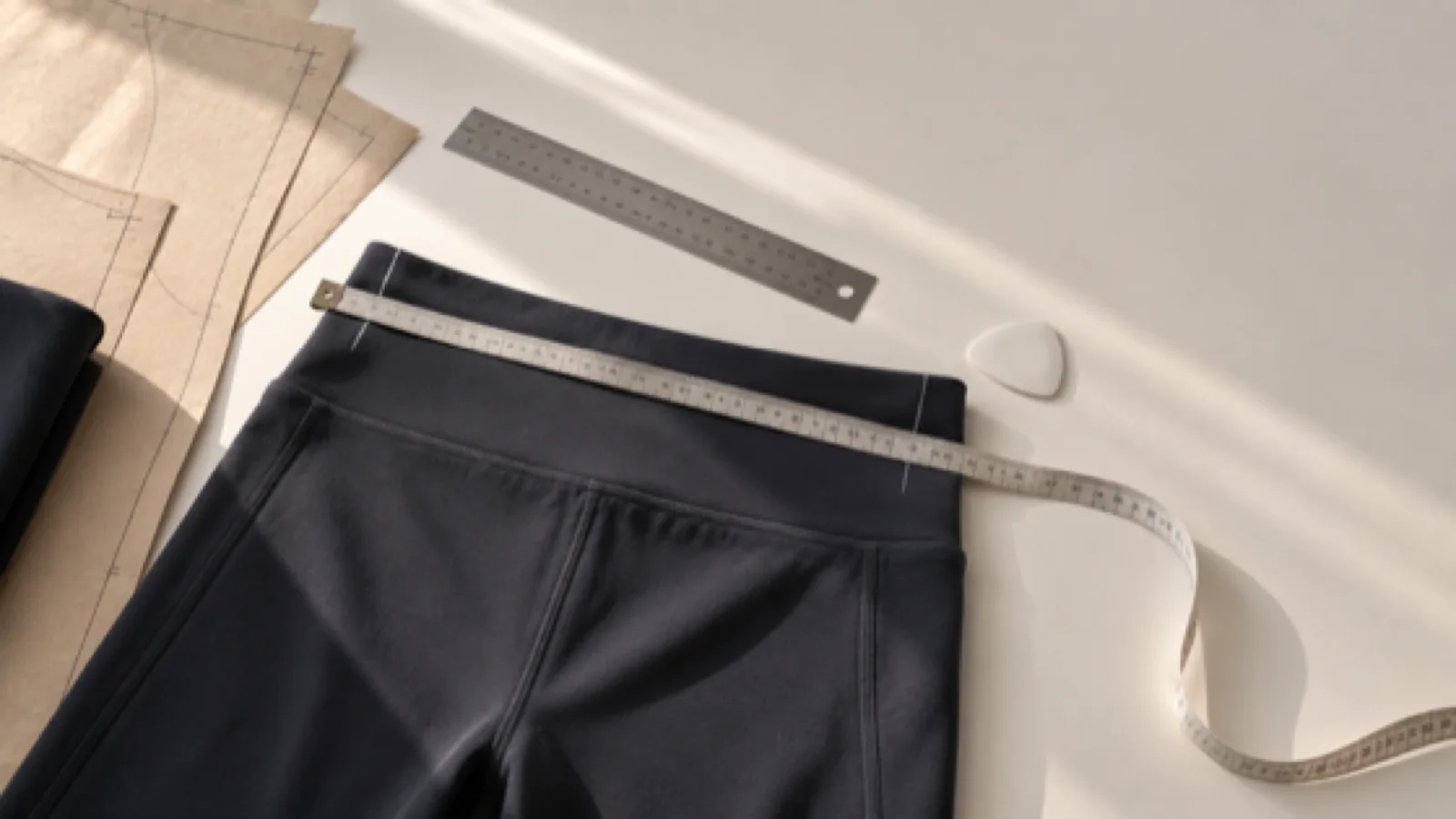
Every measurement on a garment specification is a target. The tolerance is the part that says how far from that target is still acceptable — and if nobody wrote it down, it gets decided after production by whoever has more leverage. On a first order with a small brand, that is not you.
The short answer
- A tolerance is the permitted deviation from a target measurement. Without one, “this is not the same as the sample” is an opinion; with one, it is a pass or a fail you can count.
- A tolerance number means nothing unless the measuring method sits beside it. Flat and relaxed, or extended under a stated force, are different specifications for the same garment.
- There is no universal industry tolerance. There are brand tolerances, and the only question is whose you are buying. If a supplier says theirs are standard, ask to see them — the document either exists or it does not.
What a tolerance actually is
Your specification says the waistband measures a given length relaxed. The tolerance says whether a garment slightly under that number is acceptable, and whether slightly over is. That is the whole idea, and everything else follows from writing it down before production rather than after.
The commercial consequence is larger than the technical one. A dispute with a tolerance table is arithmetic: the inspector measures, counts and reports. A dispute without one is a negotiation, and negotiations are settled by leverage rather than by evidence.
The same dispute, with and without a table
| Without a tolerance table | With one |
|---|---|
| “It is not the same as the sample” is an opinion | It is a measurable pass or fail |
| The factory sets the limit after production | You set the limit before production |
| Every disagreement becomes a negotiation | Every disagreement becomes arithmetic |
| Rework liability is unclear | Rework liability follows the table |
Why activewear is harder than woven basics
Stretch fabric moves. The same panel measures differently depending on how it was laid, how long it relaxed after cutting and how it was handled on the way to the measuring table. None of that is a factory being careless; it is the material behaving like a knit.
Which is exactly why the measuring method has to be written next to the number. More arguments are caused by two people measuring differently than by garments actually being out of specification.
Where the variation comes from
| Source of variation | Why it happens |
|---|---|
| Fabric relaxation | Knit fabric keeps shrinking back after cutting; measuring too early gives a different number |
| Cutting spread tension | Fabric stretched on the table cuts larger than it finishes |
| Seam consumption | Stitch type and operator tension change the finished dimension |
| Dye lot differences | Shrinkage varies between lots, so one pattern yields different finished sizes |
| Measuring method | Flat-measured and extended-under-force give different numbers on the same garment |
| Point of measure | “Waist” means three different lines to three different people unless it is illustrated |
What a usable tolerance table contains
Six columns, and the table is worth more than any single number in it. If a supplier returns this completed, you have learned something real about them before spending a deposit.
The six columns, and why each has to be there
| Column | Why it must be there |
|---|---|
| Point of measure, named and illustrated | A named line on a drawing removes the most common disagreement before it starts |
| Target value | The number the pattern was built to |
| Tolerance, plus and minus | Often asymmetric — a waistband may tolerate small more readily than large |
| Measuring method | Flat and relaxed, or extended under a stated force |
| When it is measured | After relaxation, after washing, or straight off the line |
| Which sizes it applies to | Tolerances commonly widen through the size range |
How it connects to inspection
A tolerance table is what makes an inspection report mean anything. The inspector measures a sample drawn from the lot and records pass or fail against your numbers. Without the table, “measurement defects” is a judgement; with it, it is a count — and a count is what lets you accept, reject or negotiate rework with evidence instead of adjectives.
It also has to predate production. A tolerance agreed after the goods are made is not a tolerance, it is a concession — and it will be granted by whoever needs the shipment more, which on a launch date is the brand.
Sampling itself follows its own logic: the inspector checks a subset, and the decision to accept or reject the lot rests on how many defects are permitted in that subset. That mechanism only produces a usable number when the definition of a defect — including a measurement defect — was fixed in advance.
The cheapest version for a first order
If a full table feels heavy for a few hundred pieces, do the short version. Pick the five measurements that decide whether the garment fits and sells — on a legging that is usually waist, hip, inseam, rise and one stretch measure — and specify target, tolerance, measuring method and measuring moment for those five.
Five rows agreed beforehand prevent more disputes than thirty rows written afterwards, and they take one conversation. The remaining points of measure can be added at the second order, when you know which ones actually moved.
The five-row starter, for a legging programme
| Point of measure | Why it is in the short list | Measuring note to write beside it |
|---|---|---|
| Waist, relaxed | Decides whether it stays up and whether it digs | Measured flat and relaxed after a stated relaxation time |
| Waist, extended | Decides the size range the garment really covers | Measured extended under a stated force |
| Hip | The most visible fit failure in photographs and returns | Measured flat at a named distance below the waistband |
| Inseam | Drives the perceived length and the size-chart promise | Measured along the seam, garment flat |
| Rise | Determines whether the waistband sits where the design intended | Front and back stated separately |
A size chart and a tolerance table are different documents
A size chart describes bodies: what a size M customer measures. A tolerance table describes garments: what the finished piece must measure, and how far it may deviate. Published body-measurement standards help with the first and say nothing about the second, which is a common source of confusion in a first development.
The link between them is the fit intention: how much ease or negative ease each measurement carries at each size. Write that once, and the tolerance table becomes an argument about manufacturing variation rather than an argument about design — which is a far shorter conversation.
When neither side has a table yet
Most first orders start here, and the productive move is not to demand a document nobody has. It is to build the short version from the approved sample: measure the approved sample at the five points that matter, write those numbers down as the targets, and agree a deviation either side plus the measuring method.
That takes an hour and converts the sample from a memory into a specification. It also exposes disagreement early — if the supplier's measurement of the same approved sample differs from yours, you have found the real problem before production rather than after it, and the fix is a shared measuring method rather than a claim.
What the table looks like at the second order
After the first production run you know something you could not know before: which points of measure actually moved, and by how much. That is the moment to revise the table rather than to write a new one — tighten the two or three measurements that stayed comfortably inside tolerance, and leave the ones that ran close to the limit alone until the cause is understood.
Record the reason beside each change. A tolerance narrowed because the fabric turned out stable is a different decision from one narrowed because a customer complained, and the next person to inherit the programme will need to know which it was. Over three or four orders this turns into the most useful document a small brand owns: a written description of what this product can actually hold in production.
What to send the supplier, and what to ask back
| You send | They return | What it tells you |
|---|---|---|
| Points of measure with an illustration | The same drawing, confirmed | Whether you are both measuring the same line |
| Targets and tolerances by size | Confirmation or a counter-proposal with reasons | Whether the pattern and the fabric can hold them |
| Measuring method and moment | Their measuring procedure | Whether their numbers and yours are comparable at all |
| The inspection standard that will be applied | Acknowledgement in the order confirmation | Whether a later claim rests on a shared document |
Quick answers
Is there a standard tolerance I can simply adopt?
There is no single one. Tolerances are set brand by brand and vary with garment type, fabric and size. What is standard is the practice of writing them down, not any particular number.
The factory says their tolerances are standard. Is that enough?
Ask to see them. If they exist, you will have them within a day. If the request produces friction rather than a document, you have your answer.
Does a tolerance table slow the sample process?
It front-loads a conversation that otherwise happens during bulk production, when it is expensive. In most programmes it shortens the overall cycle.
Who measures — me, the factory, or an inspector?
For a first order, an independent inspector measuring against your table is the cheapest evidence available. After a validated history, factory measurement with spot checks is usually workable.
What if the bulk comes out beyond tolerance?
Then you have a documented basis for rework, discount or rejection — which is exactly what the table is for, and why it has to exist before the production run.
Should tolerances be measured before or after washing?
Decide and write it down. Knits move in the wash, so a tolerance measured off the line and a tolerance measured after a stated wash procedure are different promises to your customer.
Do body-measurement standards give me the tolerances?
No. Published body-measurement tables describe bodies, not garment tolerances. They are a useful starting point for a size chart; the permitted deviation on a finished garment is still yours to set.
Sources
- ASTM D5585 — Standard Tables of Body Measurements for Adult Female Misses Figure Type: body data, not garment tolerances
- AATCC — Standard Test Methods and Procedures, including TM135 dimensional change and TM179 skew after home laundering
- NIST/SEMATECH e-Handbook of Statistical Methods — how lot acceptance sampling plans work
The tolerance table is agreed at sample approval and is the document bulk acceptance is measured against.
Open the programSourcing styles for your line? The 2026 catalogue lists every ready-to-develop style — colorways, materials, quote list built in.