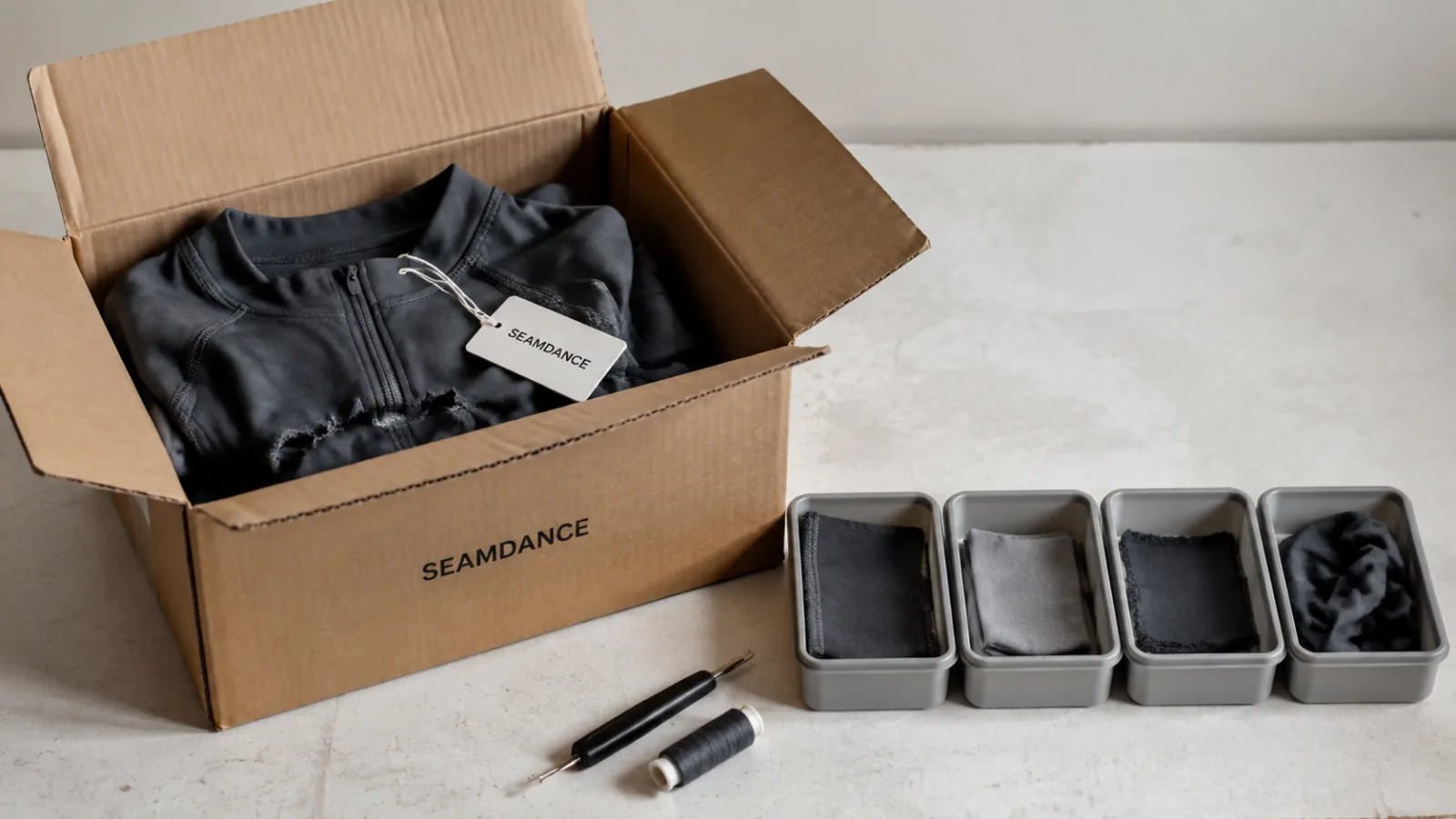
The email says the supplier is sorry and offers thirty per cent off. You are standing next to boxes you cannot sell. The instinct is to argue about whose fault it is; the useful move is to notice that the fault question and the money question have already separated. What you have paid is gone whichever way this ends. What is still live is a smaller, harder set of choices — accept, rework, reject, or walk — and each one has a real price. This guide prices all four in plain arithmetic, including the option almost nobody writes down: not paying the balance at all.
The short answer
- You have four options, not two: accept the goods with a discount, rework them, reject them and pursue a remedy, or stop paying and walk away from the deposit. Most published advice covers the first and the third, because the parties writing it have something to sell on those routes.
- The deposit is gone in every version of this story. The only numbers still live are the balance you have not yet paid, what the goods are honestly worth to you now, and what a relaunch costs. Judge every option against those three — never against what you originally paid.
- Leverage runs on a sequence, not on argument. It is highest before the balance is released and before the goods leave the factory, and it drops sharply once both have happened. That is why the strongest move in the first week is to gather documentation quickly rather than start negotiating slowly.
- Accepting a discount means buying the problem. Test the offer against the honest salvage value of the units — the price they will genuinely move at, times the number you can genuinely move, minus the cost of moving them — not against the invoice you were originally issued.
What you are actually deciding
A founder wrote about his first drop: a hundred shirts, front embroidery off centre, collars that turned yellow in the sun. The supplier’s answer was thirty per cent off the invoice, described as “sharing the loss”. His reply was the sane one — “I don’t see it that way.” He had already taken payment for some units, refused to ship them, refunded those customers and disposed of the stock. The discount was offered against the invoice, and the invoice was not where the loss was.
So separate two things that feel like one. The money already wired is sunk — gone in every branch, whether you accept, rework, reject or walk. It is not recovered by being right about who caused the defect. The reasoning that does the real damage is the one that sounds most responsible: we have already paid, so we have to make this work. That is how a manageable loss becomes a much larger one.
What remains is four live options, genuinely different decisions rather than four flavours of the same complaint. Accept the goods at a reduced price. Rework them. Reject them and pursue a remedy through whatever channel the deal sits in. Or stop paying — abandon the deposit, leave the goods where they are, take the loss deliberately. Fault still matters, but as evidence, not as a plan.
Option one: accept a discount, and how to test the number
Accepting a discount is not compensation. It is a purchase — you are buying inventory you would never have chosen, at a price the other side proposed. So it has to cover much more than the gap between what you paid and what the goods are worth: the returns a visible defect generates, the refunds, the reviews you cannot un-write, the service hours, the storage, and the months those boxes take up space meant for the next drop.
The arithmetic is worth doing out loud. These figures are illustrative — use your own. Take 300 units at $12 ex-factory plus $3 freight and duty: $4,500 landed. Thirty per cent off the goods value returns $1,080, so landed cost falls to about $3,420, roughly $11.40 a unit. That is the easy half. The hard half is what 300 flawed units are worth to you. Not the $58 you planned to charge — a visible defect on a full-price sale buys you a return, and a return costs the outbound shipping, the return shipping, the handling and usually the unit. Price them where they will honestly move: say $22 in a seconds channel, less $5 of fees, so $17 a unit — but only for the units you can genuinely sell. Shift 90 in a quarter and you have recovered $1,530 against a $3,420 bill, with 210 boxes still in the way.
The test is not whether thirty per cent feels fair. It is whether the discounted landed cost sits below the honest salvage value — units you can move, at a price they will move at, minus the cost of moving them. If it does not, the discount is not a settlement; it is you buying stock at a price you did not choose. Check the form of it too: cash against the invoice and credit against a future order are different instruments, and the second is worth little from a supplier you will not use again.
Option two: rework, and the additive-versus-structural test
Rework is sometimes the cheapest route and often impossible, and the difference is usually visible in ten seconds. Additive or removable defects can be fixed: wrong or missing labels, care wording, relabelling and repacking, a badly placed hangtag, a puller or drawcord swapped, garments re-pressed, a trim unpicked and re-sewn. Structural defects cannot: fabric weight and hand feel, a colour that came out of the dye house wrong, opacity, fit and grading, seam construction, a panel cut short. If the defect is baked into the cloth or the pattern, no amount of finishing labour reaches it.
The honest test has two halves and both must pass. Rework makes sense only when the defect is additive rather than structural, and when the rework cost plus the delay is less than the salvage value. Relabelling 300 units at a dollar each is trivial arithmetic. Relabelling them six weeks past the window the drop was meant to sell in is a different calculation — a seasonal product loses value on a clock that does not care how cheap the fix was.
Where the rework happens moves the price more than buyers expect. At the factory before shipment it is cheap, because the labour is there and the goods have not moved — available only if you caught it before the container left. At destination it is a local finisher’s hourly rate on your units, and at a few hundred pieces that turns unattractive fast. Either way, re-inspect afterwards against the same standard. Reworked goods nobody re-checked are how the same problem arrives twice.
Option three: reject and pursue a remedy
Leverage here is a sequence, and it is worth being blunt about where you sit in it. A buyer chasing an inspection his supplier kept postponing put it plainly: “Once goods leave the factory, your leverage drops fast.” The strong positions are before the balance is released and before the goods ship. Once the money has gone and the cartons are in your warehouse, the levers left are future orders and whatever process your channel provides — neither is nothing, and neither is what you held a fortnight earlier.
Gather the documentation before you complain; the first message frames everything after it. Five things: the approved sealed sample, signed and physically held; the written specification the order was placed against; dated photographs of what arrived, shot beside what was approved, defect and label both in frame; the inspection report if one exists, with the defect breakdown rather than a bare pass or fail; and a commercial invoice from the entity you actually paid. That last one catches people out, because the name on the bank details is often not the name on the contract.
If the order sits on a platform, a dispute process exists and is worth reading properly — but be realistic about the outcomes. They are frequently partial rather than whole, and sometimes arrive as platform credit rather than cash: one buyer was offered a choice framed as “50% refund or 60% credit”. Another submitted extensive photo and video evidence and was told it “was not enough”, with little indication of what would have been. A third asked whether anyone had ever improved on the first proposal by pushing back, and got no clear answer. Timing windows apply and are shorter than founders assume, so read the current terms of the channel you actually bought through rather than taking specifics from this page or a forum thread.
Option four: walk away from the deposit
This is the option nobody publishes, because nobody makes money on it. A founder with a small order who had paid part and owed the rest asked whether it was worth paying the balance, then reported back: “I didn’t pay for the rest of the order… I trashed it.” Thirty shirts is a rounding error, but the reasoning is exactly what a founder holding 300 unusable units needs. The deposit is not a reason to pay the balance. It is the thing you have already lost.
Illustrative numbers again. A custom run of 300 units at $20 is a $6,000 order; a thirty per cent deposit means $1,800 has left and $4,200 falls due before shipment. Pre-shipment photographs show the colour is wrong across the run. Pay the balance and you are $6,000 down before roughly $900 of freight and duty, holding 300 units you would have to price as seconds — if honest salvage is $12 net and you can move 120 inside two quarters, you recover $1,440 against $6,900 spent. Do not pay, and you are $1,800 down, with no freight, no duty, no storage, no returns and no reviews. The difference is not the deposit, which is spent either way. It is the $4,200.
Said plainly: when the balance owed exceeds what the goods are honestly worth to you, paying it to avoid wasting the deposit is throwing good money after bad. The deposit is not rescued by the balance; it is joined by it. It is not a costless move — it ends the relationship, and what your agreement says about non-payment, and about goods a supplier has produced and is holding, governs what follows. Read that first, and take advice if the sum is material. Walking away is a real option with a calculable price, and sometimes it is the correct one.
Disposal is a decision, not a default
Whatever you end up holding, you have to do something with, and the something costs. A seller carrying accumulated defects described his approach candidly: at year end he offloads them on eBay slightly above cost, on the reasoning that “I just don’t get bad reviews out of it.” Coherent enough — reviews protected, brand name kept out of it, a little cash back. It is also a choice with consequences a young brand feels far more sharply than an established one.
The routes price differently. Selling seconds under your own name is the fastest cash and the most expensive lesson: it teaches your list what your product is worth, and that number is hard to raise afterwards. Selling unbranded, labels removed, protects positioning but costs more handling and fetches less. Donating clears the boxes and buys goodwill, with near-zero cash and real care needed over labelling. Liquidating to a jobber is one cheque, the lowest price, and no control over where the units resurface. Destruction is the worst outcome on cash and the only defensible one for a narrow set of safety and rights problems.
None of these is clean, and the reason to write them out is that most founders never actually choose — they default into the fastest route while the pallet is in the way. For a brand still establishing what it charges, the cheapest route to cash is often the most expensive route to the brand. Decide the channel and the floor price before the goods arrive, and price that into the loss.
What prevents the next one — and where we have a stake
Every option above is downstream of the same three gates, and the gates are cheap compared with any of the remedies. First, a pre-production sample in final fabric, colour and trims, signed and physically sealed, one copy with you and one at the factory — so “wrong” has a definition rather than a debate. Second, an inspection gate written into the purchase order: who inspects, on whose behalf, against which standard, and at what point in the run. Third, the balance tied to a passed inspection rather than to “goods ready”. Those two phrases sound alike and describe entirely different situations.
We should be direct about our position here, because it is not neutral. SEAMDANCE is a gym wear, activewear, yoga wear and sportswear manufacturer in Xiamen, China. With our own factory and a one-stop service, we take a whole range from development to delivery — leggings, sports bras, tops, shorts, sets, seamless styles, jackets and hoodies, swimwear, tennis wear, bags, yoga mats and accessories. One order, one quality standard, one team accountable for all of it. We sell manufacturing and one-stop production, so read this as our own commercial perspective rather than an independent recommendation.
Here is the version that sells nothing. Whoever manages the order, that sequence decides the outcome — sealed sample, inspection booked in the purchase order, balance released against a passed report. A brand running direct can write all three into its own PO tomorrow, name the standard explicitly (AQL 2.5 final inspection against the sealed reference is the ordinary line for activewear), and hold the balance until the report exists. It also helps to know what a restart costs before deciding anything about a balance: in our own case, stock constructions start from 100 units with a sample usually in hand in three to four days, custom development nearer 300 to 500 units with a first sample around a week. Get your equivalent numbers in front of you first. And plainly: this is general commercial information about a difficult decision, not legal advice — contracts, jurisdictions and platform terms differ, and a brand facing a live dispute should take its own legal advice on its own facts.
Quick answers
Should I still pay the balance if the bulk production is wrong?
Not if the balance owed exceeds what the goods are honestly worth to you. The deposit is spent whichever way this ends, so paying the balance to avoid wasting it is throwing good money after bad. Walking away is not costless: it ends the relationship, and your agreement governs what follows on non-payment and on goods the supplier is holding, so read it first and take advice if the sum is material.
What evidence should I gather before complaining to a supplier about defective bulk?
Five things, gathered before your first message, because it frames everything after it: the approved sealed sample, signed and physically held; the written specification the order was placed against; dated photographs of what arrived beside what was approved, defect and label in frame; the inspection report with its defect breakdown, if one exists; and a commercial invoice from the entity you actually paid. Check that last one, because the name on the bank details is often not the name on the contract.
Is credit on a future order as good as a cash refund from the supplier?
Not necessarily. Cash against the invoice and credit against a future order are different instruments, and credit is worth little from a supplier you will not use again. Platform disputes can pose the same choice: one buyer was offered a 50% refund or 60% credit. Whatever the form, judge the offer against what the goods are honestly worth to you now, never against what you originally paid.
Sourcing styles for your line? The 2026 catalogue lists every ready-to-develop style — colorways, materials, quote list built in.