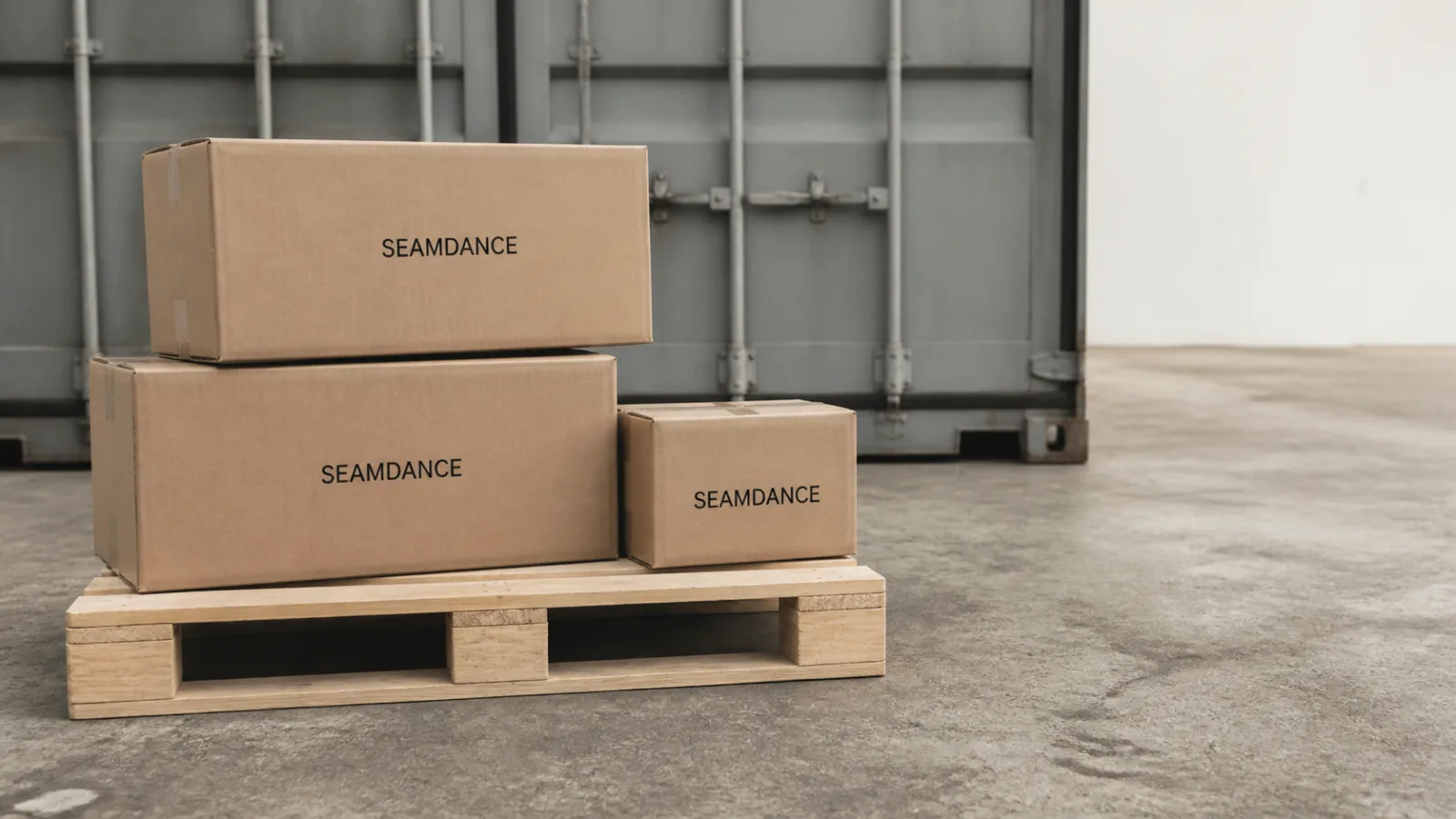
Order leggings from a seamless specialist, sports bras from a cut-and-sew line and accessories from a third supplier, and you have not placed one order — you have placed three, each with its own freight, its own customs entry and its own arrival date. Shipped separately, three consignments cost more than the goods should and land on three different days for a small team to reconcile. Consolidation merges them at origin into a single export: one forwarder, one bill of lading, one arrival. This guide covers how that works, the documentation it turns on, and the cases where merging is the wrong call.
The short answer
- Three suppliers shipping separately means three freight minimums, three customs entries and three sets of destination charges — costs that sit outside the unit price and often erase it.
- Consolidation gathers the goods at one origin point and exports them as a single shipment: one forwarder, one commercial invoice set, one bill of lading, one arrival.
- A consolidated invoice still itemizes by category, because leggings, bras and accessories fall under different HS codes and duty rates — one lumped line invites a wrong duty call or a customs hold.
- Consolidation is not automatic: single-category or single-factory orders have nothing to merge, and forcing ready goods to wait on one slow supplier can cost more than a second shipment.
Why three suppliers become three freight bills
Left to ship on its own, each supplier books its own freight — and every booking carries a minimum charge. Less-than-container-load freight has a floor that applies regardless of how little you actually move, so a small accessory lot pays close to what a much larger one would. Three separate lots means paying that floor three times on a single order.
Customs and admin multiply the same way. Each shipment is a separate customs entry with its own declaration, its own broker fee and its own clearance. Duty administration is charged per entry, not per garment, so three entries triple the fixed clearance overhead on goods that were always meant to sell as one range.
Then there is the arrival. Three consignments land on three days, by three routings, each needing to be received, checked against its own paperwork and reconciled. For a founder-led team that is three interruptions instead of one. None of this shows up on any supplier's quotation — it lands downstream, which is exactly why a multi-supplier setup looks cheaper than it ships.
What “one export” actually means
Consolidation does not mean one factory makes everything. The leggings specialist, the bra line and the accessory supplier stay independent — different machines, different materials, often different cities. What changes is that their finished, inspected goods converge at a single origin point, usually a forwarder's consolidation warehouse, before anything sails. From there the combined cargo moves as one shipment under one booking.
Someone has to appoint that forwarder, tell each supplier where and when to deliver, and reconcile three sets of cartons into one loading plan. That coordinating role is buyer-side — it belongs to the brand's own forwarder, or to a supply-chain partner acting for the brand across the independent suppliers. SEAMDANCE sits in that second position: it does not make the goods, it coordinates the specialist factories that do and holds the single export together on the buyer's behalf.
The result is that three-way fragmentation collapses into one line to manage. One forwarder relationship, one bill of lading, one arrival, one customs entry. What was three shipments to chase becomes one shipment to track — which is the actual product of consolidation, well before any freight saving.
How consolidation works, step by step
It starts before production ends. The categories are given one target cargo-ready window so they finish close enough together to travel as a single shipment. A supplier that runs early stores its goods at the consolidation point and waits; a supplier that runs late becomes the constraint the whole shipment sits behind — a tension worth naming up front, because it decides whether consolidation helps or hurts.
A single forwarder is then nominated, and each supplier delivers its cartoned goods to that forwarder's origin warehouse rather than into three separate export channels. As lots arrive, they are checked against each supplier's packing detail, so a short or mislabeled carton surfaces at origin — where it can still be fixed — instead of at the destination dock.
The lots are combined into one loading plan, mixed cartons or mixed pallets labeled by category, and a single export declaration is filed. One bill of lading covers the whole shipment; one arrival and one customs entry receive it. Stock-program accessories can join the consolidation from 100 pieces, so a small add-on category rides along rather than needing its own shipment or its own intimidating minimum.
LCL vs FCL: the break-even, without false precision
Three small supplier lots, shipped separately, are almost always less-than-container-load — priced by volume, handled at both ends, with a minimum charge on every booking. Combined, the same goods can cross into full-container-load territory, where a sealed container moves as one unit with fewer touchpoints and a flatter rate. Consolidation is often precisely what tips an order from several LCL fragments into one clean FCL.
Where that break-even sits depends on total volume, the number of lots, the route and the season — there is no single rule of thumb, and anyone who quotes you one number for it is guessing. The honest shape is that a full container frequently pays for itself well before it is physically full, because you stop paying LCL handling and per-cubic-meter premiums on every separate lot. The only reliable answer is to price both ways for the actual shipment and compare.
Consolidation helps even when you stay below the container line. One LCL booking still beats three: you pay one minimum instead of three, handle one consignment instead of three, and clear one entry instead of three. Merging does not always upgrade you to FCL — but it always moves you to the cheaper of whichever two options you are choosing between.
One document set — but itemized by HS code
A consolidated shipment carries one commercial invoice set, one packing list and one bill of lading in place of three of each. That is the paperwork saving, and it also makes destination clearance cleaner: a broker reconciles one consistent set of documents rather than three that have to agree with each other.
The catch is that consolidation is not hiding everything under one line. Leggings, sports bras and accessories fall under different HS (tariff) codes and frequently different duty rates. The single commercial invoice must itemize each category on its own line — its own HS code, description, quantity and value — and the packing list must map which cartons hold which category. A merged invoice with one lumped description invites the wrong duty assessment, or a hold while an officer asks what is actually in the container.
So consolidation simplifies the number of document sets, not the accuracy required inside them. If anything, one invoice covering three categories has to be built more carefully than three single-category invoices, because all the classification now lives in one place. A partner that promises “one simple invoice” without itemizing the HS codes is describing a shipment that gets held — not a saving you can bank.
Who arranges it: the Incoterms touchpoint
Whether you can consolidate at all depends on who controls the main carriage, and that is an Incoterms question. On FOB terms the buyer's side nominates the forwarder and controls origin logistics, so the buyer — or a partner acting for the buyer — can gather the suppliers' goods and merge them. On CIF or DDP terms the seller arranges the freight, and the decision moves out of your hands.
The trap is subtle. If each independent supplier sells you on its own CIF or DDP terms, each one arranges its own freight, and you are back to three shipments by default because no single party is positioned to combine them. Consolidation wants one hand on origin freight: your own forwarder on FOB terms across all three suppliers, or a coordinating partner that buys FOB from each specialist and exports the combined lot for you.
This is where a managing partner earns its place. It takes FOB delivery from each independent specialist, consolidates at origin, and hands the brand a single export under whatever destination terms the brand actually needs. The full FOB/CIF/DDP breakdown is its own topic — here the only point that matters is that consolidation needs one party controlling origin logistics, or it does not happen.
When consolidation is the wrong call
If your order is single-category, or comes from a single factory, there is nothing to merge — you already have one shipment, and consolidation is a service with no work to do. The same holds when one category so dwarfs the others that it fills a container by itself; the small lots simply ride along, which is loading, not a coordination decision worth paying for.
The real judgment call is timing, because consolidation ties every category to the slowest one. If the bra line runs three weeks behind the leggings and accessories, merging means the ready goods sit and wait, and your launch waits with them. Sometimes the right answer is to ship the ready categories now and let the laggard follow on a second freight bill — because a two-week delay to the whole range costs more than the freight you saved by holding it.
Consolidation is a decision to run per shipment, not a reflex to apply to every order. The arithmetic — freight saved against days lost, one clean entry against a slipped launch — has to be worked each time, and now and then it says split. The partner worth its fee is the one that will tell you when not to consolidate, not the one that consolidates because consolidation is the thing it sells. Weigh landed cost per launch, not freight cost per shipment.
Bags, mats and headwear come from a different supplier base — consolidation is the point.
Open the programSourcing styles for your line? The 2026 catalogue lists every ready-to-develop style — colorways, materials, quote list built in.