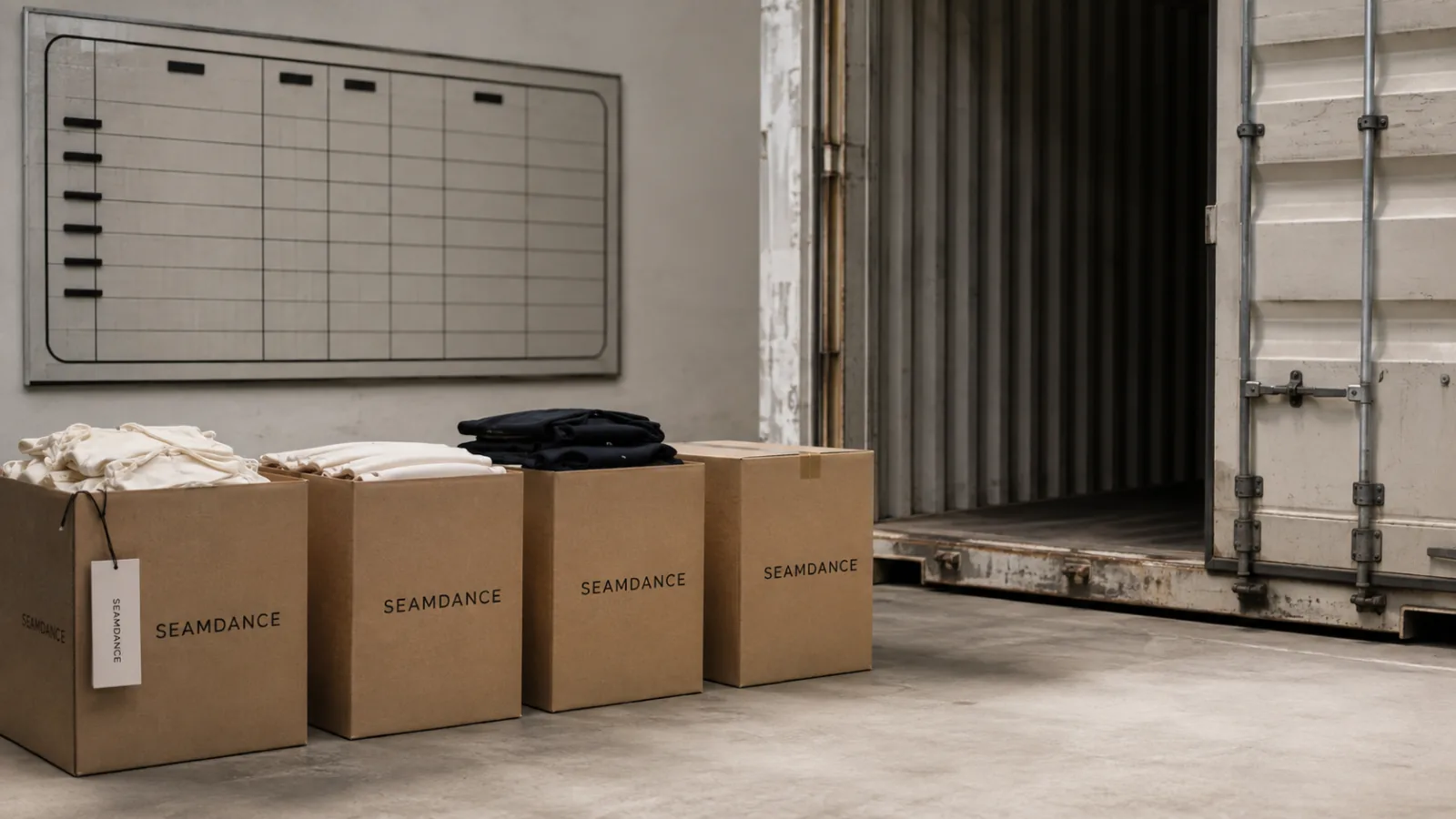
Every factory quotes a lead time it can hit in isolation. Put four of them in one range and the range is ready only when the last one lands — and the last one is rarely the one you were watching. Chasing each factory harder does not close the gap, because the gap is structural. Managing it is a planning function, decided before production, not a matter of sending more reminders.
The short answer
- A mixed range ships when its slowest factory finishes — individual lead times do not add up to a launch date.
- Ship dates diverge for structural reasons: different constructions, different upstream inputs, holiday shutdowns and each factory optimising its own queue.
- Chasing factories individually does not help; nobody owns the space between them by default.
- The fix is one delivery plan built backward from the launch date, with slower categories buffered and everything consolidated into one shipment.
Why the dates diverge in the first place
Different constructions carry different clocks. A seamless program and a cut-and-sew program do not sample or produce at the same pace, and swim or hard goods run differently again. Two categories briefed on the same day were never going to finish on the same day.
Upstream inputs diverge too. One category's fabric is in stock; another's is being knitted and dyed to order, adding weeks that live at the mill, not the garment factory. A trim on back-order at one supplier stalls one category while the others move.
Then there are shared shocks that land unevenly — a Chinese New Year shutdown, a regional power or environmental restriction — and the simple fact that each factory optimises its own queue, not your range. None of this is misbehaviour. It is what independent suppliers do.
Why chasing does not work
The instinct is to push each factory harder as the date approaches. It rarely moves the outcome, because the constraint is usually upstream of the factory you are chasing — a dye lot, a trim delivery — that no amount of pressure on the sewing floor can accelerate.
It also misdiagnoses the problem. The issue is not that one factory is slow; it is that no one owns the relationship between the four calendars. Each supplier is accountable for its own scope and correctly declines responsibility for the others. Everyone is individually on time while the range is collectively late.
For a founder this becomes a second job of reminders across time zones, one reply a day, with no authority to reallocate anything. Effort rises; the ship date does not move.
What one delivery plan actually does
A delivery plan starts from the launch date and works backward, assigning each category the latest date it can finish and still make consolidation. That reframes the question from 'when will each factory be done' to 'what must each factory hit to land together' — a target, not a report.
It buffers deliberately. The categories with the most variable inputs — order-dyed fabric, back-order-prone trims — get started earlier or held to tighter interim checkpoints, because those are where slippage originates. Buffer goes where the risk is, not spread evenly out of optimism.
And it consolidates. Instead of each factory shipping when ready, finished categories are held at one point until the range is complete, then loaded together. One shipment, one customs entry, one arrival — mixed categories in one container rather than three separate freight events.
The cost of the alternative
The usual escape from divergent dates is to ship what is ready and follow with the rest. It feels like progress and quietly destroys the economics: a second shipment means a second freight bill, a second customs entry, a second set of destination charges, and a warehouse receiving the same range twice.
On the volumes a growing brand actually runs, that split can cost more than the unit-price advantage that justified using separate factories in the first place. The saving was real on the quotation and gone on the landed cost.
The launch takes the harder hit. Campaigns, seeding and paid spend are built around a date. A range that arrives in two waves either launches incomplete or slips entirely — and neither was caused by a bad factory, only by four good ones with no one holding the space between them.
What to ask for
Ask a prospective partner to describe the delivery plan concretely: how mixed categories are consolidated, where goods are held while slower lines finish, what the interim checkpoints are, and what happens when one category slips. Specific answers here predict an on-time launch; vague ones predict the split shipment.
Ask who owns the calendar across factories — a named party accountable for the range landing together, not four suppliers each accountable for their own piece.
Then give them what the plan needs from you: the real launch date, early, and honest priorities about which categories must land together versus which can follow. A delivery plan is only as good as the date it is built backward from.
Quick answers
Can't I just build in extra time and let each factory ship when ready?
Extra time helps, but shipping each category when ready is the expensive part: separate freight, duplicate customs entries and a warehouse receiving the range in waves. Buffering within one consolidated plan keeps the schedule realistic without multiplying the freight and customs cost.
Who should own the ship date across multiple factories?
One party accountable for the range landing together — above the individual factories, able to buffer the risky categories and hold finished goods for consolidation. If no one holds that role, it defaults to you, usually without the leverage to reallocate anything.
Sourcing styles for your line? The 2026 catalogue lists every ready-to-develop style — colorways, materials, quote list built in.