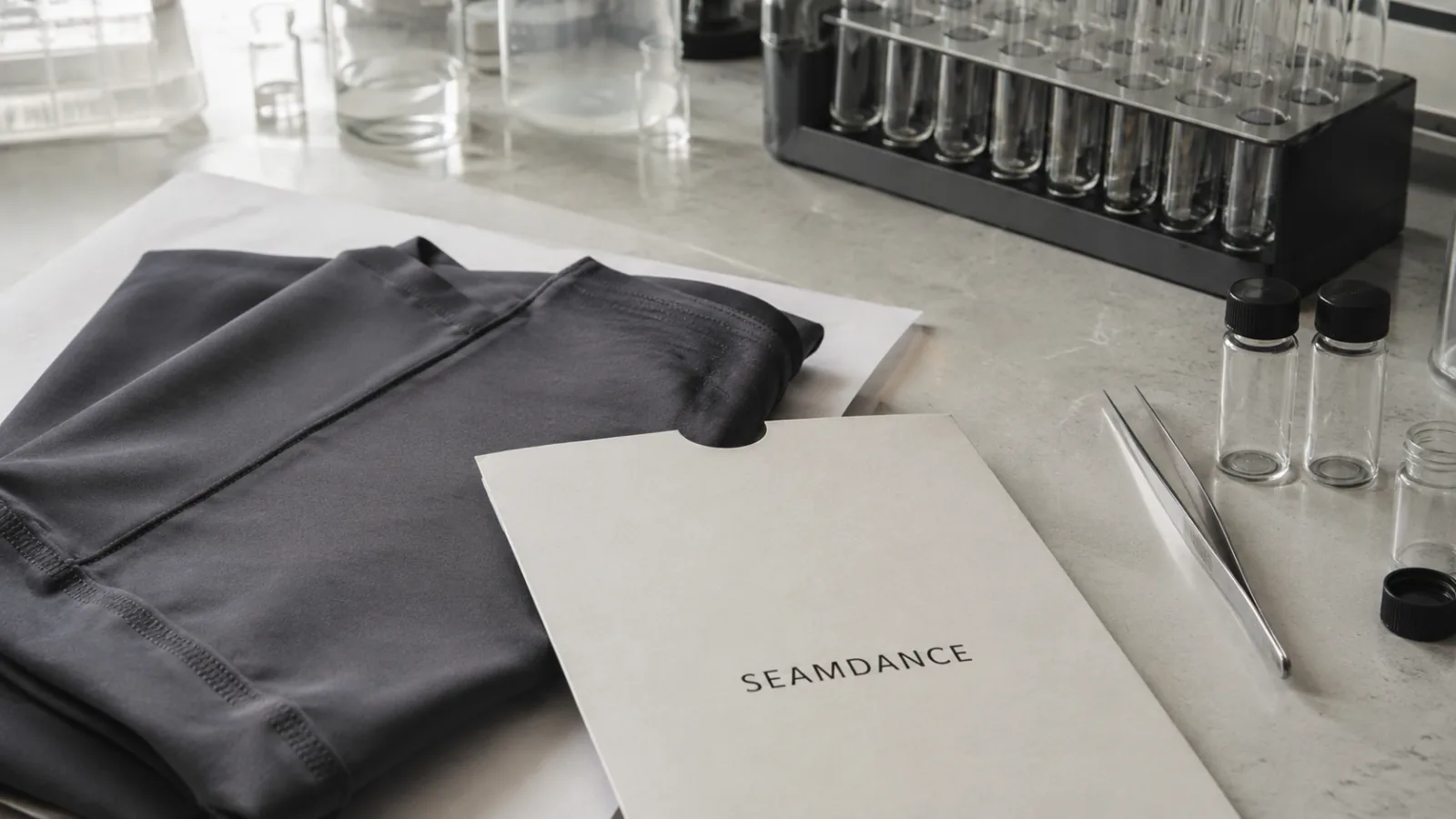
Chemical questions about leggings and sports bras used to be a wellness-blog topic. In 2026 they became a regulatory one — and the pressure landed on brands, not on the factories that made the fabric. If a customer, a retailer or a regulator asks what is in your product, “my supplier told me it is safe” is not an answer you can use. This guide covers what the certificates actually prove, what they leave uncovered, and the documents a buyer should hold before bulk.
The short answer
- Ask for documents, not assurances — “our fabric is safe” is precisely the kind of unverifiable claim now drawing regulatory scrutiny.
- OEKO-TEX Standard 100 certifies a tested article and is held by the mill or dye house, not by a trading or supply-chain partner. Check the certificate number, holder, product class and validity.
- PFAS is confirmed by third-party lab testing — total organic fluorine screening first, specific compounds after — not by a certificate alone.
- Certificates cover tested samples and named holders. They do not automatically cover your production batch, your trims, or a finish added later.
What changed in 2026
Independent testing of leggings and yoga pants has repeatedly found organic fluorine — an indicator of PFAS — in a meaningful minority of samples, with reported results ranging from around 10 ppm to several hundred ppm. Earlier work by environmental health groups also identified bisphenol A (BPA) in polyester-elastane sportswear, including sports bras. Neither finding says every legging is contaminated. Both say the question is now legitimate.
The regulatory layer moved faster than the science reporting. California restricts PFAS in apparel at 100 ppm total organic fluorine, and further US states have added their own restrictions through 2026. Enforcement attention has shifted toward whether a brand's marketing language matches what its products actually contain — in other words, toward the claim, not only the chemistry.
This is the part most independent brands miss: the legal and commercial exposure sits with the name on the label. Your factory does not answer for your product claims. You do.
Why “our fabric is safe” is an answer you should refuse
When a supplier responds to a chemical question with reassurance, they have given you something you cannot forward. You cannot send “they said it is fine” to a retailer's compliance team, to a marketplace that asks for substantiation, or to a lawyer. It also transfers nothing: if the claim turns out to be wrong, the sentence sits in your inbox, not on anyone's letterhead.
Blanket safety language is exactly the category of claim now under scrutiny. A brand that repeats its supplier's reassurance in marketing copy has adopted that claim as its own, without holding a single document to support it.
Apply the same standard to us. Nothing in this guide should be read as a promise that any garment is free of a given substance. What a competent partner can offer is narrower and more useful: named certificates you can verify, lab reports in your name, and a documented route to ask for more.
What OEKO-TEX Standard 100 actually certifies
Standard 100 certifies a tested article — a specific fabric, trim or component — against a restricted-substance list, and it is issued to a holder: usually the mill, the dye house or the garment factory. A supply-chain partner does not hold your fabric certificate. When someone forwards you a certificate, the first thing to read is not the logo but the holder's name, and whether that company is the one actually producing your fabric.
Then check three fields. The certificate number, which is verifiable on the issuing institute's public register. The product class — activewear worn against the skin normally needs Class II — since a certificate issued for a different class does not cover your use. And the validity date, because these certificates expire annually and a lapsed one proves nothing about this season's goods.
The mills behind our seamless and cut-and-sew programs hold Standard 100 certificates, and we verify holder, class and validity rather than filing the PDF unread. That verification is the deliverable — not the logo.
PFAS is a test, not a certificate
Restricted-substance lists have expanded to include PFAS compounds, but a certificate alone is a weak answer to a PFAS question, for two reasons. The lists target named compounds, while regulations such as California's are written around total organic fluorine as a screening threshold. And a certificate reflects the article tested at the time of testing — not the roll being knitted for your order.
The practical sequence is screening first, speciation second: a total organic fluorine test on the actual fabric, followed by specific compound analysis only if fluorine appears above the threshold you need to meet. Ask for the laboratory name, the method used, the detection limit, a clear description of the sample tested, and the date. A report without a sample description is not evidence about your product.
Where a buyer needs this, we send the fabric for third-party testing against the standard that buyer names, and the report goes to the buyer. We do not certify results ourselves — no responsible supply-chain partner can. What we control is that the sample tested is the fabric in your order.
The gaps certificates leave open
Trims are the most common gap. A Standard 100 certificate covering your main jersey says nothing about the zipper, the drawcord, the elastic or the printed logo. On a bra with molded cups and bonded edges, several components can sit outside the fabric certificate entirely. Ask which components are covered, and treat the rest as untested until shown otherwise.
Finishes are the second gap. A water-repellent, anti-odor or wicking treatment applied after certification changes the article. If a finish was added downstream, the certificate that predates it does not describe the goods you are buying.
Batch coverage is the third. Certification is not blanket, permanent coverage of everything a mill ever produces. Change the fabric, the dye house or the finish, and you are looking at a new question — which is why the honest answer to “is it certified?” is always “which article, held by whom, valid until when?”
What we do when a buyer's standard is stricter than our supply chain
A buyer once required GRS-certified recycled fabric. Our best-performing partner on that construction did not hold the certification. There were two easy answers available: persuade the buyer that the material was recycled anyway, or quietly place the order and hope the question never came back. Both are the kind of answer that ends up in a legal letter.
We moved the program to a certified mill instead, and told the original factory what it would take to stay on our list: obtain the certification. Comfortable relationships are not a reason to hand a buyer an undocumented claim — and a supplier that is only qualified for easy requirements is not qualified.
That is the practical shape of buyer-side sourcing. When a market or a customer imposes a standard, the supply chain moves to meet it, or the supply chain changes. The alternative — asking the buyer to lower the requirement — puts our convenience ahead of their exposure.
The document checklist before bulk
Ask for these five items and keep them on file with the order. One: the Standard 100 certificate for your fabric, with holder name, number, product class and expiry, verified on the public register. Two: written confirmation of which components are covered and which are not. Three: a lab report for any substance-specific requirement your market imposes, naming the laboratory, method, detection limit and sample.
Four: confirmation of any finish applied after certification. Five: a re-test trigger in writing — which changes (new fabric, new dye house, new finish, expiry) require fresh documentation before the next production run.
None of this makes a product safe by itself. It makes your position defensible, which is the only thing a buyer can actually control. When a retailer, marketplace or regulator asks what is in your product, you either hold the documents or you hold a sentence someone told you.
Quick answers
Does an OEKO-TEX Standard 100 certificate mean the garment is PFAS-free?
Not on its own. The restricted-substance list covers named compounds, but regulations such as California's are written around a total organic fluorine threshold. If your market sets a numeric limit, ask for a lab report on your fabric in addition to the certificate.
Who should hold the fabric certificate — my supplier or the mill?
The mill, dye house or garment factory that produces the article. A trading or supply-chain partner does not hold your fabric certificate. Always check the holder name on the document matches the company actually producing your fabric.
How often does testing need to be repeated?
Whenever the article changes or the paperwork expires: new fabric, new dye house, a finish added downstream, or certificate expiry. For ongoing programs, agree the re-test triggers in writing before the first bulk run rather than after a question arrives.
Sources
Sourcing styles for your line? The 2026 catalogue lists every ready-to-develop style — colorways, materials, quote list built in.