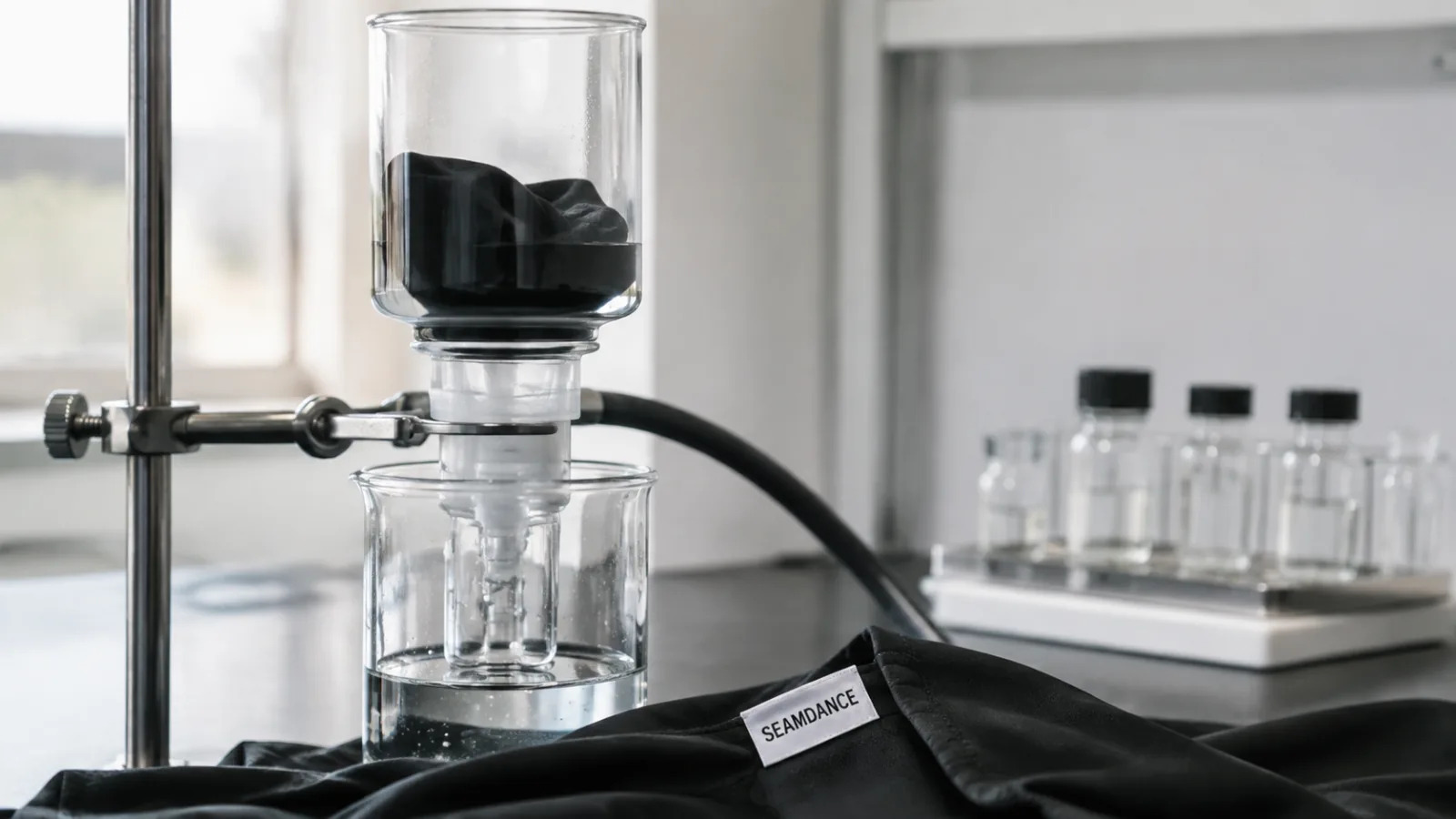
Most brands selling leggings into California have read the state ban and planned around two numbers and two dates. The number that reaches them first usually comes from somewhere else: a retailer requirement or a demand letter built on a Proposition 65 settlement, set lower than the statute and written against a broader measurement. These are two separate enforcement tracks, and confusing them is how a program that looked prepared for 2027 fails a screen in 2026. This guide sets out both, and the documents a buyer should be holding.
The short answer
- California's apparel ban (AB 1817, Health & Safety Code §§108970–108971) has run at 100 ppm total organic fluorine since 1 January 2025 and drops to 50 ppm on 1 January 2027. DTSC enforcement begins 1 July 2030.
- Proposition 65 is a separate, private-plaintiff track. A settlement bulletin dated 30 July 2026 records a limit of under 50 ppm total fluorine for pants and skirts, with further PFOA testing if that is exceeded — applying now, not from 2027.
- Total fluorine is a broader measure than total organic fluorine, so a report reading “under 100 ppm TOF” does not answer a 50 ppm total-fluorine requirement. It is a different quantity, not a different number.
- Hold a certificate of compliance from the party that made the article, plus third-party test data on the production fabric that states which fluorine measure was used, the method and the detection limit.
The number you planned for, and the number you get asked for
A brand reading California's apparel PFAS rule takes away two numbers and two dates. AB 1817, codified at Health & Safety Code §§108970–108971, has prohibited regulated PFAS in apparel since 1 January 2025 at 100 ppm total organic fluorine, and that threshold drops to 50 ppm total organic fluorine on 1 January 2027. The definition matters as much as the number: regulated PFAS means PFAS intentionally added for a functional effect, or present at or above the threshold. Unintentional contamination counts. “We never specified a fluorochemical finish” is not an answer to a test result.
The number that actually arrives is often a different one. Bureau Veritas' settlement bulletin dated 30 July 2026 records, for pants and skirts — skirts newly added to an existing pants settlement — and for cooling or water-resistant hats, a limit of “less than 50 ppm (0.005%) of total fluorine”, with further testing for PFOA if that figure is exceeded. Leggings sit inside the pants category. So does a large part of a typical activewear range.
Read the two side by side and the gap runs in the stricter direction twice over. Fifty parts per million, not a hundred. And total fluorine, which is a broader measurement than total organic fluorine. This is not the 2027 requirement arriving early — it is a different track with its own number, and it applies in 2026. A program built to be ready by 2027 can already be behind a limit that exists today.
Two tracks, and most buyers only know about one
The state ban is a prohibition written into statute and administered by the state. Its mechanism is paperwork moving down the chain: the manufacturer must give distributors and sellers a certificate of compliance, signed by an authorised official. Its enforcement date is a long way out — the Department of Toxic Substances Control begins enforcement on 1 July 2030 — which is exactly why the ban feels distant to brands who have read only this half of the picture. The prohibition is live now; the state's enforcement apparatus is not.
Proposition 65 is different in kind. It runs on private plaintiffs, sixty-day notices and settlements, and it needs no regulator to act first. For scale: in March 2026 there were 519 sixty-day notices in total, of which apparel drew five for PFOA and one for PFOS. Across Q2 2026, PFAS compounds — PFOA, PFOS and PFNA — accounted for 49 notices, while metals made up 74% of all notices filed. Apparel PFAS is not the dominant category by volume. That is not much comfort, because a single notice lands on one company's SKU and costs money long before anyone establishes what the chemistry actually shows.
The two tracks also feed each other. Plaintiffs are running total-organic-fluorine screening on product bought at retail, and pairing the state ban with unfair-competition and greenwashing claims. So the statute is not only a compliance date on your calendar — it is raw material for a private claim years before DTSC does anything with it. And be clear about what a settlement is: it binds the parties to it, and it is not law. What it does is publish the number a plaintiff was prepared to accept, which is why that number turns up next in a retailer's vendor requirements and in the following demand letter.
Total fluorine and total organic fluorine are not the same test
Total organic fluorine measures fluorine bound in organic compounds, and it is the screening proxy the California statute is written around. Total fluorine is broader: it counts fluorine wherever it sits in the material. So a report reading “under 100 ppm total organic fluorine” does not answer a requirement written at 50 ppm total fluorine, and the problem is not simply that 100 is a larger number than 50. The two reports are measuring different quantities. A buyer comparing the figures alone will reach a confident and wrong conclusion.
There is a known technical flaw here worth telling buyers about, rather than discovering it inside a dispute. Fluorine screening detects all fluorine present in any compound, not only fluorine that came from a PFAS treatment. A product can therefore fail a screen on fluorine with no fluorochemical finish behind it at all. That is why the settlement structure — screen first, then test for PFOA if the screen is exceeded — is the sensible shape, and why the right response to a failed screen is speciation rather than a panicked reformulation. We were not given data on how often screens fail on non-PFAS fluorine, so treat this as a reason to ask what a screen result means, not as a defence you can assume in advance.
The practical consequence is a documentation habit. Every test report you hold should state which measure was used, the analytical method, the detection limit, the laboratory, a clear description of the sample, and the date. A bare number with no measure named is not usable evidence, and it is the single most common weakness in the files brands actually keep.
Disclosures and warnings are a separate question again
Outdoor apparel for severe wet conditions is exempt from the ban until 1 January 2028 — but since 1 January 2025 it has required a “Made with PFAS chemicals” disclosure. The exemption is not a free pass; it swaps a prohibition for a label. Whether a particular product falls inside that category is a determination for the brand and its counsel. We were not given a definition to apply on your behalf, and for a standard leggings or training range the answer is not obviously yes.
Separately, the Prop 65 short-form warning amendments took effect on 1 January 2025 with a three-year transition. The compliance deadline is 1 January 2028, and products already labelled with existing short-form warnings can continue to be sold. The substantive change is that a short-form warning must now name at least one chemical for each relevant health risk — so the generic short warning some brands have relied on needs rewriting rather than reprinting.
For a brand with existing warning artwork, that is a label-review task with a date on it, not a chemistry task. Do not assume the two obligations substitute for each other: a warning on a label and a content limit in a settlement are different things, and whether displaying one has any bearing on the other in your situation is a question for your counsel, not an inference to draw from this page.
What a buyer should actually hold
First, a certificate of compliance from the party that made the article, signed by an authorised official — that is the mechanism the statute itself sets out. Read the holder's name before you look at the logo. It should be the entity that produced the article, not a trading company forwarding a PDF it did not generate. Who counts as the manufacturer for your particular import structure is a question for your counsel; we were not given a definition to hand you, and guessing at it is not something a supplier should do on a brand's behalf.
Second, test data on the production fabric, not a generic swatch. A mill's file report on a similar quality knitted last year, in a different colour, finished at a different dye house, is not evidence about the rolls in your order. The sample description on the report is the field that decides whether the document is about your goods or somebody else's. If that field is missing, the report proves nothing you can use.
Third, scope in writing, and a trigger for repeating the work. Which components are covered: main fabric, and separately the elastic, waistband tape, drawcord, printed or bonded logo, zip pull, and any finish applied downstream after the fabric was tested. Then agree in writing which changes require fresh evidence — a new mill, a new dye house, a new finish, a new production site, or a market requirement that moves. Files age quietly, and a reorder placed against a two-year-old report is an open question, not a closed one.
What to ask the factory for, and where we fit
Four asks, in plain language. Confirm whether any fluorochemical treatment — a durable water repellent, a stain-release or soil-release finish — is applied to the fabric or to any component. State which fluorine measure the facility can report against, and at what detection limit. Provide a signed certificate of compliance naming the specific article and its scope. And agree to third-party testing on production fabric, written into the purchase terms and tied to release or payment rather than requested as a favour after the goods are made. If the answer to the first question is that they do not know, that is more useful than a confident no — it tells you to test.
SEAMDANCE is a gym wear, activewear, yoga wear and sportswear manufacturer in Xiamen, China. With our own factory and a one-stop service, we take a whole range from development to delivery — leggings, sports bras, tops, shorts, sets, seamless styles, jackets and hoodies, swimwear, tennis wear, bags, yoga mats and accessories. One order, one quality standard, one team accountable for all of it. What that means on this topic is specific: we can put the fluorine requirement into the material specification before bulk rather than after, obtain the certificate and its stated scope from the factory that actually made the article, and route testing to a third-party laboratory with the report issued to you.
What we cannot do matters just as much. We do not test, we do not certify, and we cannot make a product lawful by saying that it is. Certificates and certifications belong to the mills and factories that hold them, and a supplier forwarding someone else's document is not a second opinion on it. Where a factory cannot document the number your market requires, the honest options are to move the work to one that can, or to change the material. Both are cheap at specification stage — a first custom sample runs around seven days — and expensive once bulk is knitted.
“PFAS-free” is a claim, and claims are the exposure
The riskiest sentence in this whole subject is usually one the brand writes itself. Plaintiffs are already pairing the state ban with unfair-competition and greenwashing claims, so a “PFAS-free” line on a product page is a statement you may be asked to substantiate — and substantiation means a laboratory report with a named measure and a stated detection limit, not an email from a supplier saying the fabric is fine. If what you hold is a result under 50 ppm total fluorine on a specific lot, then that is what you can defend. The accurate version is narrower, duller and far less quotable than “PFAS-free”, which is precisely why it is the safer one to publish.
What this guide does not cover: apparel PFAS rules in other US states, which have been expanding and which we have not set out here; federal action; EU requirements; the full list of substances beyond PFOA, PFOS and PFNA appearing in current notices; and whether any particular settlement number reaches a company that was not a party to that settlement. It also does not tell you whether your product passes. Nobody can answer that from a web page — only a test report on your fabric can.
This is general information, not legal advice. Thresholds, dates, exemptions and enforcement practice change, and settlement numbers move as new settlements are recorded. A brand must confirm the current requirements for its own markets with its own counsel, and then hold documents rather than assurances — because when the question arrives, you either have the report or you have a sentence somebody told you.
Quick answers
What are Prop 65 chemicals?
They are the chemicals on California's list of substances known to the state to cause cancer or reproductive toxicity, a list the law requires to be revised and republished at least once a year [3][5]. The warning duty for a newly listed chemical starts twelve months after listing [3]. Entries activewear buyers often ask about include PFOA, PFOS and PFNA, and bisphenol A (BPA), listed for female reproductive toxicity since 2015 and for developmental toxicity since 2020 [5].
What does a Prop 65 warning mean? Is the product unsafe?
A warning tells the buyer that the product can expose them to a listed chemical above the level that triggers the law [4]. California's Attorney General says this is not the same as a regulatory decision that a product is safe or unsafe, and describes Prop 65 as a right-to-know law that leaves the decision to the consumer [4]. So a warning is not a finding of danger, and the absence of one is not a safety certificate.
What does “Prop 65 compliant” mean for a business?
It means the business either causes no exposure above the law's thresholds or gives a clear and reasonable warning before the exposure happens [3][4]. The duty applies to businesses with ten or more employees, including out-of-state sellers whose products reach people in California [3][4]. No state approval or certificate stands behind the phrase, so when a supplier writes “Prop 65 compliant”, ask which of the two it means, for which listed chemicals, and what evidence supports it.
What is Prop 65 testing?
The law prescribes no test method. The Attorney General's guidance says the judgement on risk must rest on evidence of comparable scientific validity to that behind the chemical's listing [4]. In practice, Prop 65 testing means laboratory analysis for listed chemicals plus an exposure assessment, because the duty is tied to how much reaches a person rather than how much the product contains [4]. A content result alone does not answer the question, so ask for both parts in writing.
Does Prop 65 apply to packaging?
In two ways. A warning may go on the packaging: OEHHA's warning regulations define a label as material printed on or affixed to a product or its immediate container or wrapper [6]. And the trigger is exposure, which the regulations tie to acquiring, storing or using the product [6]. If a polybag, box or swing tag could itself expose the buyer to a listed chemical, include it in the exposure assessment rather than assume it is out of scope, and take the answer to counsel.
How is Prop 65 different from REACH?
Prop 65 is a California right-to-know law: for a consumer product above the threshold it requires a warning before exposure, not a ban [3][4]. REACH is the EU's chemicals regulation. It requires registration of substances made or imported at a tonne or more a year, can restrict or ban substances outright, and covers businesses that import products such as clothing [7]. It also lets consumers ask whether an article contains a substance of very high concern, with a reply due within 45 days [8].
Sources
- Proposition 65 — OEHHA official site
- California AB 1817 (2022) — PFAS in textile articles
- California Legislative Information — Health and Safety Code, Chapter 6.6 (§§25249.5–25249.14), the Proposition 65 statute: warning duty, enforcement, the list, exemptions and the employee threshold
- California Attorney General — Proposition 65 frequently asked questions (what a warning means, exemptions, testing method, enforcement)
- OEHHA — Proposition 65 list of chemicals known to cause cancer or reproductive toxicity (list dated 31 July 2026)
- OEHHA — Article 6 Clear and Reasonable Warnings, final amended regulation text (§25600.1 definitions of label and consumer product exposure)
- European Commission, Your Europe — Registering chemicals (REACH): who is covered, including importers of clothing, and how registration and restriction work
- European Commission — REACH Regulation overview (Article 33 consumer right to know and the 45-day reply)
Sourcing styles for your line? The 2026 catalogue lists every ready-to-develop style — colorways, materials, quote list built in.