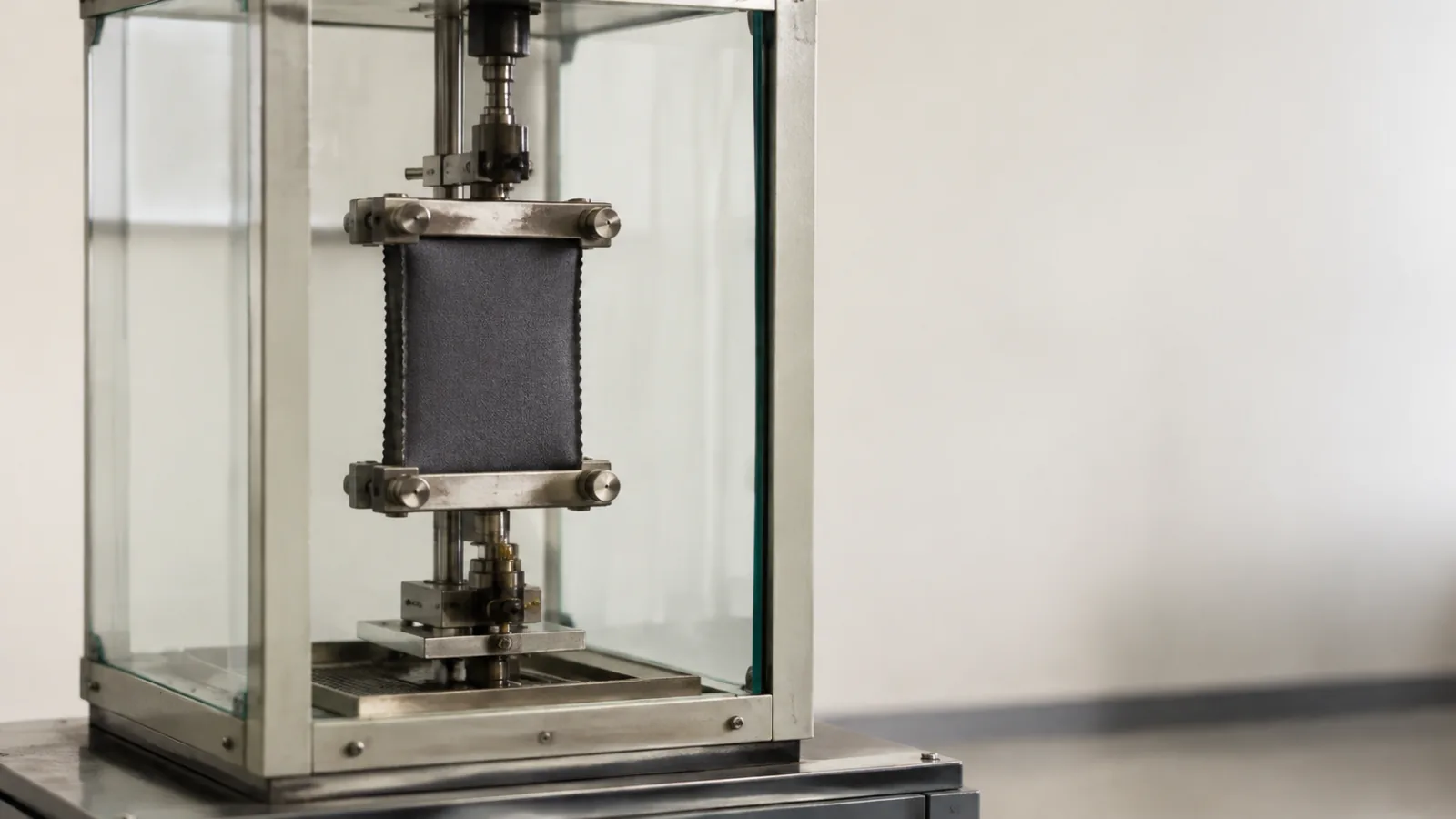
Most brands selling activewear into the US have decided their flammability question is closed, and most of them decided it by reading the wrong line on the spec sheet. Polyester is an exempt fiber under 16 CFR Part 1610. Elastane is not — which means the 12% spandex sitting quietly under the polyester changes the analysis entirely. This guide covers what §1610.1(d) actually exempts, the two constructions where a spandex knit has no exemption route at all, and what to establish before you brief a laboratory.
The short answer
- 16 CFR §1610.1(d) provides two routes to exemption from testing — not from the standard itself. Class 3 fabrics, which burn rapidly and intensely, are prohibited for use in wearing apparel either way.
- One route exempts fabrics made entirely of, or entirely of a combination of, acrylic, modacrylic, nylon, olefin, polyester and wool. Elastane is not on that list, so a poly-spandex or nylon-spandex knit does not qualify at any blend ratio.
- That leaves the other route: plain surface and 2.6 oz/yd² or more, any fiber content. Most mid-weight performance knits clear the weight comfortably; lightweight and sheer knits may not.
- A raised fiber surface — brushed, fleeced or napped — disqualifies the weight route at any weight, and spandex disqualifies the fiber route. A brushed spandex knit has no exemption route at all.
The 12% nobody reads on the spec sheet
A brand looks at a fabric spec — 88% polyester, 12% spandex — sees polyester on the exempt fiber list in 16 CFR Part 1610, and files the flammability question as answered. Polyester genuinely is on that list. But the exemption is written for fabrics made entirely of, or entirely of a combination of, six named fibers: acrylic, modacrylic, nylon, olefin, polyester and wool. Elastane is not one of them. A fabric that is 88% listed fiber and 12% unlisted fiber is not made entirely of listed fibers.
The ratio does not soften this. Twelve percent or five, the answer is the same, and it is the same for nylon-spandex as for poly-spandex. Since almost every performance knit contains elastane, that route is closed to almost the entire activewear category. The exemption most brands believe they are relying on is not the one they actually have.
It is worth being precise about what an exemption is, because the word does more work than it should. §1610.1(d) exempts qualifying fabrics from testing under the standard. It does not lift the standard. Class 3 fabrics — the “rapid and intense burning” category — are prohibited for use in wearing apparel regardless of whether anyone tested them. An exemption means you are not required to run the test to establish the position; it does not mean the garment sits outside the rule.
The two routes, and which one you actually have
The first route is about weight and surface. Plain-surface fabrics of any fiber content, weighing 2.6 oz/yd² or more, are exempt from testing. Fiber content is irrelevant here — spandex, cotton, viscose, anything. What matters is that the face is plain and the weight clears the threshold. The second route is about fiber content only. All fabrics, plain or raised-fiber surface, at any weight, made entirely of or entirely of a combination of the six listed fibers. Here fiber content is everything and weight does not enter into it.
For a spandex knit the second route is closed, so the first is the only one on the table — and it carries two conditions you need both of. Plain surface, and 2.6 oz/yd² or more. The reassuring part is that most mid-weight performance knits clear 2.6 oz/yd² comfortably: a standard compression legging quality, a mid-weight jersey, a double-knit. For much of a typical range the outcome is fine. It is just fine for a different reason than the brand assumed, and that difference is what determines where the exceptions are.
It also changes what you need on file. Under a fiber-content exemption, the composition label answers the question. Under a weight-and-surface exemption, the answers are the fabric weight and the face construction — two things most brands have never asked a supplier to confirm in writing. There is a unit trap waiting there too: the threshold is written in oz/yd², while mills across Asia quote fabric weight in gsm. That number has to be converted before it means anything, and reading a gsm figure as though it were the threshold value is not a conversion.
Brushed, fleeced, napped: where the exemption disappears entirely
The second mistake is assuming a fleece-back legging sits in the same position as a smooth one. It does not. A raised fiber surface — brushed, fleeced or napped — disqualifies the weight route, which is limited to plain-surface fabrics. The fiber route does cover raised surfaces at any weight, but only for those six listed fibers. Put a raised face and elastane in the same fabric and you have failed both tests for exemption. There is no exemption route left, and no amount of fabric weight brings one back.
This is the construction that catches brands out, and it catches them precisely because it feels safe. Winter leggings with a brushed inner face, fleece-back joggers, napped training tops — these fabrics are heavy, and heaviness is the thing a brand instinctively reads as reassuring. Weight is exactly what stops mattering the moment the surface is raised.
The other exposed group sits at the opposite end: sheer and ultra-lightweight knits below 2.6 oz/yd². Plain surface, but under the threshold, with elastane closing the fiber route — same outcome, no exemption available. Between them, brushed constructions and lightweight or sheer constructions are where a range that was fine last season quietly stops being fine. Usually nothing was decided badly; a new fabric was simply added to the range and nobody re-ran the analysis, because nobody realized the analysis was per fabric rather than per brand.
Do not plan around the rule changing
CPSC has previously sought public comment on adding spandex to the exempt fiber list. That is a real thing that happened, and it is the origin of the half-memory you occasionally meet in supplier emails and seller forums — that spandex is exempt, or is about to be. There is no evidence it was ever added. The question has been raised. It has not been resolved in the direction people assume it was.
The honest framing is that the uncertainty runs in one direction only. What is not uncertain is the list as it stands, which does not include elastane. What is uncertain is whether it ever will, and neither we nor anyone selling you fabric knows the answer to that. A sourcing decision that depends on a rule change which has not happened is not a plan; it is a bet with your production calendar as the stake.
This is also why secondhand summaries are a poor foundation here. Someone read a comment request years ago and remembered the wrong ending, and that memory now travels through supplier correspondence as though it were the rule. Read the current list, or have someone read it against your specific construction, rather than inheriting a conclusion whose origin nobody can name.
The report a marketplace wants is not the report a factory has
If you sell on Amazon, the requirement is at least written down. For apparel, Amazon requires test reports from a CPSC-accepted lab that confirm products have been tested to and meet 16 CFR Part 1610, as applicable. Two phrases there deserve slow reading. A CPSC-accepted lab is a narrower set than whichever laboratory a factory happens to use. And “as applicable” hands the exemption analysis straight back to you — the marketplace is not going to work out which of your fabrics needed testing.
The format requirement is what surprises people. Amazon requires those reports to contain images of the tested product, including packaging, compliance markings and warning labels. A standard factory test report normally contains none of that. It reports a fabric result on a laboratory letterhead. So a brand can hold a genuine, passing, correctly performed test report and still fail the submission — not because anything is wrong with the goods, but because the document was produced for a different audience than the one now asking.
Cost is rarely the real obstacle. An indicative published range from a compliance-guidance publisher, updated August 2025, puts flammability testing at roughly $50 to $200 per fabric. Treat that as a published range for orientation, not as a quotation from us — your laboratory, your market and the number of distinct fabrics in your range decide the actual figure. But at that order of magnitude, the reason a brand does not hold the report is almost never that it was too expensive. It is that nobody established whether it was needed until someone external asked.
What to establish before you brief a lab
Three things, in this order, all of them before you contact a laboratory. First, the fabric weight in oz/yd² — converted from gsm, written down, per fabric rather than per range. Second, whether the face is plain or raised, stated explicitly, because a brushing or napping step often lives in a finishing note rather than in the fabric name and disappears when the spec is summarized. Third, which route, if either, that specific fabric could rely on. A laboratory will test whatever you send it. It will not tell you what you should have tested.
Get the weight on the production quality, not on the sample. Sample yardage is frequently knitted or finished a little differently from bulk, and a fabric sitting close to 2.6 oz/yd² is exactly the case where a small difference decides the outcome. Ask the factory to confirm the weight on the actual production quality, in writing, and treat a borderline number as a reason to test rather than a reason to relax. A fabric that is comfortably over the threshold and a fabric that is barely over it are not the same risk, even though they produce the same answer today.
If a test is needed, make the report describe what you are shipping: the production fabric, and the colorway. A report on a different quality, or on the black when the order is the heather, is a document about a different fabric. This is the same discipline that applies to any test report — the value sits in the sample description, and a report that does not clearly identify what was tested is not evidence about your goods.
What this does not cover, and where we stop
Be clear about the limits of what you have just read. This guide does not tell you whether your particular garment must be tested — that turns on your construction, your markets, your channels and your customers' own requirements, and it is not a question a supplier can close on your behalf. It does not address children's product categories, which raise separate questions this guide does not answer. It does not address any market outside the US: a UK or EU brand shipping into the US has this question in addition to its own home-market obligations, not instead of them. And it says nothing about whether a fabric would pass. Weight and surface determine whether a test is required; they do not predict the result.
Where we fit is narrow and worth stating plainly. SEAMDANCE is a gym wear, activewear, yoga wear and sportswear manufacturer in Xiamen, China. With our own factory and a one-stop service, we take a whole range from development to delivery — leggings, sports bras, tops, shorts, sets, seamless styles, jackets and hoodies, swimwear, tennis wear, bags, yoga mats and accessories. One order, one quality standard, one team accountable for all of it. On this topic that means we can get the fabric specification and weight confirmed by the factory, in writing, against the production quality rather than the sample, and make sure the fabric actually going into your order is the fabric presented for testing. We are not a laboratory. We do not issue test reports and we do not certify compliance. Where a mill or factory holds a certification, it is that facility's certificate, and holder, scope and validity are verified before an order is placed.
This is general information, not legal advice, and a brand should confirm its own obligations for its own markets with a competent laboratory or advisor. What a buyer can actually control is smaller than certainty and more useful than reassurance: knowing the weight and the surface of every fabric in the range, knowing which of those fabrics has no exemption route available, and holding a report that describes the fabric you are shipping rather than one that describes something adjacent to it.
Quick answers
How flammable is cotton under US clothing rules?
16 CFR 1610 rates fabrics by test result, not by fibre, and cotton is not on its list of fibres exempt from testing at any weight [1]. Plain-surface cotton of 2.6 oz/yd² or more is exempt; lighter cotton, and raised surfaces such as fleece or terry, are not [1]. CPSC's own interpretation of the standard lists cotton and polyester-cotton fleece and sherpa garments, and cotton terry robes, among violating products it found between 1994 and 1998, noting that results for such fabrics can vary between tests [1].
What counts as flammable clothing under 16 CFR 1610?
The standard times how fast a flame travels 5 inches (127 mm) up a specimen held at 45 degrees after a 1-second ignition, before and after dry cleaning and laundering [1]. Class 3, “rapid and intense burning”, is the dangerously flammable class and may not be used in clothing: a burn time under 3.5 seconds for plain surfaces, or under 4.0 seconds with the base fabric igniting for raised surfaces [1]. Making, selling or importing Class 3 apparel is a prohibited act [1].
Is there such a thing as non-flammable clothing?
Not in 16 CFR 1610's terms. The standard treats flammability as how easily a material ignites and keeps burning, and its best rating is Class 1, “normal flammability”: acceptable for clothing, not non-flammable [1]. Plain fabrics reach Class 1 with a burn time of 3.5 seconds or more; raised surfaces need more than 7.0 seconds, or a surface flash that does not ignite the base fabric [1]. Class 2 applies only to raised surfaces and is also acceptable [1]. A “flame-resistant” claim needs its own evidence.
Sources
Sourcing styles for your line? The 2026 catalogue lists every ready-to-develop style — colorways, materials, quote list built in.