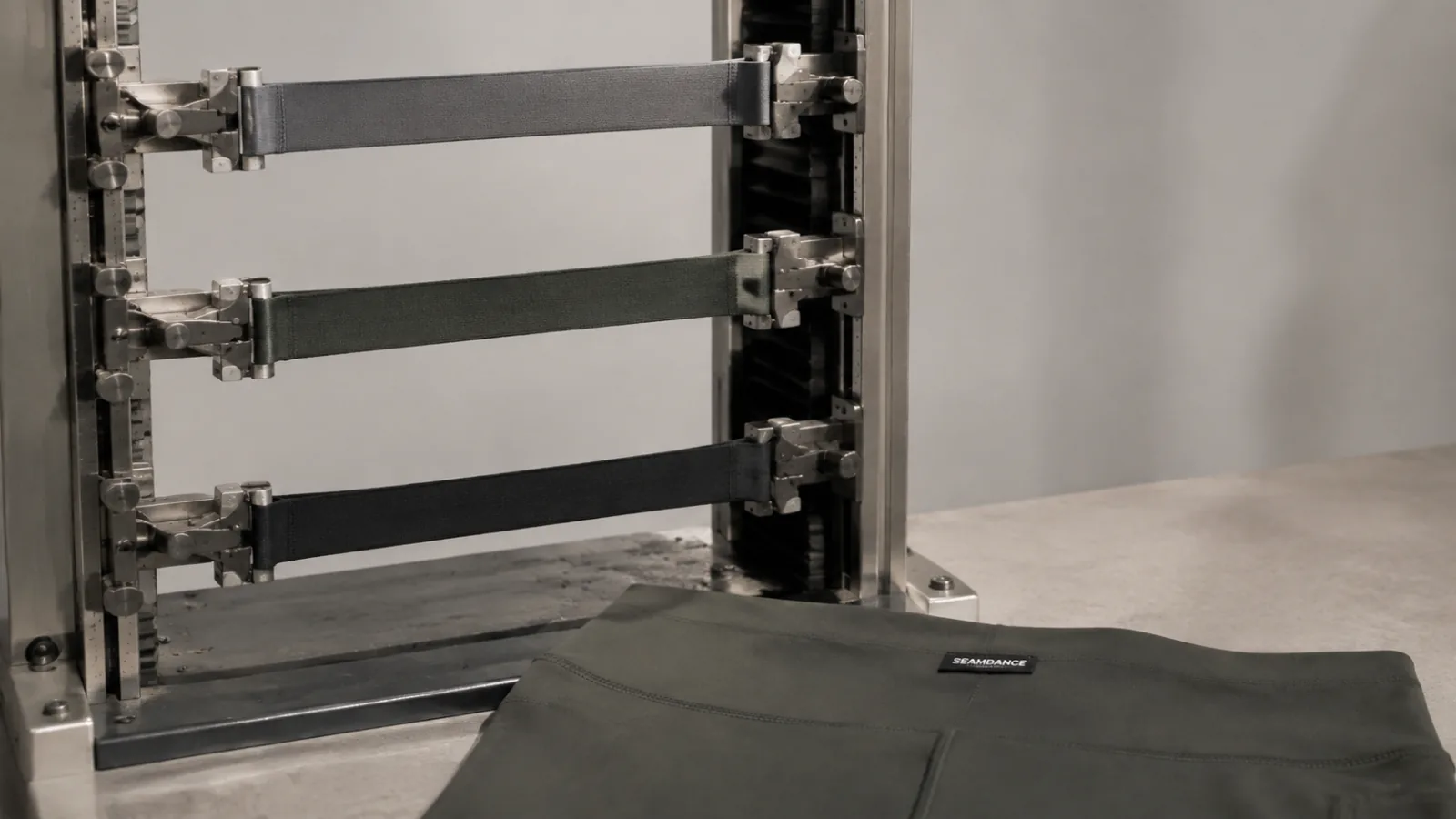
Recovery apparel sells three promises in one sentence: the garment squeezes, the fabric returns body heat as far-infrared energy, and the wearer bounces back faster. Each promise needs a different kind of evidence, and only the first two can be bought from a textile laboratory. This guide maps each claim to the test that can support it, shows what a pass does and does not prove, and sets out what regulators in the US, EU, UK and China expect before the word recovery goes on a hangtag.
The short answer
- Split the claim before you test it. “Compression” is a pressure claim, measured on the garment in mmHg. “Far-infrared” is a material claim, measured on the fabric as emissivity and temperature rise. “Faster recovery”, “less soreness” or “better circulation” is a physiological claim, and no fabric test can carry it.
- For far-infrared fabric, the main published method is China's GB/T 30127-2013: a knitted or woven fabric passes when its far-infrared emissivity is at least 0.88 and its temperature rise is at least 1.4 °C. The standard states that it does not evaluate medical effects.
- For compression, ask for pressure in mmHg at named points, for each size, with the method stated. Medical hosiery has its own standards; sports compression has no internationally agreed method, so the method has to be written into the order.
- Physiological claims need trials on people wearing the product. Reviews find small benefits from compression for recovery of strength, while the one systematic review of far-infrared garments called the evidence inconclusive. In the US the FTC generally expects randomised controlled trials for health claims, and in the EU and UK claims about soreness, swelling or circulation can make a garment a medical device.
Three claims, three kinds of evidence
Recovery apparel copy usually blends three different statements. “Graduated compression” describes what the garment does at the skin: a pressure, which a laboratory can measure. “Far-infrared fabric” describes a property of the textile: how strongly it emits in the far-infrared band and how fast it warms under an infrared source, which a laboratory can also measure. “Recovers faster”, “reduces muscle soreness” and “improves circulation” describe what happens inside the wearer, and only a study of people can show that.
The distinction matters because evidence does not travel upward. A pressure report does not show that the pressure helps recovery, and an emissivity report does not show that the radiation reaches muscle or changes anything there. Write each claim at the level its evidence supports, and the copy, the test plan and the regulatory risk all become easier to manage.
Which evidence supports which claim
| Claim on the hangtag | Type of claim | Evidence that can support it | Who produces it |
|---|---|---|---|
| “Firm compression”, a stated mmHg range | Pressure | Interface pressure on the finished garment, per size, at named measuring points, with the method stated | A textile laboratory, or a factory laboratory with a calibrated tester |
| “Graduated compression” | Pressure profile | Pressure measured at several heights, falling from ankle to thigh | A laboratory with a leg form or body-worn sensors |
| “Far-infrared fabric”, “returns body heat as infrared” | Material property | Far-infrared emissivity and temperature rise, for example to GB/T 30127-2013, on the finished fabric after washing | A textile laboratory |
| “Speeds up recovery”, “reduces soreness”, “improves circulation” | Physiological effect | Controlled trials on people wearing the product, measuring the outcome the claim names | A research team running a human study, not a textile laboratory |
| “Medical compression”, “treats swelling” | Medical purpose | Conformity with medical device rules and a medical hosiery standard | A medical device manufacturer and its regulator, outside activewear |
Compression: measure pressure in mmHg, on the garment
Compression is the pressure a garment exerts on the skin, reported in millimetres of mercury; 1 mmHg is about 0.133 kPa. There are three ways to get the number: calculate it from the fabric's tension and the limb's radius using Laplace's law, measure it on a leg form or mannequin fitted with sensors, or measure it on a person with thin air-filled, fluid-filled, piezoresistive or capacitive sensors under the garment [6]. Fabric tests such as ASTM D4964 and ISO 20932-1 measure how the fabric stretches and pulls back; they are useful in development, but they are not a garment pressure [7][8].
Medical compression has standards of its own, such as Germany's RAL-GZ 387/1 and the European method report CEN/TR 15831:2009 [9][10]. Sports compression has no internationally agreed method, a gap the research literature points out [11]. China's FZ/T 70015-2022 sets a method for the pressure of knitted tight-fitting clothes, measured on a mannequin, and is the closest published reference for activewear [12]. Because no single method can be assumed, the method belongs in the order.
Pressure also depends on fit. In one study, 50 active adults were sized with the garment makers' own size guides, and many may not have received adequate pressure [13]. A pressure claim is therefore a claim about a size on a body shape, and the report has to say which.
What a usable pressure report states
| Item | Why it matters |
|---|---|
| Size tested, and the leg form or body measurements used | The same garment gives different pressures on different limbs |
| Measuring points, such as ankle, calf and thigh | “Graduated” is only true if pressure falls between named points |
| Method, instrument type and calibration date | Different sensor types read differently, especially at low pressure |
| Mean pressure in mmHg per point, and the number of specimens | One reading on one garment is not a specification |
| Washes before testing | Elastane relaxes with heat and detergent, and pressure falls with it |
Far-infrared fabric: what GB/T 30127-2013 measures
China's GB/T 30127-2013, Textiles — Testing and evaluation for far infrared radiation properties, is a recommended national standard in force since December 2014 [1]. It covers fibres, yarns, fabrics, nonwovens and their products, and it runs two tests. The emissivity test compares the specimen's far-infrared output with a standard blackbody plate at the same temperature on a 34 °C hot plate, read in the 5–14 µm band. The temperature-rise test places the specimen 500 mm from a 150 W infrared source and records how much its surface warms within 30 seconds [2][3].
A fabric passes only when both results clear the line: emissivity of at least 0.88 and a temperature rise of at least 1.4 °C for ordinary knitted and woven fabrics, and at least 0.83 and 1.7 °C for nonwovens and raised or pile fabrics. Fibres and yarns are measured but not graded [3][4]. The standard allows specimens to be washed first, using the GB/T 8629 domestic washing procedure, and suggests at least 30 washes for garments worn next to the skin and 10 for outerwear [2]. Ask for washed results: a finish that fades in the first month is not a property of the product you sell.
As of October 2026 we found no ISO, ASTM or JIS method written specifically for far-infrared textiles. Other markets rely on industry-scheme methods with their own thresholds and wavelength bands, so ask which method produced any far-infrared figure a supplier quotes.
What a far-infrared pass does not prove
A pass describes the fabric under laboratory conditions, and the conditions are generous. The 150 W lamp delivers far more infrared energy than a body passes to its clothing, and a 2026 study found that most samples, with or without far-infrared additives, warmed by more than 2 °C within 30 seconds, which limits how much the temperature-rise criterion separates them [3].
Emissivity alone does not prove an additive either. In a 2018 study, an ordinary nylon fabric measured 86.72% emissivity with a 1.52 °C rise, and changing only the fibre's cross-section, with no mineral added, raised emissivity to 91.85% [4]. A report shows that the fabric met the thresholds; it does not show what is in the yarn, and it says nothing about the wearer. GB/T 30127 itself states that it does not evaluate medical effects [2].
In practice: test the finished fabric rather than relying on an additive supplier's data sheet, test after the number of washes your care label implies, keep each report with the fabric lot it describes, and ask the mill to declare any additive in writing if you intend to name it.
Physiological claims need trials on people
For compression, the evidence is real but modest. A 2017 meta-analysis of 23 studies found small, very likely benefits for recovery, largest for the recovery of strength at 2–8 hours and after 24 hours, mainly after resistance exercise; it could not say how much pressure is needed, because few studies reported it [5]. A later scoping review of 183 studies found effects on performance equivocal, with possible reductions in muscle soreness, and asked researchers to report pressure at several sites [14].
For far-infrared garments, the evidence is thin. The only systematic review we found covered 11 studies of 5 to 22 participants each, too varied to pool, and called the results inconclusive, with possible effects on body temperature and blood flow; only 4 of the 11 reported clearly what the garment was made of or how much it emitted [15]. In a double-blind, placebo-controlled trial with 21 elite football players, far-infrared garments made no difference to jump height or strength [16], and in a trial with 25 players neither far-infrared garments nor cold-water immersion improved recovery after a match [17].
So “speeds up recovery” needs studies of the product itself, on people like the ones who will wear it, measuring the outcome the claim names, such as soreness or strength, against a control garment. Studies of a different garment, of people at rest or of animals do not transfer.
Claim wording and the evidence it needs
| Wording | Evidence needed | Can a fabric or garment lab test supply it? |
|---|---|---|
| “Compression fabric”, with a stated mmHg range per size | Garment pressure report at named points, after washing | Yes |
| “Far-infrared fabric” | Emissivity and temperature-rise report on the finished fabric, after washing | Yes |
| “Supports recovery”, “recovers faster” | Controlled human trials with the product, measuring recovery outcomes | No |
| “Reduces soreness”, “improves circulation”, “reduces swelling” | Human trials, and in some markets medical device rules | No |
What regulators expect before “recovery” goes on the label
United States. The FTC's Health Products Compliance Guidance (2022) applies to health claims for any product: claims need competent and reliable scientific evidence, and for health benefits the FTC generally expects high-quality randomised, controlled human clinical trials [18]. Separately, a product intended to treat, mitigate or prevent disease, or to affect the structure or function of the body, is a medical device under the Federal Food, Drug, and Cosmetic Act; FDA's General Wellness guidance covers only low-risk products making wellness claims, and being covered does not establish that a product works [19][20].
European Union. A product with a medical purpose is a device under Regulation (EU) 2017/745, and its intended purpose is read from the label, the instructions and the promotional or sales material, so recovery copy can pull a garment into device rules [21]. The Unfair Commercial Practices Directive lists falsely claiming that a product can cure illnesses, dysfunction or malformations as unfair in all circumstances [22].
United Kingdom. The advertising code requires documentary evidence for claims consumers would take as objective, and evidence from trials on people where relevant; medical claims are reserved for products with the required device marking [23][24]. The ASA has upheld complaints against far-infrared sleepwear sold to help wearers recover faster (2019), against a far-infrared compression top said to be proven to improve strength and endurance (2020), and against recovery compression tights whose soreness, swelling and circulation claims were treated as medical claims (2025).
China. Under Article 17 of the Advertising Law, only advertisements for medical services, drugs and medical devices may refer to treating disease or use medical terms. GB/T 30127 is a voluntary test method; a pass does not license health claims. This is general information, not legal advice.
How to write the claim into the order
Decide the wording before sampling, then test to it. For compression, put the target in the order as a pressure range in mmHg for each size at named points, with the method and the number of washes before testing. For far-infrared fabric, name GB/T 30127-2013 or the method your market recognises, the category threshold, the washing procedure and count, and one report per fabric lot.
Wording that stays inside the evidence describes the garment, not the body: a stated pressure range at the calf for each size, measured on a leg form after a stated number of washes, or a fabric that meets the GB/T 30127-2013 far-infrared criteria after 30 washes. Wording such as “boosts recovery”, “improves circulation” or “reduces swelling” needs your own human trials and, in some markets, device approval. Without both, leave it off the hangtag.
Quick answers
What testing standard applies to far-infrared fabrics?
The main published method is China's GB/T 30127-2013, a recommended national standard that measures far-infrared emissivity and temperature rise. Knitted and woven fabrics pass at an emissivity of at least 0.88 and a temperature rise of at least 1.4 °C; nonwovens and pile fabrics at 0.83 and 1.7 °C. As of October 2026 we found no ISO, ASTM or JIS method written for far-infrared textiles.
How is compression measured on activewear?
As pressure on the skin in mmHg: calculated from fabric tension and limb size, measured on a leg form or mannequin with sensors, or measured on a person with thin sensors under the garment. Medical hosiery has its own standards; sports compression has no internationally agreed one, so state the method, size, measuring points and washes in the order.
Does a far-infrared test report prove that a garment helps recovery?
No. It shows that the fabric met emissivity and temperature-rise thresholds in a laboratory. GB/T 30127 states that it does not evaluate medical effects, and the one systematic review of far-infrared garments called the human evidence inconclusive.
Do compression garments help recovery?
Modestly. A 2017 meta-analysis of 23 studies found small, very likely benefits, largest for the recovery of strength after resistance exercise, while effects on performance are less clear. A brand that wants to claim faster recovery for its own garment still needs evidence on that garment.
What evidence does the FTC expect for a recovery claim?
Competent and reliable scientific evidence. For health benefits, its 2022 Health Products Compliance Guidance says it generally expects high-quality randomised, controlled human clinical trials measuring the benefit claimed. A laboratory test on the fabric does not meet that bar on its own.
Can a recovery claim turn activewear into a medical device?
In some markets, yes. In the EU the intended purpose is read from labels and promotional material, so claims about treating soreness, swelling or circulation can bring a garment under the Medical Devices Regulation; the UK advertising code reserves medical claims for marked devices; and in the US a product intended to affect the structure or function of the body can be a device.
Sources
- GB/T 30127-2013, Textiles — Testing and evaluation for far infrared radiation properties (national standards information platform)
- GB/T 30127-2013, English translation: scope, test conditions and pre-washing
- Chen J. (2026), testing and evaluation of far-infrared textiles, Technical Textiles 44(2): 45–52
- Tao et al. (2018), far-infrared emissivity of nylon fibres with different cross-sections, Polymers 10(10)
- Brown et al. (2017), compression garments and recovery from exercise: a meta-analysis, Sports Medicine 47(11): 2245–2267
- Schauss & Hayman (2025), measuring compression garment pressure, Sensors 25(14): 4445
- ASTM D4964 — Tension and Elongation of Elastic Fabrics (Constant-Rate-of-Extension Type Tensile Testing Machine)
- ISO 20932-1:2018 — Textiles — Determination of the elasticity of fabrics — Part 1: Strip tests
- RAL-GZ 387/1 — Medical compression hosiery, quality assurance (2008)
- CEN/TR 15831:2009 — Method for testing compression in medical hosiery
- McManus et al. (2020), measuring the pressure of sports compression garments, Measurement 156: 107592
- Interpretation of FZ/T 70015-2022, Knitted tight clothes — Testing and evaluation for pressure, Knitting Industries (2024)
- Hill et al. (2015), size guides and the pressure delivered by compression garments, Sports Engineering 18: 115–121
- Weakley et al. (2022), compression garments and exercise: a scoping review, Sports Medicine 52(5): 1141–1160
- Bontemps et al. (2021), far-infrared emitting garments and exercise: a systematic review, PLOS ONE 16(5): e0251282
- Loturco et al. (2016), far-infrared garments and recovery in elite soccer players: a randomised trial, Biology of Sport 33(3): 277–283
- Coelho et al. (2021), far-infrared garments and cold-water immersion after soccer matches, Journal of Sports Science and Medicine 20: 732–742
- FTC — Health Products Compliance Guidance (December 2022)
- FDA — How to determine if your product is a medical device
- FDA — General Wellness: Policy for Low Risk Devices
- Regulation (EU) 2017/745 on medical devices, Article 2
- Directive 2005/29/EC on unfair commercial practices, Annex I
- CAP Code, section 3: Misleading advertising (rule 3.7)
- CAP Code, section 12: Medicines, medical devices, health-related products and beauty products (rule 12.1)
Compression leggings, tops, sleeves and base layers, developed and fit-tested for measured compression.
Open the programSourcing styles for your line? The 2026 catalogue lists every ready-to-develop style — colorways, materials, quote list built in.