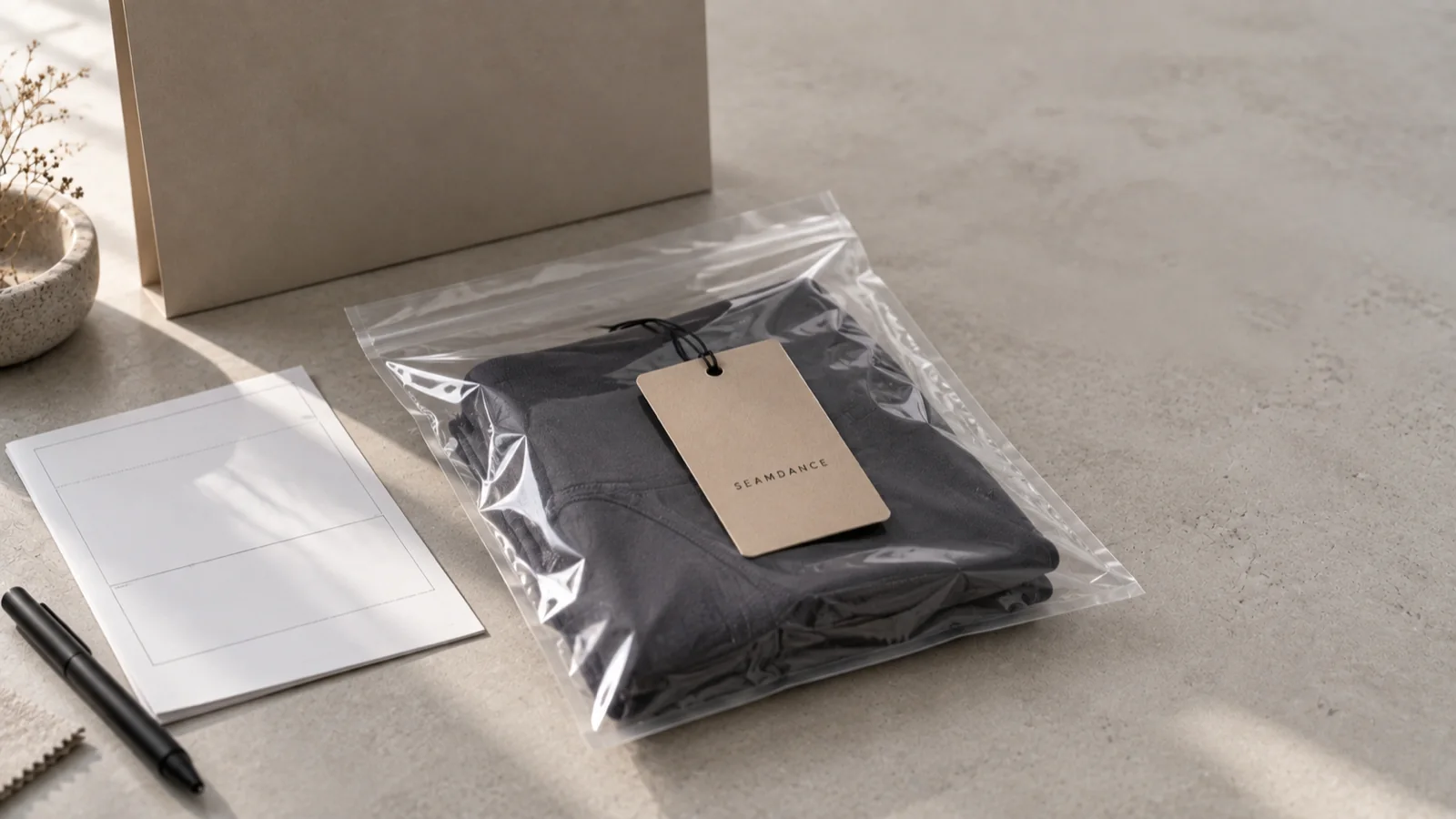
In most quotations, “refundable” does not mean you get your money back. It means the amount is credited against a bulk order you have not yet decided to place. Those are different promises, and the difference only becomes visible on the day you decide not to order.
The short answer
- Ask which one you are being offered, in writing, before you pay: returned to you, or credited against a bulk order. Almost always it is the second.
- Five versions of the same word circulate — credited against bulk, credited above a threshold, credited within a time window, partially refunded, and refundable in name only with no mechanism described.
- Our own terms, stated in full: a sample fee of $20 to $100, deducted from the bulk order payment, not refunded if no order follows, with courier billed separately.
What “refundable” turns out to mean
None of the versions below is dishonest in itself. They are different commercial terms at different prices. The problem is that they share one word, and the buyer usually assumes the most generous reading while the supplier means the most common one.
Five versions of one word
| Version | What actually happens | When you find out |
|---|---|---|
| Credited against bulk | Deducted from your bulk payment; nothing is returned if you do not order | On the day you decide not to order |
| Credited above a threshold | Only if the bulk order exceeds a minimum value or quantity | When your first order turns out to be small |
| Credited within a window | Only if you order within a set period after sample approval | When development runs longer than planned |
| Partially refunded | Returned minus courier, materials or handling | When the transfer arrives short |
| Refundable in name only | The word appears; no mechanism is described anywhere | When you ask for it |
The five questions that settle it
Get the answers in the same document as the price. A term that lives only in a chat thread is not a term — it is a memory, and memories differ.
Ask these, and read the answers carefully
| Ask | A usable answer | An answer that tells you to be careful |
|---|---|---|
| Is it credited, or returned? | “Credited against bulk”, or “returned to you” | “Refundable”, and nothing further |
| Credited against what, exactly? | “Deducted from the balance of your bulk order” | “We will take care of it” |
| What if I do not place an order? | A yes or a no | Silence, or a change of subject |
| Is there a minimum order or a deadline? | A number and a date | “Normally there is no problem” |
| Does it include courier and materials? | An itemised answer | A single figure with no breakdown |
Why suppliers keep it vague
Worth saying plainly, because it is not villainy. Sampling costs a factory real money: pattern making, a small cut of fabric, a machine changeover, an operator's time on a one-off that will never be repeated. When a buyer samples and disappears, that cost is absorbed by the factory.
Vagueness is how many suppliers protect themselves without appearing expensive at the quotation stage. The honest version is to charge for it and say exactly what happens to the money — which is harder to do in a market where the competitor's quotation says “refundable” and stops there.
Our terms, stated in full
We are not going to write an article telling you to demand a straight answer and then avoid giving one. Here is ours, including the row most suppliers leave out.
What it means in practice: the fee is not a deposit you are risking, it is the price of the sample. If you order, the sample is effectively free. If you do not, you paid for a physical garment made to your specification, which you keep, and which you can put in front of the next supplier as a reference. For that money, that is not a bad outcome.
SEAMDANCE sample fee terms
| Term | What we do |
|---|---|
| Sample fee | $20 to $100 — the lower end for a stock style with your branding, the higher end for a fully custom development |
| If you place a bulk order | Deducted from the bulk order payment |
| If you do not place an order | Not refunded |
| Courier | Billed separately from the sample fee |
What this does not protect you from
Sampling fees are a small number attached to a large decision, and it is worth being clear about their limits. The expensive failures happen elsewhere: a sample approved too early because the revision rounds were tiring, a bulk lot that differs from the approved sample with no tolerance table to measure it against, a claim raised after the evidence window closed.
A generous refund policy protects you from none of those. What protects you is the approved sample record, the tolerance table and the inspection standard — all agreed before the deposit, all cheaper than the argument they replace.
What to compare this against
Take the four rows of our table to any supplier you are considering and ask them to fill in their own. Whether their numbers are higher or lower matters less than whether the four rows come back answered.
The ones who answer in the same shape are the ones you can plan around. The ones who answer three rows and skip the third — what happens if no order follows — have told you what the answer is.
What the fee actually buys
It helps to know what happens on the other side once a sample is ordered, because the cost is not one thing. A pattern is made or adapted. A small length of fabric is pulled, and on a custom development it may have to be knitted or dyed specially, which is the largest single cost in the range. A machine is changed over from whatever it was running. An operator spends time on a one-off, at a speed no production line would accept.
None of that is recovered by the sale of the sample. It is recovered either by the order that follows, or by the fee. That is the entire economics of sampling, and it is why the version where nothing is charged and nothing is credited usually means the cost is sitting in the unit price instead.
When paying for a sample is the wrong purchase
Not every sample is worth ordering. If the style is a stock item and your only change is branding, a stock sample answers most questions for less, and the custom fee buys you very little at that stage. If your specification is not settled — fabric undecided, fit intention unwritten — the first sample becomes a conversation starter rather than a decision, and a second round is guaranteed.
The productive order is: settle what you can on paper, buy the sample that tests the thing you cannot settle on paper, and keep the fee for the development that genuinely needs it. Buyers who sample early and often on unsettled specifications spend more, wait longer, and end up with a sample nobody can approve because the target was never written down.
Reading a quotation line by line
Sampling terms rarely sit in one place. They are spread across the unit price, a sample line, a courier line and sometimes a development or trim charge, and each of those can carry its own condition. Reading them together is what turns a quotation into a comparable offer.
Four questions do it. What is charged for the sample itself; what is charged for each additional round; what is billed separately, courier included; and what happens to all of it if an order follows — and if one does not. A supplier who answers those four in writing has given you something you can put next to another supplier's answer, which is the only comparison that means anything.
It is also worth noticing which of the four a quotation leaves out. The omission is usually the term that would be least attractive if stated, and asking about it directly costs nothing at the quotation stage — unlike discovering it after the second sample round.
The four rows to send any supplier
| Row | What to ask them to state |
|---|---|
| Sample fee | The amount, and what changes it |
| If a bulk order follows | Credited, deducted or returned — in those words |
| If no order follows | Refunded or not refunded, with no qualifier |
| Courier and materials | Inside the fee, or billed separately |
Quick answers
Is a free sample better than a paid one?
Usually not. A free sample is either a stock item you did not specify, or a cost recovered somewhere else in your unit price. Paying a small, defined fee with a stated condition is generally the cheaper arrangement and always the clearer one.
Why is there a range rather than a single price?
Because a stock style with your logo consumes very little development, while a fully custom style consumes pattern making, fabric sourcing and several iterations. One flat fee would overcharge the first and undercharge the second.
Can I get the pattern if I paid for sampling?
That is a separate term and it has to be stated separately. Paying for sampling buys the sampling work; it does not automatically buy the pattern developed during it.
How many rounds does the fee cover?
Ask, and get it in writing. Rounds included is the second most common ambiguity in sampling, after the refund condition itself.
Does the fee include the courier cost?
Courier is normally billed separately from the sample fee. Confirm which costs sit inside the figure you were quoted — ours is billed separately.
So if I sample with you and then walk away, I lose the fee?
Yes. You paid between $20 and $100, and you keep the sample. We would rather write that down here than let you find it out at the point where it matters.
Is any of this negotiable on a larger programme?
Sampling terms usually move with the size and the shape of the programme rather than with a request. What does not move is the principle that the term is written down before you pay, which is the part this article is actually about.
Sampling, approval and bulk acceptance under one desk, with the terms stated before the first sample is cut.
Open the programSourcing styles for your line? The 2026 catalogue lists every ready-to-develop style — colorways, materials, quote list built in.