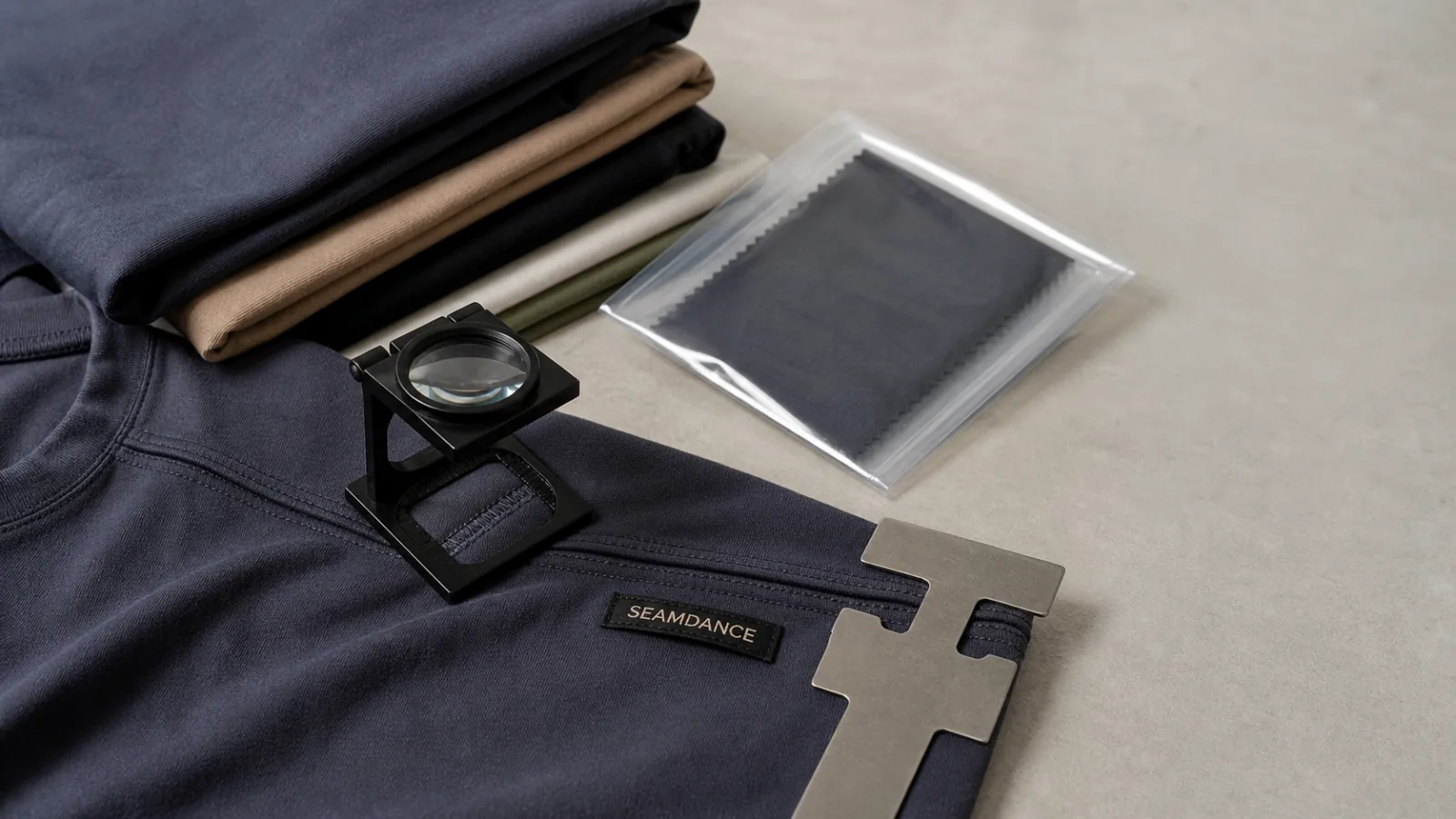
Third-party inspection is a check of your order by an inspection body with no stake in the goods, made against your approved sample, specification and sampling plan before you release the shipment and the balance payment. A factory audit looks at the supplier instead: how it treats workers, how its quality system runs, or whether it can make your product at all.
The short answer
- Third-party inspection is independent evidence about one lot on one day; it is not a guarantee and does not improve the factory's process.
- The four common apparel inspections are pre-production, during production, pre-shipment (final random) and container loading; each catches different problems.
- AQL is a sampling-plan setting that decides whether a lot is accepted, not a promised defect rate for your shipment or any garment.
- Confirm an inspection body's ISO/IEC 17020 accreditation in its accreditation body's directory, and a factory's ISO 9001 certificate in IAF CertSearch.
What is third-party inspection, and why do buyers use it?
Inspection means an expert examining a product, material or process and judging whether it conforms, unlike a laboratory test or a certificate [1]. ISO/IEC 17020 sets the requirements for inspection bodies' competence, impartiality and consistent operation [2]. ‘Third-party’ describes who the inspector answers to: the factory's QC is first-party, your own staff are second-party, and a third-party inspection company or agency is independent of both. The standard calls this Type A, a body that takes inspection work from outside clients and reports back to them [1]; its 2026 revision keeps Type A and groups the rest as ‘Type non-A’ [2].
Buyers use it for leverage and evidence. When the balance is due before shipment, the final inspection is your last chance to hold payment, and a report from a body with nothing to gain is evidence for a retail customer, a bank or a claim. That independence is why third-party verification matters; the inspection itself does not improve the factory's process.
Inspection is one of three related services. Testing measures characteristics by a set procedure, often in laboratories accredited to ISO/IEC 17025; certification is a third-party attestation by bodies accredited to ISO/IEC 17065 for products or ISO/IEC 17021-1 for management systems [3].
Which inspection do you need, and what does each one catch?
Book by risk: a new factory, fabric or style justifies an early check; a repeat style from a factory with a clean record may need only the final one.
Four inspections on an apparel order
| Inspection | When | What it catches | What it misses |
|---|---|---|---|
| Pre-production (PPI) | Before cutting, with fabric and trims in the factory | Wrong fabric, weight or colour; wrong trims or labels; no approved pre-production sample | Sewing and measurement faults not yet made |
| During production (DPI) | Once part of the order is finished and lines are running | Repeated sewing faults, measurement drift, shade differences between cut lots, late output | Faults added later in finishing or packing |
| Pre-shipment or final random (PSI, FRI) | Production complete, most cartons packed | Whether a random sample meets your AQL for workmanship, measurements, labels and packing | Unsampled pieces; fibre content and chemistry, which need a laboratory |
| Container loading check (CLC) | While the container is loaded | Wrong quantities, damaged cartons, wrong shipping marks, an unfit container; records the seal number | Goods in unopened cartons |
How does AQL sampling work, and what does a pass prove?
A final inspection uses lot acceptance sampling: in a single sampling plan the inspector examines n randomly drawn pieces, and the lot is accepted only if the defectives found do not exceed the acceptance number c [4]. The usual AQL tables descend from the US military standard MIL-STD-105, adopted as ANSI Z1.4 and as ISO 2859 [5]; ISO 2859-1 was revised in 2026 and includes rules for switching between normal, tightened, reduced and skip-lot inspection [6].
You do not pick n and c. You set an AQL for each defect class and an inspection level; the lot size and level give a code letter, and the table for your AQL gives the sample size with its accept and reject numbers [5]. The standard has three general inspection levels and four special ones [5], so write the standard, edition, level and AQLs into the booking, and define the classes yourself: critical for safety or legal faults such as a needle fragment, major for faults a customer would return, minor for small cosmetic flaws.
AQL stands for acceptance quality limit [6]; older texts say acceptable quality level. A plan gives lots at or better than the AQL a high chance of acceptance [4], and the scheme aims to hold the producer's process average there over many lots [6]. In NIST's worked example, a plan with a sample of 52 and an acceptance number of 3 accepts a lot that is 5 per cent defective with probability 0.739, and one that is 12 per cent defective with probability 0.115 [7]. A pass at AQL 2.5 means the sample stayed within the acceptance number, not that at most 2.5 per cent of the goods are faulty.
What should an inspection report contain?
A usable third-party inspection report lets someone who was not there reach the same decision: the order and quantities produced and packed; the sampling settings actually used; every defect counted, classified and photographed; measurements per size against tolerance; on-site tests and packing checks; a pass, fail or pending verdict with reasons; and the inspector, date and site address. Build the inspection form, the checklist used on site, from your booking pack.
What is a factory audit, and how is it different?
A factory audit, also called a supplier or vendor audit, asks whether a supplier should make your goods at all. It matters because a wrong factory cannot be inspected into a right one: a failed lot can be reworked, but a site that quietly subcontracts or cannot sew stretch fabric to tolerance will fail again. Retail customers may also require audits before listing your products.
Social audit schemes set their own rules; amfori BSCI, for example, says it is not a certification. Its audit asks 81 questions, answered from observation, interviews and documents, on a two-year cycle, and a C, D or E grade requires a follow-up within two to twelve months [8]. Full reports are open only to members and the audited supplier, so ask the factory for its latest report [8].
Three kinds of factory audit
| Audit type | Question it answers | Assessed against | What you receive |
|---|---|---|---|
| Social compliance | Are workers employed lawfully and treated fairly? | A code of conduct; amfori BSCI's covers 13 performance areas, including pay, hours, child and forced labour [8] | A graded report; amfori BSCI grades run from A to E [8] |
| Quality system | Are defects prevented, detected and corrected in a documented way? | ISO 9001 or the buyer's quality manual | Findings and corrective actions; a certificate only from an accredited certification body |
| Technical capability | Can this site make this product at this volume and standard? | Your product's machine, skill, testing and capacity needs | A capability assessment for your categories |
What should a supplier audit checklist cover?
A supplier audit checklist lists what the auditor must verify on site and the evidence expected for each item. For a factory audit in China, two checks earn their keep: that the company on your contract operates the site you visit, and whether any process goes to another workshop.
For an Excel audit form, use one row per requirement with columns for area, requirement, evidence seen, result (yes, partial, no, not applicable), severity, photo, corrective action, owner and due date; a sample row reads ‘needle log missing on one line; major; start the log and brief line leaders’. The audit report format adds a cover sheet (legal name, address, date, auditor, scope) and a section summary; one critical finding should outweigh a good average.
Supplier audit checklist for an activewear factory
| Area | What to check | Evidence to ask for |
|---|---|---|
| Identity | Licence name and address match the contract and the site | Business licence, lease or property papers |
| Capacity and subcontracting | Lines for your product type, capacity already booked, processes sent out | Machine list, production schedule, subcontractor list |
| Activewear machinery | Flatlock, coverstitch and overlock machines working; bonding equipment if needed | Machine register, maintenance log |
| Materials and pre-production | Fabric checked for faults, weight and shade; approved sample on file | Fabric inspection records, shade bands, signed samples |
| QC and needle control | Roving and final QC recorded; every broken needle logged | QC sheets by line, needle log |
| Testing and quality system | Laboratory access, calibrated tape measures, corrective actions | Test reports, calibration records, any ISO 9001 certificate |
| Social compliance | Hours, wages, age checks, fire exits, grievance channel | Time and wage records, latest social audit report |
| Chemicals | Inventory and storage; wastewater where dyeing or printing is done | Chemical list with safety data sheets, discharge permit |
How do you book a third-party inspection?
Send a pack, not just a PO number: the golden sample (the approved production sample, sealed and signed, with a twin kept at the factory); the tech pack; the measurement chart with a tolerance for each point of measure; your defect list; the sampling standard, edition, level and AQLs; packing requirements such as carton marks, polybag warnings and assortment; the on-site tests; and the factory's address and contact.
Fix the date against a readiness rule, such as production finished and an agreed share of cartons packed, confirmed by the factory in writing; a wasted visit still costs a man-day. Agree in the contract who pays for re-inspection after a fail, what a pending verdict triggers, and that you receive the report no later than the factory.
How do you check an inspection body before hiring it?
Accreditation is the independent confirmation that an inspection body is competent and impartial, granted against ISO/IEC 17020 [3]. Confirm the accreditation certificate and scope in the accreditation body's online directory; not every accreditation body has signed the Global ACI mutual recognition arrangement [3]. As checked on 22 September 2026, Global ACI has carried out the former roles of ILAC and IAF since 1 January 2026, and documents may still show the older ILAC or IAF marks during the transition [3]. In China, the national accreditation body, CNAS, accredits inspection bodies under criteria based on ISO/IEC 17020 [9].
On the scope, check that it covers garments, textiles or consumer goods, that the body is Type A for that work [1], and that it is current; accreditations granted before the 2026 revision [2] may still cite the 2012 edition [9].
What drives the cost of third-party inspection?
Inspections are usually quoted per man-day plus travel, so cost follows time; this guide gives no prices.
What moves the price of an inspection or audit
| Cost driver | Why it changes the bill | How to keep it down |
|---|---|---|
| Man-days on site | Sample size, styles, colours and tests set the time needed | Group styles from one factory into one visit |
| Factory location | Remote sites add travel time and may add travel charges | Use a body with inspectors based nearby |
| Lot size and inspection level | Bigger lots and higher levels mean more pieces examined | Use the level your risk justifies |
| Report type and turnaround | Custom protocols and same-day reports take longer | Keep one standard protocol for repeat styles |
| Booking notice | Short-notice, weekend and holiday visits can carry surcharges | Book once the ship date is firm |
| Re-inspection | A failed lot is inspected, and charged, again | Put re-inspection costs on the supplier in the contract |
What should you put in writing?
Write the inspection plan into the purchase contract: the inspections, sampling settings, defect list, golden sample reference, readiness rule, who pays for re-inspection, and that shipment and balance payment depend on a passed final inspection or your written waiver. File audit findings with the order, so the next one starts from the last corrective action plan.
SEAMDANCE runs final inspection at AQL 2.5 on every style it ships, whichever factory makes it. If you also appoint an independent inspection body, give it the same golden sample, measurement chart and defect list, so both checks judge the goods against one standard.
Inspection company, agency or individual inspector in China: who can do the job
Whether you search for an inspection company, agency, service or inspector, the choice in China comes down to who will stand in the factory for you and whom they answer to. Only an inspection body that takes work from outside clients and returns its reports to them is third-party, Type A; a body that belongs to the organisation making or selling the goods is Type B or C [1]. The providers you will meet range from large international testing, inspection and certification groups to smaller accredited bodies, unaccredited agencies and individual inspectors; the table shows what each can prove.
For a body registered in China, ask for its CNAS accreditation certificate and scope. CNAS lists commodity inspection among the fields in which it accredits inspection bodies [11], and it publishes suspensions, cancellations and withdrawals, including those that cover only part of a scope [12]. Check that the legal entity named on your booking and on the report is the one named on the certificate, then confirm it in the directory [3].
Book around China's public holidays. As checked on 22 September 2026, the State Council's notice for 2026 sets 25 to 27 September for the Mid-Autumn Festival and 1 to 7 October for National Day, with Saturday 10 October a working day [13]. That notice was issued on 4 November 2025, so the 2027 dates, including the Spring Festival break, will come in a later notice; treat a readiness date just after a long holiday with caution.
Who can inspect your order in China, and what each can prove
| Provider | Whose side it is on | What you can verify | Watch for |
|---|---|---|---|
| Accredited inspection body (Type A) | Independent; reports to you as its client [1] | ISO/IEC 17020 accreditation and scope, in the accreditation body's directory [3] | A scope that covers garments, and the office that will do your job |
| Inspection company or agency without accreditation | Independent, if you book and pay | Its written procedures, a sample report and inspector training records | No outside check of its competence or impartiality |
| Individual inspector | Whoever books and pays | References, sample reports and identity on the day | No organisation behind the report if it is disputed |
| Supplier's or trading company's QC team | The seller's | In-line records and its own reports | Not independent evidence for a customer, a bank or a claim |
| Your own staff or buying office | Yours, as second party | Your checklist and your staff's training | Travel cost, and no independence to show a customer or lender |
Quick answers
What is a third-party inspection certificate?
It is the document an inspection body issues for one inspected lot, stating what was checked, against which requirements, when, and the result. It is not a product or factory certification, which is a separate third-party attestation [3]. If a letter of credit requires one, name the issuer and the pass criteria in the credit.
Why is third-party inspection required, and is it a legal requirement?
Where it is required, the requirement usually comes from a purchase contract, a retailer's vendor terms or a letter of credit, because the payer wants evidence from someone with no stake in the result. Your market may separately require laboratory test reports, which an inspection does not replace. This is general information, not legal advice.
How much does third-party inspection cost?
No price is quoted here, because the bill depends on your order: man-days on site, travel, styles and tests, lot size and inspection level, report type and turnaround, booking notice and any re-inspection. Send several inspection bodies the same brief and compare quotes in man-days, with extras listed separately.
What is the difference between a factory audit and a product inspection?
An inspection judges one lot against your requirements on one day. An audit judges the supplier: its treatment of workers, its quality system or its ability to make your product. Audit before choosing a factory and then on a cycle; inspect each order. A good audit lowers the risk of a failed inspection without replacing one.
What is a supplier quality audit?
It is an on-site review of how a factory prevents, detects and corrects defects (incoming material checks, pre-production approval, in-line and final QC, tool calibration, corrective action), judged against ISO 9001 or your own manual. An ISO 9001 certificate shows the system was audited, not that your next order will measure correctly.
How do you conduct a supplier or factory audit?
Agree scope and date, and send a pre-audit questionnaire. On site, hold a short opening meeting, walk the process from fabric store to packing, test records against what you see and interview workers away from managers. Close with agreed findings, a report with evidence and severity, and a dated corrective action plan you verify later.
Does AQL 2.5 mean up to 2.5 per cent of my order can be defective?
No. With the lot size and inspection level, the AQL fixes a sample size and an acceptance number [5]; a pass means the sample stayed within that number. Worse lots can still pass: in NIST's worked example, a lot with 5 per cent defectives is accepted with probability 0.739 [7]. Unsampled pieces are never seen.
Which third-party inspection companies are the best?
This guide names none; the right choice depends on your product and factory location. Compare candidates on current ISO/IEC 17020 accreditation with a garment or consumer-goods scope, Type A independence, garment-trained inspectors near your factory, a clear sample report, a written anti-bribery policy with inspector rotation, and plain terms on cancellation, re-inspection and report ownership.
How can I verify a factory's ISO 9001 certificate?
Search IAF CertSearch with the company name or details from the certificate; it confirms that the certificate is valid, that the certification body held accreditation to issue it and that the accreditation body is recognised [10]. If nothing appears, ask the certification body named on the certificate [3], and check that the scope covers the site and garment manufacturing.
Is SGS a third-party inspection company, and should I use it in China?
SGS is one of the large international testing, inspection and certification groups; this guide does not rate or recommend it or any other provider. Whichever body you consider, ask which legal entity and office will inspect your order, then check that entity's ISO/IEC 17020 accreditation and scope in the accreditation body's directory [3]; in China the national accreditation body is CNAS [9]. Then compare a sample report, where its inspectors are based, and its re-inspection and cancellation terms.
Who pays third-party inspection charges, the buyer or the supplier?
Whoever books the inspection is the body's client and pays its invoice, and that should be you: a third-party body reports to the client that engaged it [1], so keep the booking, the payment and the report in your name. The contract can still move specific charges to the supplier, such as re-inspection after a failed lot or a wasted visit when goods were not ready on the confirmed date. If the supplier books “your” inspection, the supplier becomes the client.
What types of factory audits are there?
Three kinds come up most. A social compliance audit checks labour conditions and health and safety, and in some versions environment and business ethics: amfori BSCI grades a site from A to E on a two-year cycle and is not a certification [8], and Sedex's SMETA runs as a two-pillar or four-pillar audit and is also a method rather than a certificate [14]. A management-system audit leads to certificates such as ISO 9001, which you can check in IAF CertSearch [10]. A technical audit, usually commissioned by the buyer, looks at the machines, processes and quality controls for your product.
Sources
- DAkkS, German national accreditation body — Inspection bodies / DIN EN ISO/IEC 17020 (what an inspection is; Type A as the independent third-party inspection body)
- European co-operation for Accreditation (EA) — Publication of the new international standards for bodies performing inspection and certification of persons, 8 April 2026 (ISO/IEC 17020 scope; independence types reduced to Type A and Type non-A)
- Global ACI, successor to ILAC and IAF — FAQ (testing, inspection and certification defined; accreditation standards; how purchasers confirm accredited reports; operational from 1 January 2026)
- NIST/SEMATECH e-Handbook of Statistical Methods — 6.2.2 What kinds of lot acceptance sampling plans are there? (single sampling plan (n, c); AQL definition)
- NIST/SEMATECH e-Handbook of Statistical Methods — 6.2.3.1 Choosing a sampling plan: MIL Standard 105D (inspection levels, code letters, switching rules; adoption as ANSI Z1.4 and ISO 2859)
- BSI Knowledge — BS ISO 2859-1:2026, sampling schemes indexed by acceptance quality limit (AQL) for lot-by-lot inspection (identical to ISO 2859-1:2026; purpose and switching rules)
- NIST/SEMATECH e-Handbook of Statistical Methods — 6.2.3.2 Choosing a sampling plan with a given OC curve (acceptance probabilities for a (52, 3) plan)
- amfori — amfori BSCI (13 performance areas, A to E grades, two-year audit cycle, not a certification)
- CNAS, China National Accreditation Service for Conformity Assessment — Accreditation of inspection bodies: criteria (programme based on ISO/IEC 17020)
- IAF CertSearch — verification of accredited management system certificates
- CNAS, China National Accreditation Service for Conformity Assessment — Accreditation of inspection bodies: fields (commodity inspection among the programmes offered)
- CNAS — Suspending, cancelling and withdrawing accreditation (published lists for inspection bodies, covering all or part of a scope)
- General Office of the State Council, gov.cn — Notice on the arrangement of certain public holidays in 2026, issued 4 November 2025 (in Chinese; checked 22 September 2026)
- Sedex — SMETA audit (a social audit methodology: labour standards and health and safety, plus environment and business ethics in the four-pillar version; not a certification; checked 27 September 2026)
Sourcing styles for your line? The 2026 catalogue lists every ready-to-develop style — colorways, materials, quote list built in.