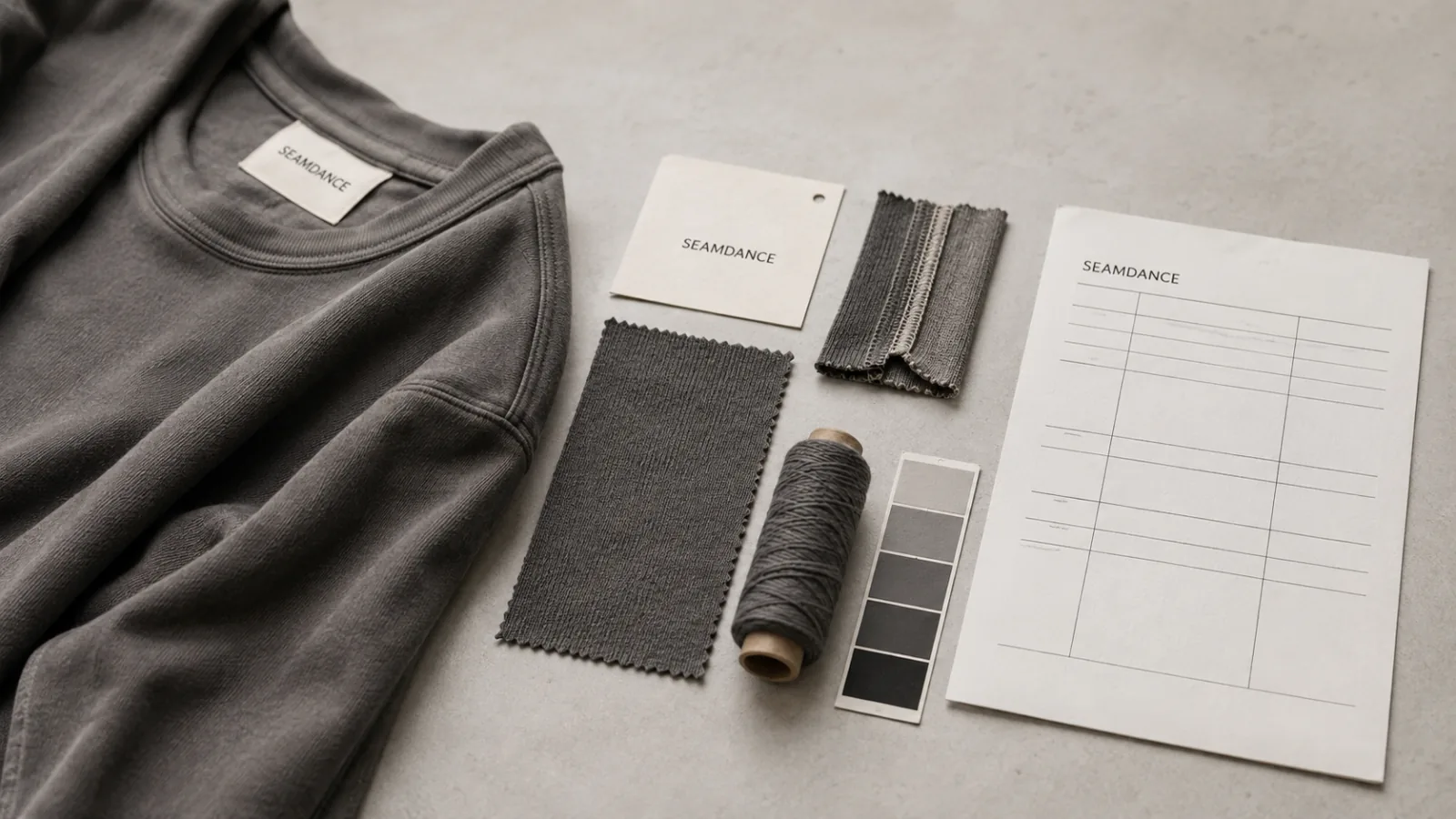
The most common brief in activewear development is a garment in a bag with a note attached: make it feel like this. It is a reasonable way to communicate — the buyer knows exactly what they want and has no vocabulary for it — and it is also the brief most likely to produce a disappointing first sample. The words that usually come with it, buttery, second-skin, sculpting, weightless, are real descriptions of real sensations, but none of them is a property a mill can knit to. This guide is about the translation step: what those words decompose into, and what happens at the point where a reference stops being a reference and becomes something else.
The short answer
- A reference garment communicates a result, not a recipe. Words like buttery or second-skin describe a combination of fibre, yarn fineness, knit structure, weight, elastane share and finishing — and each of those has to be named separately before anyone can quote it.
- You cannot buy another brand's fabric by naming the brand. Established labels contract capacity and finishing routines with specific mills, and those arrangements are the point of the relationship; a different mill can match measurable properties, not the identity.
- Matching properties is ordinary development. Claiming equivalence to a named brand's technology is a different act, carries legal exposure for the buyer rather than the factory, and is a line some suppliers will cross for you without mentioning it.
- The productive version is to have the reference deconstructed into measurable values — composition, denier, gauge, GSM, stretch and recovery, finish — and then to develop against those numbers with a tolerance you have agreed.
What the reference actually communicates
A reference garment carries an enormous amount of information and almost none of it is in a form a factory can act on. When a buyer says buttery, they are usually describing a fine-denier nylon knit with a light brushed finish — three separate decisions, any one of which changes the result. When they say second-skin, they usually mean a high elastane share in a dense knit with good recovery, which is a compression decision as much as a hand-feel one. Weightless is a fabric weight and a yarn fineness. Sculpting is compression plus panel engineering, and half of it is not in the fabric at all.
None of this means the buyer is being vague. The sensation is real and consistent; it is the vocabulary that is missing. The mistake is handing over the garment and the adjective and expecting the translation to happen invisibly, because what actually happens is that someone at the factory guesses, and their guess is anchored on what they already run rather than on what you meant.
Why you cannot order another brand's fabric
Buyers are often surprised that a fabric they can feel cannot simply be bought. The reason is structural rather than secretive. An established brand develops a fabric with a specific mill over multiple seasons, then contracts capacity for it; the finishing routine — how it is brushed, set, and treated — is frequently the part that took longest to settle and is the part least likely to be shared. Some of it is written into supply agreements. Much of it is simply accumulated process knowledge inside one building.
So a different mill can approach the same measurable properties, and often gets close, but it is approaching them by a different route. That difference tends to show up exactly where the buyer was most attached: a hand feel that is nearly right but slightly crisper, a recovery that is comparable but not identical after twenty washes. Setting the expectation correctly at the start — we are matching properties, not reproducing an object — prevents the sample round where everyone is disappointed for reasons nobody wrote down.
This is also why the request should be framed as a target with a tolerance. If the reference is a fine-denier nylon-elastane knit at a certain weight with a light brush, say so, and agree what counts as close enough before the first sample is made rather than after it arrives.
Where matching stops and misrepresentation starts
Developing a fabric that performs like a reference is normal product work and the entire industry does it. Presenting the result as the same technology as a named brand is a different act, and it is worth being precise about who carries the risk. The factory is not the party making the claim to consumers; the brand is. Marketing copy that implies equivalence with a named label's proprietary fabric is the brand's exposure, and it is the kind of claim that attracts attention precisely when a product starts selling.
The pattern to watch for is a supplier who volunteers the comparison. An offer to supply the same fabric as a well-known brand, or to sell a fabric under a name that sounds like a trademarked one, is a supplier telling you they are comfortable making claims they cannot support. If they will do it in a sales message, the same judgement is being applied to the fibre content declaration and the certification paperwork.
The honest formulation is easy and loses nothing commercially: describe what the fabric is and what it does. A fine nylon-elastane knit with a brushed finish, a stated weight, and stated stretch and recovery behaviour is a stronger claim than a comparison, because it is checkable and it is yours.
How to deconstruct a reference properly
The productive first step is to have the reference garment tested rather than described. Fibre composition by laboratory analysis rather than by reading the care label, because labels drift from what was actually knitted. Fabric weight measured on a cut swatch. Knit structure and gauge identified. Stretch and recovery measured in both directions, before and after wash cycles, because recovery is where the expensive disappointments live. Whether the surface is brushed, on one side or two.
That produces a specification with numbers in it, and numbers can be quoted, sampled against and argued about productively. It also reveals things adjectives hide: buyers regularly discover the reference they love is a lighter fabric than they assumed, or has a lower elastane share than the compression they were describing, or is doing its work through construction rather than fabric.
Send the deconstructed values with the reference garment, not instead of it. The physical object remains useful — it settles questions about surface and drape that no number captures — but it should arrive as supporting evidence for a specification rather than as the specification itself.
Judging the first sample against the right thing
When the sample arrives, the temptation is to hold it against the reference and decide by feel. Do that second. First check it against the numbers you specified, because that is the only comparison anyone can act on. If the weight is right, the composition is right, the recovery is right and it still does not feel like the reference, the gap is almost always in finishing — and that is a specific, solvable conversation about brushing passes, heat setting and softeners.
If the numbers are wrong, the feel is not the issue yet. A sample that came back at a different weight or a different elastane share is not a near miss on hand feel; it is a different fabric, and judging its hand tells you nothing about what the correct one would feel like.
Then decide what tolerance you will accept and write it into the approval. A fabric approved as close enough with no recorded definition of close enough will be reproduced at whatever the mill considers close enough, which may not be the same thing on the second order.
Where SEAMDANCE fits, and what a reference cannot deliver
SEAMDANCE is a gym wear, activewear, yoga wear and sportswear manufacturer in Xiamen, China. With our own factory and a one-stop service, we take a whole range from development to delivery — leggings, sports bras, tops, shorts, sets, seamless styles, jackets and hoodies, swimwear, tennis wear, bags, yoga mats and accessories. One order, one quality standard, one team accountable for all of it. Cut-and-sew fabrics are knitted and dyed by our partner mills. On this particular brief our part is the translation: taking the reference garment and the adjectives, turning them into a specification with values in it, and matching that specification to a base and a facility that actually runs it. Quotations follow within 24 hours with the assumptions stated, and physical proof follows quickly — stock samples in 3–4 days, custom first samples in about 7.
The limits deserve to be as clear as the offer. We will not represent a fabric as another brand's fabric, and we will not write comparison claims into a specification, because the exposure from that lands on the brand rather than on us and it is not a service worth providing. A reference can be approached on measurable properties; it cannot be reproduced as an object, and any supplier promising otherwise is describing a commercial arrangement they do not have. If the specific hand of a specific garment is genuinely non-negotiable for your product, the honest answer is that you need the mill that makes it, not a mill that can get close.
What the adjectives actually decompose into
| What the brief says | What it usually means | What to specify |
|---|---|---|
| "Buttery" | Fine-denier nylon knit with a light brushed finish | Fibre, yarn denier, brush passes and which side |
| "Second skin" | High elastane share in a dense knit with strong recovery | Elastane percentage, gauge, stretch and recovery values |
| "Weightless" | Low fabric weight at fine yarn, often unbrushed | Target GSM and yarn denier together |
| "Sculpting" | Compression plus panel and seam engineering | Compression level, panel map, pattern reduction |
| "Thick and supportive" | Higher weight and denser construction | GSM, gauge, and an opacity condition |
| "Cool to the touch" | Yarn cross-section and finish, not fibre alone | The finish name and whether it is durable or topical |
| "Holds its shape" | Recovery after repeated wash and wear, not new | Recovery figures after stated wash cycles |
Quick answers
Can a factory copy a specific brand's legging fabric?
They can approach its measurable properties — composition, weight, gauge, stretch and recovery, finish. They cannot reproduce it as an object, because established brands contract capacity and finishing routines with specific mills and those arrangements are the point. Expect a close match on numbers and a small difference in hand.
Is it legal to develop a fabric that performs like a well-known brand's?
Developing to comparable measurable properties is ordinary product work. Marketing the result as the same technology as a named brand is a claim, and the exposure sits with the brand making it rather than with the factory. Describe what your fabric is and does; it is checkable and it belongs to you.
What should I send a supplier along with a reference garment?
Send the garment plus its deconstructed values — laboratory fibre composition, measured weight, knit structure and gauge, stretch and recovery in both directions, and the finish. The garment settles questions about surface that numbers cannot; the numbers are what anyone can quote, sample and be held to.
Matching a brief to a fabric base and a facility that actually runs it, with physical proof early rather than promises.
Open the programSourcing styles for your line? The 2026 catalogue lists every ready-to-develop style — colorways, materials, quote list built in.