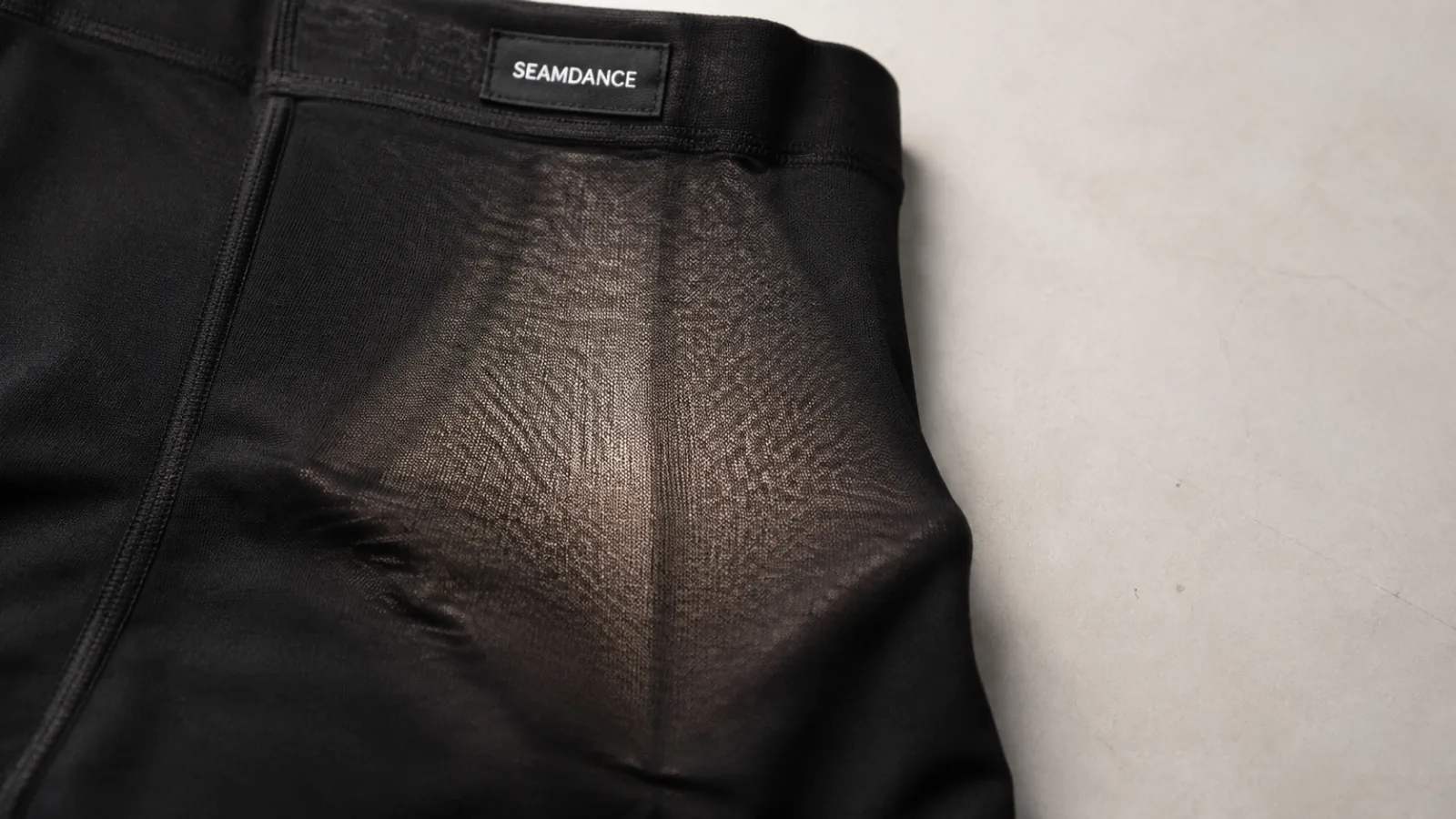
Almost every brand that has launched leggings has had the message: someone bought a pair, wore them to a class, and found out in a mirror that they were transparent in the seat. It is one of the few product failures that generates returns, screenshots and lost trust at the same time, and it is almost always avoidable. The reason it keeps happening is that opacity is treated as a property of the fabric roll, when it is really a property of the fabric under load, in a particular colour, on a particular body. Those are different things, and only one of them can be checked on a table.
The short answer
- Opacity fails under stretch, not at rest. A fabric that looks solid on a table can whiten and thin at the seat once it is stretched over a body, because stretching pulls the loops apart and reduces the amount of yarn blocking light.
- Fabric weight alone does not decide it. Knit density, yarn fineness, colour depth, dye penetration and finishing all matter, which is why two fabrics at the same GSM can behave completely differently in a squat.
- Light and bright colours fail first. There is less pigment blocking light, and any unevenness in dye penetration shows immediately, which is why a style can pass in black and fail in the same fabric in grey or pastel.
- It has to be specified as a condition, not a wish. "Must pass a squat test in the lightest colourway under overhead light" is a specification a mill can quote against; "squat-proof" on its own is not.
Opacity is a property of the fabric under load
Knitted fabric works because its loops can move. When a legging is pulled over a thigh and then a wearer squats, the fabric at the seat and the knee is stretched in two directions at once, and every loop opens. The same square centimetre that had a dense mesh of yarn across it now has less yarn spread over more area, so more light passes through. That is the entire mechanism. It is not a defect in the sense of something going wrong; it is the normal behaviour of a knit, and the job of the specification is to make sure the fabric still blocks light when it happens.
This is why the table test fools people. Fabric held flat and inspected against a light looks reassuringly solid, and the buyer signs it off. The garment is then cut, sewn, worn and stretched somewhere between twenty and forty per cent, and the property everyone approved no longer applies. Any opacity check that does not involve stretching the fabric to the extent the garment will actually see is measuring something that will not happen in use.
Why GSM is necessary but not sufficient
Fabric weight is the number everyone reaches for, and it is genuinely useful: heavier fabric generally has more yarn per unit area, and more yarn blocks more light. Most legging fabrics sit in the commonly cited 220–320 GSM band, and moving up that band usually helps. But weight is an outcome, not a cause, and two fabrics can arrive at the same weight by very different routes — one with fine yarn packed densely, another with coarser yarn knitted loosely. The dense one will hold opacity under stretch far better, at identical weight.
The variable that matters more is stitch density: how many courses and wales per unit length the machine put in. A tighter construction has more loops to redistribute when stretched, so the mesh opens less. Ask the mill for the construction and the machine gauge alongside the weight. If a supplier can only tell you the GSM, they are describing the fabric the way a spec sheet describes it rather than the way it behaves.
A useful test of whether a supplier understands this: quote the same target weight to two of them and ask what they would change to improve opacity without adding weight. The one who answers in terms of gauge, yarn denier and finishing is thinking about the fabric. The one who answers by proposing a heavier fabric is guessing.
None of this is measurable until you attach methods to it. Stretch and recovery on the knit are measured to ASTM D2594 [2]; surface break-up that turns a smooth face fuzzy is measured to ASTM D3512 [3]; fabric strength under load is ASTM D5034 [4]; colourfastness and dimensional change after wash run against AATCC methods, which the association describes as international standards cited in government, industry and individual company specifications worldwide [1]. Laboratories that take part in AATCC proficiency programmes are demonstrating that their readings line up with everyone else's [9] — worth asking when two labs disagree about your fabric.
The four fabric variables behind opacity, and how each is pinned down
| Variable | What it does to opacity | How to write it so it can be quoted and tested |
|---|---|---|
| Fabric weight | More yarn per unit area generally blocks more light, but weight alone does not decide it | State a target weight in g/m² with a tolerance, and never as the only opacity requirement |
| Stitch density | A tighter construction leaves smaller gaps when the loops open under load | State courses and wales per unit length, not just weight |
| Elastane share and stretch behaviour | How far the fabric opens before it stops is what exposes the gaps | Specify stretch and growth to ASTM D2594 [2] at the extension your wearer actually reaches |
| Colour and finish | Dark saturated dyes leave more pigment in the yarn; brushing breaks fibre ends free and thins the face | Approve each colourway separately, and re-check opacity after the finish, not before |
Colour is not a cosmetic decision
The same fabric can pass in black and fail in grey. Dark, saturated dyes leave more pigment in the yarn, and pigment blocks light — so a black legging has an opacity advantage that has nothing to do with the knit. Light, bright and pastel shades have far less pigment to work with, and any unevenness in how the dye penetrated the yarn becomes visible the moment the fabric is stretched thin.
This has a direct practical consequence for how a range is approved. Approving a style in the darkest colourway and assuming the rest will follow is the single most common route to a see-through complaint, because the approval was performed under the easiest possible condition. The colourway that decides whether the fabric is good enough is the lightest one you intend to sell, and it should be the one you test.
It also changes what to do when a light shade fails. The answer is rarely to abandon the colour; it is usually to run that colourway in a slightly denser or heavier version of the same base, or to line the seat panel. Both are ordinary production decisions, and both are far cheaper before bulk than after.
Where brushing, finishing and construction come in
Brushing raises a soft surface by breaking fibre ends free of the yarn structure. It is the thing that makes a fabric feel expensive, and it also, mildly, works against opacity by moving fibre out of the interlocked structure that blocks light. A brushed fabric is not automatically less opaque than a smooth one, but two versions of the same base, one brushed and one not, will not behave identically, and the approval has to be done on the finish you are actually buying.
Construction offers real solutions that specification writers under-use. A gusset in a heavier or doubled fabric puts more material exactly where the stretch is highest. A seat panel with a second layer solves the problem outright at a small cost in weight and price. Seam placement matters too: a seam running through the highest-stretch area concentrates load on either side of it and can make thinning worse than a flat panel would be.
None of these are exotic. They are the ordinary toolkit, and the reason they get skipped is that the opacity requirement was never written down clearly enough for anyone to reach for them.
How to write it so a mill can quote it
"Squat-proof" is not a specification. It has no measurable condition, so a factory cannot price it, and when the finished garment disappoints there is no standard to hold anyone to. What is needed is a stated condition: the garment must show no visible skin tone or lightening at the seat when worn in the correct size and held in a deep squat, in the lightest colourway, under overhead light, photographed from one metre behind. Every part of that sentence removes an argument.
Alongside it, specify the fabric properly: fibre composition and elastane share, target weight, the knit construction, the finish, and whether a lined gusset or seat panel is required. Then require the test to be run on the approved bulk fabric rather than on a sample-room piece, because bulk dyeing is where colour depth and penetration can drift from the lab dip that was approved.
Finally, put the check into the inspection scope so it is not just a development-stage exercise. An opacity condition that exists only in an email disappears the moment the order is being packed.
An opacity clause a mill can actually price
| Element of the clause | What to write | Why this wording |
|---|---|---|
| The condition | Garment on a form or a fitted body, in a stated squat or lunge position, held | Opacity is a property under load; flat on a table it cannot be judged |
| The light | A stated light source and distance, the same one every time | Otherwise two people disagree and neither is wrong |
| The reference | A physical pass and fail sample, sealed with the pre-production sample | Turns a judgement into a comparison |
| The colourways | Every colourway checked, not the darkest one only | The same fabric can pass in black and fail in grey |
| Where it lives | In the inspection scope, not only in the development notes | A condition that is not inspected is not a requirement |
| After wash | Re-checked after the wash cycles your customer will actually run | Finish and hand change, and so does the face of the fabric |
Where SEAMDANCE fits, and what opacity cannot be promised
SEAMDANCE is a gym wear, activewear, yoga wear and sportswear manufacturer in Xiamen, China. With our own factory and a one-stop service, we take a whole range from development to delivery — leggings, sports bras, tops, shorts, sets, seamless styles, jackets and hoodies, swimwear, tennis wear, bags, yoga mats and accessories. One order, one quality standard, one team accountable for all of it. In practice our part of this is matching the requirement to a fabric base and a facility that runs it, then getting a physical answer quickly: stock samples in 3–4 days, custom first samples in about 7, and final inspection to AQL 2.5 before shipment. If a light colourway will not hold up in the base you like, the useful moment to find out is at first sample, not after a launch.
The honest limit is worth stating plainly, because no supplier should promise otherwise: there is no fabric that is opaque at every possible stretch. A legging worn a size too small will thin at the seat regardless of specification, which is a fit and size-advice problem rather than a fabric one. What a specification can do is define the condition the fabric must survive, and make that condition testable before bulk — which is the difference between a product that occasionally disappoints and one that generates returns.
What actually decides whether a legging stays opaque
| Factor | Why it matters | What to ask for |
|---|---|---|
| Stitch density / gauge | More loops means less mesh opening when stretched | Courses and wales per unit, and machine gauge — not weight alone |
| Fabric weight (GSM) | More yarn per area, but reachable by different routes | Target GSM stated on bulk fabric, verified by weighing |
| Yarn denier | Fine yarn packs denser at the same weight | The yarn specification, not only the finished fabric weight |
| Colour depth | Pigment blocks light; pale shades have far less | Approval run on the lightest colourway you will sell |
| Dye penetration | Poorly penetrated dye shows as whitening under stretch | Lab dip against a textile colour reference, then bulk-lot check |
| Finishing | Brushing moves fibre out of the interlocked structure | Approval on the exact finish you are buying, brushed or not |
| Construction | A lined gusset or seat panel adds material where stretch peaks | Specify lining explicitly if the base is borderline |
| Test condition | Opacity only exists relative to a stated condition | Deep squat, correct size, lightest colour, overhead light |
Quick answers
What GSM do I need for squat-proof leggings?
There is no single number that guarantees it. Most legging fabrics sit in the widely cited 220–320 GSM range and heavier generally helps, but knit density, yarn fineness and colour depth change the outcome at identical weight. Specify a weight and a squat-test condition together; the weight alone will not hold anyone to anything.
Why are my light-coloured leggings see-through when the black ones are fine?
Dark dyes leave far more pigment in the yarn, and pigment blocks light. The same fabric in a pale shade has less to work with, and any unevenness in dye penetration becomes visible once the fabric is stretched thin. Approve the range on the lightest colourway, not the darkest.
Can a supplier guarantee leggings will never be see-through?
No, and a supplier who says otherwise is overselling. Every knit thins as it stretches, and a garment worn a size too small will thin at the seat whatever the specification says. What is achievable is a defined condition — squat, correct size, lightest colour, stated lighting — that the fabric must pass before bulk and at inspection.
How do I make an opacity requirement testable rather than an opinion?
Name the position, the light and the reference. A garment on a form in a stated squat position, under a stated light, judged against a sealed pass and fail sample. Then put that check in the inspection scope so it is applied to bulk, not only to the development sample.
Do I need a laboratory for opacity?
Not for opacity itself, which is judged against a physical reference. You do need laboratory methods for the properties underneath it — stretch and growth to ASTM D2594 [2], surface change to ASTM D3512 [3], colourfastness and dimensional change to AATCC methods [1]. If two labs disagree, ask whether they take part in proficiency programmes [9].
Are printed or rainbow leggings more likely to be see-through?
A print adds colour, not cover. Sublimation, a common method for all-over prints on polyester, needs a white or light base, so a rainbow or pastel print sits on the least forgiving ground, and that base can show wherever the fabric stretches most, at the seat and the knees. Treat each print colourway as its own opacity test: stretch it to the extension it reaches in wear, check it in daylight on a fit model, and approve the print only on fabric that has passed.
Sources
- AATCC — Testing & Standards: test methods for textile evaluation
- ASTM D2594 — Standard Test Method for Stretch Properties of Knitted Fabrics Having Low Power
- ASTM D3512 — Standard Test Method for Pilling Resistance and Other Related Surface Changes: Random Tumble Pilling Tester
- ASTM D5034 — Standard Test Method for Breaking Strength and Elongation of Textile Fabrics (Grab Test)
- 16 CFR Part 303 — Rules and Regulations Under the Textile Fiber Products Identification Act (eCFR)
- 16 CFR Part 423 — Care Labeling of Textile Wearing Apparel and Certain Piece Goods (eCFR)
- GINETEX — Care labelling: the five symbols, ISO 3758 and the trademark licence
- OEKO-TEX® STANDARD 100 — what is certified, the four product classes and the one-year certificate
- AATCC — Proficiency Testing Programs
Sourcing styles for your line? The 2026 catalogue lists every ready-to-develop style — colorways, materials, quote list built in.