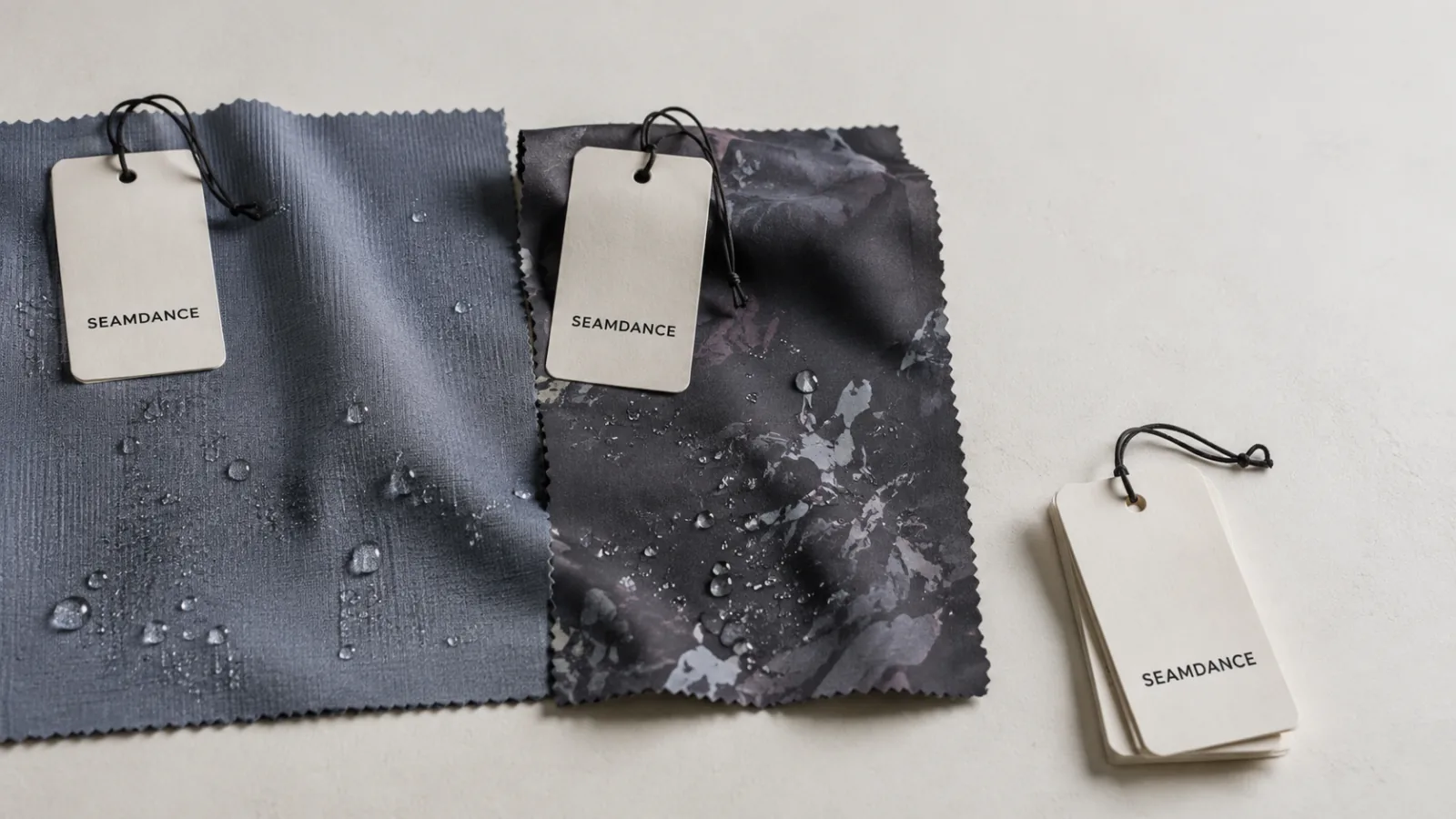
Search 'spandex vs polyester' and you are asking a question no fabric buyer ever faces, because spandex is inside both options. Nearly every performance knit is a body fiber — nylon or polyester — with spandex blended in for stretch. The real decision, the one that shapes hand feel, color, print options and cost across an entire collection, is nylon-spandex versus polyester-spandex. Both are excellent fabrics; neither is the better one. They are different tools with different jobs, and choosing between them by reputation rather than by the garment's job is how brands end up with a printed line on the wrong substrate or a 'buttery' promise the fabric cannot keep. Here is the comparison, property by property.
The short answer
- 'Spandex vs polyester' is a false matchup: spandex is the stretch fiber inside both leading activewear blends. The real sourcing decision is which body fiber carries it — nylon-spandex or polyester-spandex.
- Nylon-spandex is the softer, smoother hand — the fiber base behind most 'buttery' premium leggings — with rich piece-dyed solids and strong abrasion resistance. It is not the usual base for sublimation printing.
- Polyester-spandex wicks and dries faster, resists sun and chlorine better, takes sublimation printing beautifully, and generally costs less — which is why printed training lines and team wear default to it.
- Choose by the garment's job, not fiber reputation: deep solids and a premium hand point to nylon-spandex; all-over print, fast drying and sharper costs point to polyester-spandex. Neither blend is the better fabric.
The question behind the question
Type 'spandex vs polyester' into a search engine and the results compare a stretch fiber with a body fiber — two components that do different jobs and usually share a fabric. Spandex (elastane in European usage) supplies stretch and recovery from inside the knit, typically at 8–30% of the blend. Polyester or nylon supplies everything else: the surface, the hand, the moisture behavior, the color. So the honest version of the question is not whether to use spandex — performance knits nearly always do — but which body fiber should carry it.
That decision — nylon-spandex or polyester-spandex — is one of the highest-leverage calls in activewear development. It reaches into hand feel, drying speed, print options, color depth, durability and fabric cost all at once, and it is hard to reverse after launch because your customers learn a feel and expect it again. The rest of this guide takes the two blends property by property. If you want the deeper background on fiber roles — why spandex is never the majority fiber — that is a separate guide; here we assume the stretch and compare the bodies.
Hand feel: what 'buttery' is actually made of
At equal knit specification, nylon takes a softer, smoother hand than polyester, and hand feel is the property a customer judges before anything else. The 'buttery' association that sells premium leggings is overwhelmingly a nylon-spandex phenomenon: a fine nylon yarn, a dense knit and a light brushing produce the powder-soft touch the word describes. If your brand's promise lives on how the fabric feels in the hand and on the skin, nylon-spandex is the natural starting point.
Polyester has closed much of the gap. Fine-denier polyester yarns with peached finishes can feel genuinely soft, at a lower fabric cost, and for many mid-market lines the difference will not survive a blind test by an average customer. But 'much of the gap' is the honest phrasing: at the premium end, where the customer is paying specifically for hand feel, side-by-side comparison still tends to favor nylon. Feel both as physical samples before deciding — this is not a property to judge from a spec sheet.
Moisture and drying: two kinds of comfortable
Polyester is the more hydrophobic fiber: it absorbs very little moisture, moves sweat along the fiber surface rather than into it, and dries noticeably faster. For high-sweat training, running and anything worn outdoors, that is a genuine advantage — the garment stays lighter when soaked and is ready to wear again sooner. Kit that gets washed after every session collects the same benefit at the laundry end. If the product's life is drenched, polyester-spandex starts ahead.
Nylon absorbs slightly more moisture — a fiber-level fact, not a flaw — and in low-to-moderate sweat settings that works in its favor: the fabric feels less clammy against the skin, which is part of why studio and yoga products lean nylon. Both blends wick and dry well when the knit is engineered for it; construction moves these properties more than most buyers expect. The fiber sets the tendency. The knit decides how far the tendency shows up in the finished garment.
Print and color: the decision that makes itself
If your design language includes all-over prints, the fiber decision is largely made for you. Sublimation — the printing method that fuses disperse dye into the fiber under heat, producing prints that cannot crack or peel — works best on polyester and prints lighter on nylon. Printed training collections, team wear and anything with edge-to-edge graphics are polyester-spandex territory for this reason alone. Trying to force a sublimation-style look onto a nylon base means compromises in every direction.
Solid color runs the other way. Nylon takes acid dyes, and acid-dyed nylon produces the deep, rich, saturated solids that premium studio lines are built on; polyester's disperse dyes are stable and colorfast but read slightly flatter at the deep end of the shade card. So the split is clean: piece-dyed solids at the premium end favor nylon-spandex, printed graphics favor polyester-spandex. Brands that want both usually run both — the same silhouette can exist in a solid nylon version and a printed polyester version.
Durability, pilling and the cost direction
Durability splits by exposure. Nylon is the stronger, more abrasion-resistant fiber for its weight — leggings that live with gym floors, bag straps and daily wash cycles age well on a nylon base. Polyester resists sunlight and chlorine better, which is why outdoor and swim-adjacent products lean its way. Pilling is mostly not a fiber question: yarn quality, knit tightness and finishing decide it, so specify a pilling test on whichever blend you choose rather than assuming either fiber protects you.
On cost, the direction is consistent even though the numbers move with the market: nylon yarn typically costs more than polyester yarn, so at equal weight and construction a nylon-spandex fabric usually quotes higher. That is not a reason to avoid it — the premium end of the market charges for the difference — but it is a reason to compare quotes only at equal specification. A cheaper quote on a lighter or lower-spandex fabric is a different product, not a better price.
Choose by the job — and what the blend cannot fix
The decision rule that survives contact with real collections: choose by the garment's job, not by fiber reputation. A buttery studio legging in deep solids is a nylon-spandex brief. A printed training set that gets soaked and washed constantly is a polyester-spandex brief. A mixed collection is usually both, deliberately, with each style on the base its job demands. Neither fiber is premium in any absolute sense — positioning comes from how well the fabric fits the use, and customers feel that fit faster than they read a label.
Be clear about what the blend choice does not solve. It will not make a legging squat-proof — opacity comes from knit density and color depth, and both blends can pass or fail. It will not guarantee recovery after a season of washing; that is spandex grade and knit quality. And it does not choose a mill for you: the same nominal blend comes off different machines as a noticeably different fabric. The fiber decision narrows the field. Sampling, wash testing and inspection do the rest.
The next step is to match the fabric to the production route. SEAMDANCE is a gym wear, activewear, yoga wear and sportswear manufacturer in Xiamen, China. With our own factory and a one-stop service, we take a whole range from development to delivery — leggings, sports bras, tops, shorts, sets, seamless styles, jackets and hoodies, swimwear, tennis wear, bags, yoga mats and accessories. One order, one quality standard, one team accountable for all of it. Certificates are provided for the order by the factory or mill that holds them; we verify the holder, scope and validity before the order is placed. No certification is claimed for SEAMDANCE or its own factory. In practice that means reviewing the fabric and construction for the factory making the category — our own or a partner — then moving fast on physical proof: quotes within 24 hours, stock samples in 3–4 days, a custom first sample in around 7 days, MOQ from 100 pieces on stock programs and 300–500 for custom, with final inspection to AQL 2.5. What no partner can offer is an exemption from the trade-offs above — nylon will not sublimate for anyone.
Nylon-spandex vs polyester-spandex at a glance
| Property | Nylon-spandex | Polyester-spandex |
|---|---|---|
| Hand feel | Softer, smoother at equal spec — the 'buttery' association | Crisper; fine-denier yarns and peaching close much of the gap |
| Moisture | Absorbs slightly more; feels less clammy in studio settings | More hydrophobic; wicks along the fiber and holds less water |
| Drying speed | Slower | Faster — the choice for soaked, wash-often products |
| Printing | Usually piece-dyed; sublimation prints lighter | Takes sublimation — the substrate for all-over print |
| Color | Acid dyes; deep, rich, saturated solids | Disperse dyes; stable, colorfast, slightly flatter deep shades |
| Durability | Higher abrasion resistance for its weight | Better resistance to sunlight and chlorine |
| Pilling | Decided by yarn quality, knit and finishing — specify a test | Same — the fiber choice does not protect you |
| Cost direction | Nylon yarn typically costs more; quotes usually higher at equal spec | Generally the lower-cost base at equal spec |
| Typical home | Premium studio and yoga lines, deep piece-dyed solids | Printed training, team wear, outdoor and high-sweat use |
Quick answers
Is nylon-spandex better than polyester-spandex?
Neither is better; they are tuned for different jobs. Nylon-spandex wins on hand feel, deep solid color and abrasion resistance — the premium studio brief. Polyester-spandex wins on drying speed, print capability, sun and chlorine resistance and cost. Judge each against the garment's job, not against each other in the abstract.
Can you print on nylon-spandex fabric?
Sublimation printing works best on polyester and prints lighter on nylon, so all-over printed programs usually run on polyester-spandex. Nylon-spandex carries color as deep piece-dyed solids instead. If a collection needs both looks, the practical answer is two fabrics — a solid nylon base and a printed polyester base — rather than forcing one fiber to do both jobs.
Which blend lasts longer?
It depends on what the garment is exposed to. Abrasion and wash-cycle wear favor nylon; sunlight and chlorine favor polyester. Recovery over time — the usual way leggings actually wear out — is decided by spandex grade and knit quality, which is not a body-fiber question at all.
How do I compare pilling and abrasion between nylon-spandex and polyester-spandex fabrics?
Test both candidate fabrics side by side, and read the results within their limits. Ask for Martindale abrasion to ASTM D4966 and random-tumble pilling to ASTM D3512, which grades fabric from 5 (no pilling) to 1 (very severe) [2]. Read the results as a comparison: D4966 says lab abrasion should not predict wear life in a specific use without data linking the two, D3512 notes that real-world pilling varies more with use and wearer than between lab specimens, and neither is recommended for acceptance testing [1][2].
Polyester vs spandex: what is the difference, and why do blends use both?
They are different fiber classes. Polyester's legal definition is purely chemical, an ester-based polymer, and says nothing about stretch [3]. Spandex, called elastane in the EU, is defined by chemistry and behavior: at least 85% segmented polyurethane that springs back quickly and largely to its original length after being stretched to three times that length [4]. A stretch polyester fabric therefore needs spandex, or an elastic polyester type that US rules call elasterell-p, which must recover quickly after being stretched by at least 100% [3].
How do nylon, polyester and spandex differ inside one garment?
Each can do a different job in a different part. A sports bra, for example, may pair a nylon-spandex outer fabric with a polyester-spandex lining: two body fibers chosen per component, with spandex supplying stretch in both. In the EU, each component with a different fiber content needs its own composition on the label, unless it is not a main lining and weighs under 30% of the product [4]. Within each composition, fibers are listed by weight, largest first, in both the EU and the US [4][5].
Sources
- ASTM International — D4966-22 Standard Test Method for Abrasion Resistance of Textile Fabrics (Martindale Abrasion Tester Method) (scope, precision and the limits of predicting wear life; checked 27 September 2026)
- ASTM International — D3512/D3512M-22 Standard Test Method for Pilling Resistance and Other Related Surface Changes of Textile Fabrics: Random Tumble Pilling Tester (rating scale, precision and real-wear caveat; checked 27 September 2026)
- Legal Information Institute, Cornell Law School — 16 CFR 303.7, Generic names and definitions for manufactured fibers (US definitions of polyester, its elasterell-p subclass, and spandex; checked 27 September 2026)
- Publications Office of the EU — Regulation (EU) No 1007/2011 on textile fibre names and related labelling, OJ L 272, 18.10.2011 (Annex I definition of elastane; Articles 9 and 11 on fiber order and multi-component products; checked 27 September 2026)
- Legal Information Institute, Cornell Law School — 16 CFR 303.16, Arrangement and form of required information (fibers listed by weight in order of predominance; checked 27 September 2026)
Sourcing styles for your line? The 2026 catalogue lists every ready-to-develop style — colorways, materials, quote list built in.