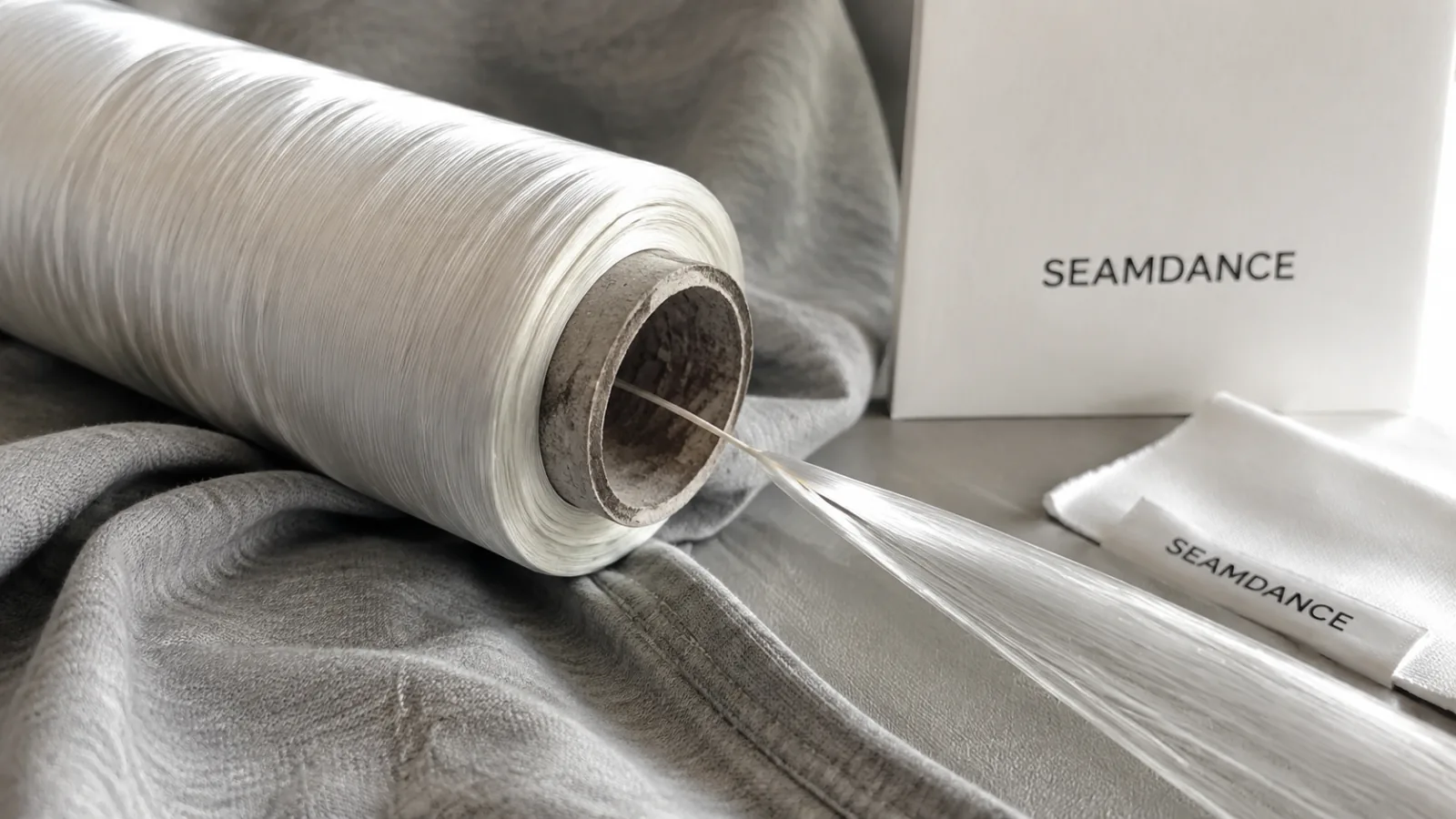
Nylon and spandex are not alternatives, and spandex is not a kind of nylon: a nylon/elastane activewear fabric uses both, for different jobs. Nylon is the body of the fabric — the fiber you touch, the surface that takes the dye and the wear. Spandex is the stretch component blended into it, usually somewhere between 8% and 30% of the knit. They are not competitors; they are colleagues with different jobs. The same is true of 'elastane vs nylon', because elastane and spandex are the same fiber under two naming conventions. This guide explains what each fiber actually does, why neither works alone, and what a blend ratio genuinely tells a buyer.
The short answer
- Nylon vs spandex is not a choice a buyer ever makes. Nylon is the body fiber — the surface, the hand feel, the durability. Spandex is the stretch fiber blended into it. Nearly every legging contains both.
- Spandex and elastane are the same fiber under two naming conventions — spandex in North American usage, elastane in European usage and on EU labels. A search for 'elastane vs nylon' is comparing the same pair.
- Typical activewear blends run 8–30% spandex, with around 20–25% common for compression-weight leggings. More spandex means more compression and a higher fabric cost — not automatically a better garment.
- Breathability is not decided by the nylon–spandex pairing. Knit construction and fabric weight matter more than fiber content, and the nylon–spandex knits used in activewear are engineered to wick moisture and dry.
Two fibers, one fabric: why this is not a versus
Composition labels read like ingredient lists, and 'nylon/spandex' looks like a compromise between two options. It is a division of labor. Nylon — polyamide on European labels — is the majority fiber: it forms the surface you touch, carries the color, takes the abrasion and does the moisture work. Spandex is the minority fiber knitted alongside it, and it does one job only: stretch and snap back. Searching 'nylon vs spandex' is like comparing flour with yeast. Nobody chooses between them; every recipe that works uses both in proportion.
The naming adds confusion the fiber does not deserve. Spandex and elastane are one fiber with two generic names — spandex in North American usage, elastane in Europe and on EU care labels. Lycra is the best-known brand name for it: a brand of the fiber, not a separate material. So 'elastane vs nylon' asks the same question as 'spandex vs nylon', and both have the same answer — the two fibers are blended together, not chosen between. When this guide says spandex, read elastane freely; nothing else changes.
What nylon contributes: surface, strength and comfort
Nylon is what your customer feels. At equal knit spec it takes a softer, smoother hand than polyester, which is why the premium end of the legging market leans so heavily on nylon blends. It is also a genuinely tough fiber — high abrasion resistance for its weight — so a nylon-bodied legging survives wash cycles, gym floors and bag straps well. The body fiber decides how the fabric ages, because it is the fiber on the surface taking the friction.
Moisture behavior is quieter but real. Nylon absorbs slightly more moisture than polyester — a qualitative difference, not a defect — and in low-to-moderate sweat settings that makes it feel less clammy against skin, which suits studio and yoga use. It also dyes richly: acid dyes give nylon deep, saturated solids, one reason 'buttery' premium leggings are usually solid-colored. Everything on this list — hand, wear, moisture, color — is the body fiber's territory. None of it comes from spandex.
What spandex contributes: stretch you can trust to return
Spandex does one thing to an extreme degree: it stretches far beyond what any conventional fiber manages, then snaps back to its original length. Knitted in at a minority share, it lends that behavior to the whole fabric. Stretch is what a shopper notices in the fitting room; recovery is what decides whether the garment still fits months later. A legging that grows at the knees or bags at the waist has a recovery problem, and recovery is spandex's department.
Not all spandex behaves alike. The fiber is sensitive to heat, chlorine and repeated strain, and cheaper grades lose their snap-back sooner — the fabric measures well off the roll and disappoints after a season of washing. That is why blend percentage alone is a weak quality signal: the grade of the spandex and the quality of the knitting move recovery more than an extra few points of content. The practical protection is to ask for stretch-and-recovery figures after wash testing, not just on new fabric.
Why there is no such thing as a 100% spandex legging
If spandex delivers the stretch, why not use more of it — or all of it? Because as a surface fiber it fails at everything else. Pure spandex feels rubbery rather than soft, abrades quickly, degrades under heat and sunlight, and is difficult to dye to rich shades. A garment knitted entirely from it would grip like a rubber band and wear like one. Spandex is an engine, not a bodywork material; it is engineered to work from inside a fabric, wrapped in and surrounded by the body fiber.
This is why composition labels never read 100% spandex, and why the search result you were probably looking for does not exist. The commercial question was never nylon or spandex. It is which body fiber should carry the spandex — nylon or polyester — and how much spandex the garment's job requires. The first question is a separate comparison with its own guide; the second is the blend ratio, and it is where a buyer's attention actually pays off.
Reading blend ratios: what 8–30% actually tells you
Activewear blends typically carry between 8% and 30% spandex, with the balance in the body fiber. The low end suits tees, looser tops and layers that need ease rather than hold. As spandex share climbs, the fabric pulls harder against the body: more compression, more sculpting, and — because spandex is the more expensive input — a higher fabric cost. Compression-weight leggings commonly sit around 20–25%. These are industry-standard ranges, not lab values for any specific fabric; treat them as orientation, not specification.
What the percentage does not tell you matters just as much. It says nothing about the grade of spandex used, the knit structure carrying it, or how the fabric recovers after washing — and those three decide whether a legging keeps its shape. Two fabrics with identical labels can behave completely differently on the body. So use the ratio the way it deserves: as a first filter and a cost signal. A higher number means you should expect more compression and a higher price, not automatically a better garment.
What the fiber pair cannot fix — and where a partner fits
Understanding fiber roles will stop you asking the wrong comparison question, but it will not make a fabric decision for you. The label cannot tell you whether a legging passes a squat test — opacity comes from knit density and color depth. It cannot tell you how the fabric recovers after real wash cycles, whether the hand feel matches your positioning, or whether this season's lot matches last season's. Those answers come from testing physical fabric on physical bodies, lot by lot.
A production partner needs to make the material and production route clear. SEAMDANCE is a gym wear, activewear, yoga wear and sportswear manufacturer in Xiamen, China. With our own factory and a one-stop service, we take a whole range from development to delivery — leggings, sports bras, tops, shorts, sets, seamless styles, jackets and hoodies, swimwear, tennis wear, bags, yoga mats and accessories. One order, one quality standard, one team accountable for all of it. Certificates are provided for the order by the factory or mill that holds them; we verify the holder, scope and validity before the order is placed. No certification is claimed for SEAMDANCE or its own factory. What we do is match a brief to a fabric and a facility, move quickly on physical proof — quotes within 24 hours, stock samples in 3–4 days, a custom first sample in around 7 days — and inspect finished goods to AQL 2.5. What no partner can do is make blend percentage substitute for wash testing. The fiber facts in this guide narrow your options; samples decide.
Nylon and spandex: who does which job in the fabric
| What it does | Nylon (body fiber) | Spandex (stretch fiber) |
|---|---|---|
| Role in the blend | The majority fiber — forms the fabric's surface and structure | The minority fiber — adds stretch from inside the knit |
| Typical share | The balance of the blend — everything the spandex is not | Typically 8–30%; around 20–25% in compression-weight leggings |
| Hand feel | Soft, smooth — the fiber your customer actually touches | Rubbery on its own; never worn as a surface fiber |
| Stretch | Modest as a fiber; knit structure adds mechanical give | Extreme elastic stretch — its entire reason for being there |
| Recovery | Cannot pull a stretched fabric back into shape | Snaps back to length; decides whether the garment keeps its fit |
| Durability | Tough and abrasion-resistant; handles wash cycles and friction | Sensitive to heat, chlorine and sunlight; the grade matters |
| Moisture | Absorbs slightly more than polyester; feels less clammy in studio use | No meaningful moisture role at its blend share |
| Color | Acid-dyes to rich, deep, saturated solids | Hard to dye; relies on the body fiber to carry the shade |
| On the label | Listed as nylon or polyamide (PA) | Listed as spandex or elastane — two names, one fiber |
Quick answers
Is nylon and spandex fabric breathable?
Breathability depends more on knit construction and fabric weight than on the fiber pair. The nylon–spandex knits used in activewear are engineered to wick moisture and move heat, and a lighter, more open knit breathes more than a dense compression knit of any composition. Judge the specific fabric, not the label.
Are elastane and spandex the same thing?
Yes — one fiber, two generic names. Spandex is the customary term in North America; elastane is the European term and the word on EU care labels. A composition label using either describes the same stretch fiber.
Does a higher spandex percentage mean a better legging?
No. A higher share means more compression and a higher fabric cost, which is a positioning choice, not a quality upgrade. Recovery after washing — driven by spandex grade and knit quality — separates good leggings from bagging ones, and the percentage does not measure it.
Is spandex a type of nylon, and are nylon and spandex polyester?
No to both: they are three separate generic fibers, each defined by the polymer it is made of. Under US rules nylon is a long-chain synthetic polyamide, polyester is built at least 85% by weight from an aromatic ester such as terephthalate, and spandex is at least 85% segmented polyurethane [1]. The EU list draws the same lines with separate entries for polyamide or nylon, polyester and elastane [2]. A nylon-spandex fabric blends two distinct fibers, and neither of them is polyester.
What is the difference between LYCRA, spandex and elastane?
Spandex and elastane are generic fiber names; LYCRA® is a brand. The LYCRA Company traces the fiber to the 1950s, holds the name as a globally registered trademark and asks that it always be followed by a generic word such as fiber [3][4]. US rules let a fiber trademark appear on a label only alongside the generic name, in lettering of equal size and prominence [5]. The brand also covers LYCRA® T400® fiber, a spandex-free elastomultiester polyester [6]: its EU label name is elastomultiester [2], and US labels call it polyester or elasterell-p [1].
Does nylon-spandex fabric shrink?
It can. Knits containing elastane are less dimensionally stable than knits without it, so mills stretch and heat-set them during finishing to limit shrinkage in later washing; overheating, though, damages some elastane filaments and weakens recovery [7]. To check a fabric, ask for dimensional change after home laundering to AATCC TM135, which measures length and width change across set wash temperatures, agitation cycles and drying procedures [8]. The garment version, TM150, warns that it may not work for some garments made from stretch fabric [9].
Can a label name spandex below 5%, or must it say 'other fibers'?
It can name it. US rules normally group any fiber under 5% of the weight as 'other fiber', but allow it to be named when it clearly serves a defined function, and the rule's own example is a fabric with 4 percent spandex [10]. EU rules require every fiber with its weight percentage in descending order; 'other fibres' is only a fallback for a fiber of up to 5%, or several totaling up to 15%, that cannot easily be stated at manufacture [2].
Sources
- Legal Information Institute, Cornell Law School — 16 CFR 303.7, Generic names and definitions for manufactured fibers (US definitions of nylon, polyester, spandex and the elasterell-p subclass; checked 27 September 2026)
- Publications Office of the EU — Regulation (EU) No 1007/2011 on textile fibre names and related labelling, OJ L 272, 18.10.2011 (Annex I definitions of polyamide or nylon, polyester, elastane and elastomultiester; Article 9 on 'other fibres'; checked 27 September 2026)
- The LYCRA Company — What is LYCRA® fiber? (brand name vs the generic terms spandex and elastane; invention in the 1950s; checked 27 September 2026)
- The LYCRA Company — Trademarks and patents (LYCRA® as a globally registered trademark; required generic word after the mark; checked 27 September 2026)
- Legal Information Institute, Cornell Law School — 16 CFR 303.17, Use of fiber trademarks and generic names on labels (trademark must accompany the generic name in equal type; checked 27 September 2026)
- The LYCRA Company — LYCRA® T400® technology (described as an elastomultiester polyester, elasterell-p fiber, giving spandex-free stretch; checked 27 September 2026)
- Indian Journal of Fibre & Textile Research — Huzaisham, Nasir, Idris & Quintero Rodriguez, 'Heat-setting parameters optimisation of cotton/elastane fabric using response surface methodology', 48 (2023) 27–34 (why elastic knits are heat-set; overheating and elastane recovery; checked 27 September 2026)
- AATCC — TM135-2025, Test Method for Dimensional Changes of Fabrics after Home Laundering (scope; checked 27 September 2026)
- AATCC — TM150-2025, Dimensional Changes of Garments after Home Laundering (scope and stretch-fabric limitation; checked 27 September 2026)
- Legal Information Institute, Cornell Law School — 16 CFR 303.3, Fibers present in amounts of less than 5 percent (the 'other fiber' rule and its spandex example; checked 27 September 2026)
How fibre choice becomes a fabric spec, and how the spec is locked before bulk.
Open the programSourcing styles for your line? The 2026 catalogue lists every ready-to-develop style — colorways, materials, quote list built in.