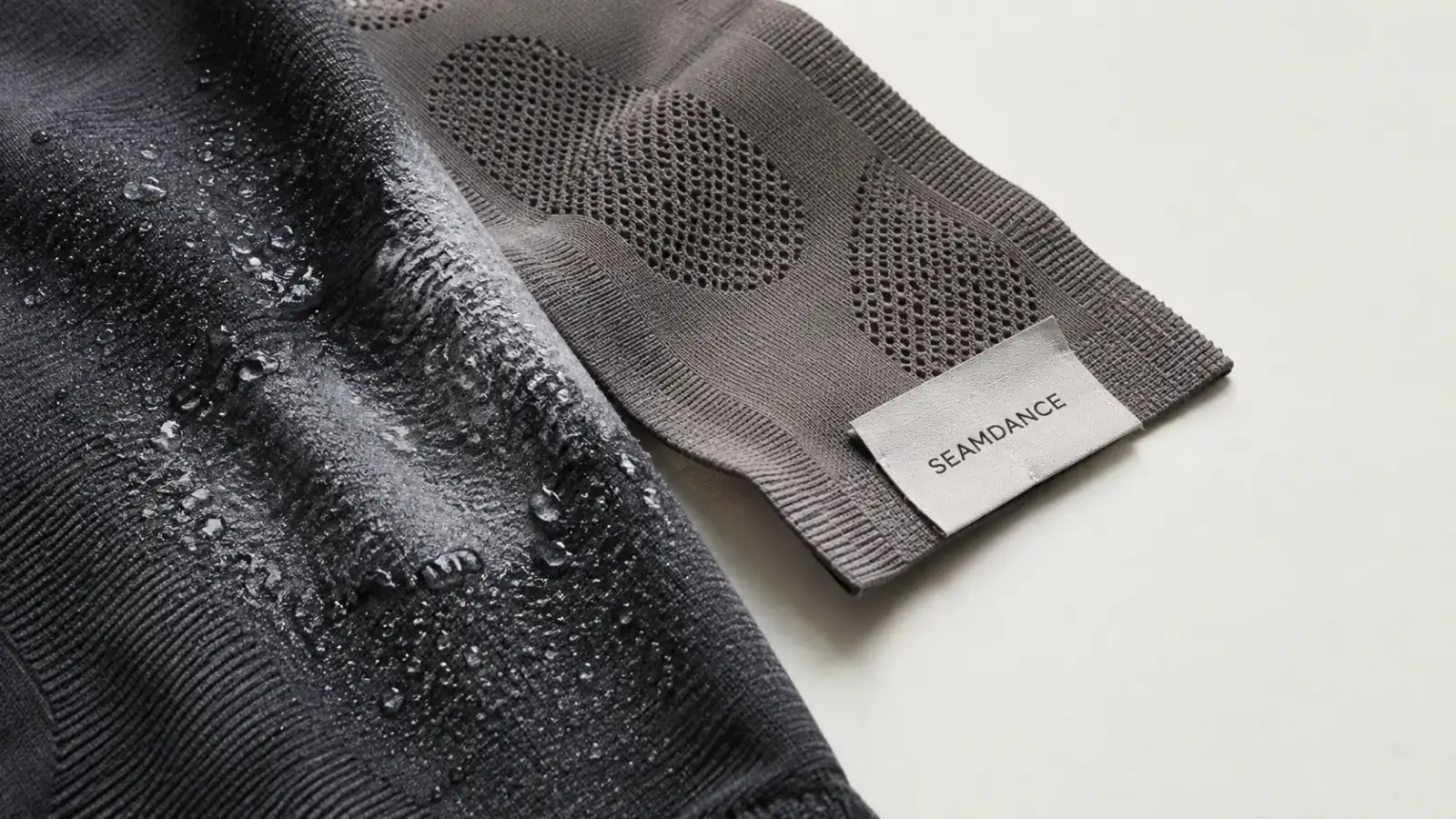
Moisture-wicking, quick-drying and breathable describe different fabric behaviours. Before approving activewear, ask for separate evidence of liquid transport, drying and airflow, with a report tied to the fabric you will actually buy.
The short answer
- Moisture-wicking describes liquid moving along or through a textile by capillary action. It does not, by itself, establish drying speed or airflow. [1]
- For an activewear brief, specify liquid transport, drying and air permeability separately; compare finished fabrics under the same methods and conditions. [2][3]
- A fibre percentage or a demonstration video is not a production-lot test report. Ask which fabric was tested, which finish it carried and whether the result was measured before or after laundering.
What does moisture-wicking mean?
Wicking is liquid movement driven by capillary action along or through a material. In a textile, the paths involve fibres, yarns and the spaces within the construction. Absorbing water, transporting it across a fabric and losing it by evaporation are different behaviours. A demonstration of one does not measure all three. [1][2]
Read a supplier's claim as a question to investigate: does liquid enter the intended skin-facing surface, where does it travel, and what happens next? A spreading drop can be a useful comparison between samples, but the viewing angle, amount of liquid and fabric face all matter. Use a named test method before turning the comparison into a product claim.
Is moisture-wicking the same as breathable or quick-drying?
No. Wicking concerns liquid transport; drying concerns loss of moisture; air permeability concerns airflow through the fabric. “Breathable” is a loose sales term, so ask whether the supplier means airflow or water-vapour transfer. ASTM D737 measures air permeability, not every aspect of wearer comfort. [2][3]
Construction and finishing can change air permeability. A result for one knit cannot be carried across to a denser panel merely because the fibre label is unchanged. For a garment with ventilation zones, identify the main fabric and the mesh separately in the test request. [3]
Which test should an activewear buyer request?
Match the method to the question. AATCC lists different methods for liquid moisture management, vertical wicking and drying. Their names describe different measurements; there is no single interchangeable “wicking score”. The table below is a starting point for a discussion with the testing laboratory, not a replacement for its current method instructions. [2]
Agree the acceptance criterion and the benchmark before testing. Record the method edition, fabric face and direction where relevant, sample identification, preparation and results. Two reports are not a useful comparison if one tests an untreated development swatch and the other tests finished production fabric.
What should the supplier put in the approval file?
Ask for the fabric reference, colour, finished weight, composition, finish identification and the lot or roll reference linked to the report. Add the intended activity and the approved comparison fabric. These fields let the parties check whether the evidence describes the material being bought, rather than a similar item in the mill's collection.
For a wash-durability claim, agree the laundering procedure and checkpoints with the laboratory, then compare the same properties before and after that preparation. Do not assume a finish disappears, or that yarn-based performance lasts indefinitely. Obtain evidence for the actual fabric and care instructions.
At SEAMDANCE, moisture-management targets are set per program brief and verified with fabric test reports during material approval. A buyer should still request the report tied to the proposed material; this guide does not certify a fabric or report a test result for a specific order.
Separate the performance claim from the test request
| Question | Method to discuss with the laboratory | Limit of that evidence |
|---|---|---|
| How does liquid move through the fabric? | AATCC TM195: liquid moisture management [2] | Not a drying or airflow result |
| How quickly does liquid wick vertically? | AATCC TM197: rate to specified distances [2] | Does not establish whole-garment comfort |
| How does it dry under controlled conditions? | AATCC TM201: heated-plate drying [2] | Compare the same method and preparation |
| How readily does air pass through it? | ASTM D737: air permeability [3] | Does not measure liquid transport |
Quick answers
Does moisture-wicking fabric keep you completely dry?
The label alone cannot promise that. Liquid transport, drying, garment design and wearing conditions all matter. Approve a measurable fabric requirement instead of an unconditional comfort claim.
Is polyester automatically moisture-wicking?
A polyester composition label does not establish the finished fabric's measured performance. Check the construction and finish, then compare samples using the same liquid-transport and drying methods.
Is cotton always wrong for activewear?
No. Cotton Incorporated describes cotton technologies designed for moisture management, so a blanket rejection by fibre name is inaccurate. Evaluate the particular fabric and finish for the activity, rather than assuming all cotton or all synthetics behave alike. [4]
Do wicking finishes wash out?
Durability depends on the specific finish and fabric. Ask what treatment was applied and request comparable results before and after an agreed laundering procedure. A claim of lasting performance needs that evidence.
Does an AATCC method number mean the fabric is certified?
No. A method number identifies a way to test a property. You still need the report, the sample identity, the result and your agreed acceptance criterion; citing a method does not establish that an order passed.
Sources
Sourcing styles for your line? The 2026 catalogue lists every ready-to-develop style — colorways, materials, quote list built in.