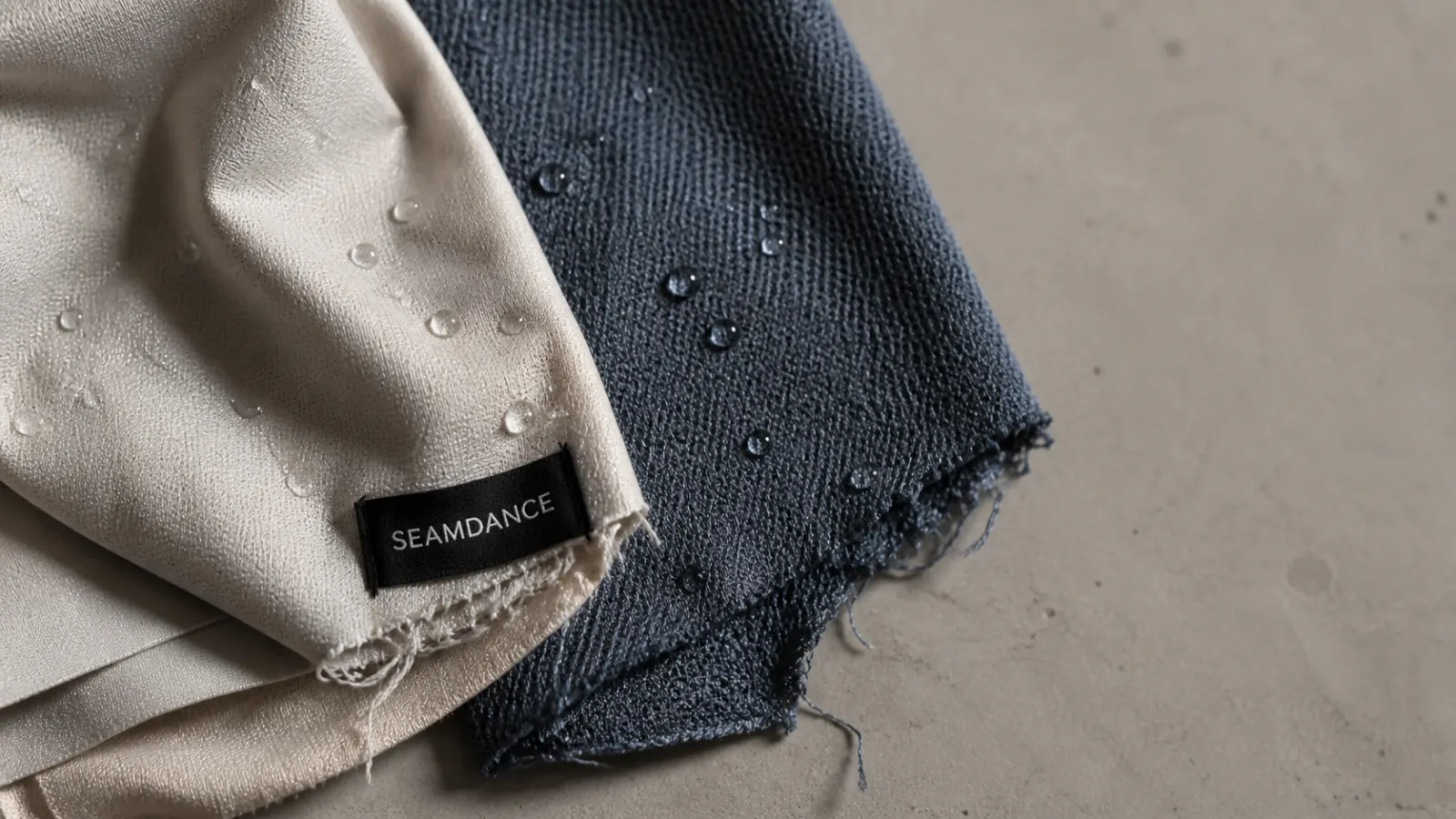
Almost every legging on the market is nylon/spandex or polyester/spandex. Both can be excellent; they are different tools. Fiber choice touches hand feel, color, print, price and sustainability story — here is the practical comparison buyers need.
The short answer
- Neither fiber is better outright. Nylon gives the softer hand and deep solid colors premium studio leggings are built on; polyester is more hydrophobic, the standard substrate for sublimation and all-over print, and generally the lower-cost fiber.
- Fiber facts are fixed by chemistry or law; construction facts such as drying, breathability, abrasion and pilling depend mostly on yarn, knit, weight and finish, so specify and test them on your own fabric rather than assuming them from the label.
- Decide by market: premium studio lines usually mean nylon/spandex with solid dyes and a soft finish, performance training or printed lines polyester/spandex, and mixed collections often run both fibers across styles.
Hand feel and the premium perception
Nylon (polyamide) takes a softer, smoother hand at the same knit spec and is the fiber behind most “buttery” premium leggings. It absorbs slightly more moisture, which paradoxically makes it feel less clammy against skin in studio use.
Polyester has stiffened its reputation unfairly: modern micro-denier polyester with brushing can approach nylon softness at lower cost. But at equal spec, blind hand-feel tests still favor nylon — which is why premium yoga positioning usually means nylon/spandex.
Performance differences that matter
Polyester is more hydrophobic: it wicks and dries faster, holds less water weight, and resists UV and chlorine better — the reason it dominates running, outdoor and swim-adjacent products. Nylon is stronger and more abrasion-resistant per weight, relevant for leggings that survive years of wash cycles.
Color behavior differs fundamentally: polyester disperse-dyes into deep, stable shades and is the standard substrate for sublimation printing. Nylon acid-dyes beautifully but large-scale prints are harder — if all-over print is your design language, that alone may decide the fiber.
What the fiber fixes and what the fabric decides
The table below separates two kinds of statement. Fiber facts are fixed by chemistry or by law and hold for every fabric made from that fiber. Construction facts depend on yarn, knit, weight and finish, so they have to be specified and tested on your own fabric. Where a cell says a property depends on the fabric, treat it as something to test, not something to assume from the label.
Fiber facts and fabric facts, with sources
| Property | Nylon (polyamide) | Polyester | What it means for your fabric |
|---|---|---|---|
| Moisture regain (EU agreed allowance) | 5.75% for filament yarn, 6.25% for staple fiber [1] | 1.50% [1] | Values the law defines as moisture regain, used to calculate label percentages on a clean, dry basis [1]; they are not drying or comfort data |
| Drying | Varies with yarn fineness, knit density, weight and finish | Varies with the same construction choices | A 2024 swimwear study describes both fibers as quick-drying [2]; the rate you actually get is set by the knit |
| Sublimation printing | Printed in a peer-reviewed trial on plain-woven fabric, with wash fastness rated 4/5, in lighter shades than polyester [3] | Same trial: darker prints than on nylon [3] | The trial used plain-woven fabrics without elastane, so run a strike-off on your own stretch fabric |
| Abrasion and pilling | Depends on yarn, knit tightness and finishing | Depends on the same factors; the fiber name guarantees neither | Both fibers are credited with strong resistance to wear and abrasion [2]; confirm with abrasion and pilling tests on the finished fabric |
| Chlorine and sun | All the nylon-elastane swim knits in a 2024 outdoor pool study lost strength along the wale [2] | The single polyester-elastane knit in that study did too [2] | Time in chlorinated water drove the loss: 12.4% after 200 hours, 65.7% after 300; added sunlight made no significant difference [2]. The study tested one polyester knit, so it does not rank the two fibers |
| Odor after wear | Did not differ from polyester in overall odor intensity in a wear trial, though it took up more odorants [4] | Oleophilic: oily odorants wash out less completely than from cotton and build up over wash cycles [5] | Wear-test washed fabric; odor on nylon may rise if worn fabric is stored at room temperature [4] |
Names on the label: nylon, polyamide, polyester, spandex, elastane, LYCRA
Fiber names on a garment label are regulated words, and the rules differ by market. In the United States, the FTC's textile rules at 16 CFR 303.7 set out the generic names nylon, polyester and spandex, each defined by the polymer the fiber is made from, and they also adopt the generic names listed in the international standard ISO 2076:2013 [6].
The EU is stricter about wording. Regulation (EU) No 1007/2011 allows only the names in its Annex I to describe fiber content on labels and markings [1]. Entry 30 is 'polyamide or nylon', so either word is correct; polyester is entry 35; the fiber US rules call spandex, at least 85% segmented polyurethane, is entry 43 under the name elastane [6][1]. The word spandex does not occur in the regulation, so EU labels say elastane. Fibers are listed with their weight percentages in descending order, the composition must be clearly visible before purchase, online sales included, and a manufacturing tolerance of 3% is allowed between the stated composition and a laboratory analysis [1].
LYCRA® is not a fiber name in either system. It is a globally registered trademark of The LYCRA Company, which wants the mark followed every time by a generic term such as fiber or fabric, and which asks brands to sign a trademark license agreement before using its word marks or logos or creating their own hangtags and packaging [7]. Under the EU rules a trademark may sit immediately before or after the fiber composition, but the composition itself must still use the Annex I names [1]. An EU label for a nylon-spandex legging therefore names polyamide (or nylon) and elastane, with any LYCRA® reference placed beside those words rather than in place of them.
Which fiber for which garment
Leggings usually carry the most elastane in a range, and elastane is more sensitive to heat than the polymers around it [2]. Whichever body fiber you choose, agree printing, heat-setting and care-label temperatures with the mill before bulk, and check stretch recovery on a sample that has been through those temperatures, not on fabric straight off the knitting machine.
Running and training shorts are often a light shell over a separate liner, and the two do not need the same fiber. Specify them as two fabrics: the shell for airflow, drying and abrasion, the liner for skin feel and odor. The answer on pants and shorts below covers how to measure airflow.
Pants and joggers see long wear and frequent washing, so abrasion, pilling and dimensional change after laundering come first. The fiber name settles none of these; write them into the test plan for the finished fabric, with extra attention to the seat and inner thigh.
Tops and tees sit over the main sweat zones, where odor matters most. Oily odorants wash out of polyester less completely than out of cotton [5], so wear-test polyester tops on washed fabric and confirm that any odor-control finish still works after laundering.
Swimwear-adjacent pieces, such as swim leggings, rash-guard-style tops and water shorts, meet chlorinated water, which weakened the swim knits in the pool study summarized in the table above [2]. Treat 'pool-safe' as a claim that needs chlorine-resistance and colorfastness results on the finished fabric, whichever fiber carries it.
Spandex content and quality
The stretch fiber (spandex/elastane) typically runs 18–28% in performance leggings. More spandex is not automatically better — quality of the spandex and the knitting matters more than the percentage. Branded spandex (Lycra® and peers) offers more consistent recovery over wash cycles than unbranded equivalents.
Ask for stretch-and-recovery data after wash testing, not off the roll. Fabric that measures well new but bags after twenty washes is a returns problem scheduled in advance.
Cost, sustainability and how to decide
Polyester is generally the more economical fiber and recycled polyester (rPET) is widely available with GRS chains. Recycled nylon exists (including regenerated fishing-net fibers) at a premium and carries a strong story for yoga positioning.
Decide by market: premium studio brand — nylon/spandex, solid dyes, soft finish. Performance training or printed lines — polyester/spandex. Mixed collections often run both fibers across styles; SEAMDANCE matches each fabric to mills within the managed network, and certified recycled options are sourced through GRS-certified partners with certificates shared per project.
Nylon vs polyester at a glance
| Property | Nylon | Polyester |
|---|---|---|
| Hand feel | Softer, smoother at equal knit spec — the premium association | Crisper; fine-denier and brushed versions narrow the gap |
| Moisture | Absorbs slightly more; feels less clammy in studio use | More hydrophobic; wicks and dries faster |
| Durability | Stronger and more abrasion-resistant for its weight | Better resistance to UV and chlorine |
| Color | Acid dyes; deep, rich, saturated solids | Disperse dyes; stable, colorfast shades |
| Printing | Usually piece-dyed; sublimation prints lighter | The substrate for sublimation and all-over print |
| Cost direction | Typically the more expensive yarn | Generally the lower-cost fiber |
| Recycled options | Available at a premium, including regenerated fishing-net sources | Recycled polyester widely available with GRS chains |
| Typical home | Premium studio and yoga, deep solids | Printed training, outdoor, swim-adjacent and high-sweat use |
Quick answers
Which is more squat-proof, nylon or polyester?
Neither inherently. Opacity comes from knit density, yarn fineness and color depth. Both fibers can pass or fail a squat test depending on construction.
Is recycled fabric weaker than virgin?
Good recycled polyester is functionally equivalent for activewear. Recycled nylon varies more by source — test recovery and strength data per lot, and keep certificates traceable.
Is polyester or nylon better for leggings?
Neither is better outright. Nylon-spandex gives the softer hand and deeper solid colors that premium studio leggings are built on, and resists abrasion well. Polyester-spandex dries faster, takes all-over printing and usually costs less. Decide by the legging's job and positioning — then confirm with physical samples, because knit quality moves the result more than the fiber name.
Which is cheaper, nylon or polyester?
Polyester yarn is generally the lower-cost fiber, and nylon typically quotes higher at the same specification. Treat that as a direction rather than a fixed gap: finished fabric prices move with weight, spandex share, finish and quantity, so only compare quotes at equal spec.
Is nylon or polyester better for workout clothes and sportswear?
Neither wins across every sport. One fixed fiber-level difference is moisture: EU labeling law sets the agreed moisture regain of nylon filament at 5.75% and of polyester at 1.50% [1]. In a controlled wear trial, the two did not differ in overall odor intensity [4]. Breathability, drying and durability depend mostly on how the fabric is knitted and finished, so choose per garment, then compare finished fabrics on the properties that sport punishes, not on fiber reputation.
Nylon or polyester pants and shorts: which should I choose?
Choose by what the garment faces rather than by fiber name. For running shorts and warm-weather training pants, airflow matters most. ASTM D737, the air-permeability test for fabrics including knits, notes that construction and finishing can change the result appreciably, and it is considered precise enough between laboratories for acceptance testing of commercial shipments [8]. Add abrasion and pilling checks at the seat and inner thigh, then let print, hand feel and price decide.
Which is more breathable, nylon or polyester?
The evidence points to the fabric, not the fiber. In a 2024 study of nylon and polyester sportswear knits, fabrics made with standard polyester yarn let the most air through in every structure, but they were also the most porous, and across all fabrics air permeability tracked porosity; adding elastane lowered single-jersey air permeability, on average, from 165.88 to 41.90 l/min [9]. For sweat comfort, compare evaporative resistance measured on a sweating hot plate to ASTM F1868 [10].
Which holds odor more, nylon or polyester, and why do synthetic clothes smell?
Neither consistently. In a controlled wear trial, nylon and polyester fabrics did not differ in overall odor intensity; differences seemed to depend on the wearer, although nylon took up more odorants [4]. Clothes smell because skin bacteria turn odorless sweat compounds into volatile ones, commonly short- and medium-chain fatty acids [5]. Oily odorants cling to hydrophobic polyester, so washing removes them less completely than from cotton and they accumulate over cycles [5]. Judge odor on worn, washed fabric.
Is polyamide the same as nylon?
Yes, on a label they name the same fiber. Under US rules nylon is, by definition, a long-chain synthetic polyamide [6], and the EU list has a single entry, 'polyamide or nylon' [1]. The exception is aramid, an aromatic polyamide that both systems list as a separate fiber [6][1]. So 'polyamide vs nylon leggings' compares one fiber under two names, and any difference comes from yarn, knit and finish; 'polyamide vs polyester leggings' is the choice this guide covers.
Are polyester leggings good?
Yes, when the brief suits them: printed, high-sweat, outdoor or value-led lines. A 2024 swimwear study describes polyester, like nylon, as dimensionally stable in water, highly resistant to wear and abrasion, and quick to dry [2]. What separates a good polyester legging from a poor one is the knit, the elastane and the finish rather than the fiber itself, so approve on samples that have been washed and worn, and include odor in that wear test.
Which fiber is better for printed leggings?
It depends on the print. In a peer-reviewed sublimation trial on plain-woven fabrics, polyester gave darker prints and nylon lighter ones, and both were rated 4/5 for wash fastness when pressed at 150 °C or 200 °C [3]. That trial used fabrics without elastane. Leggings contain it, and elastane is more heat-sensitive than the other polymers [2], so approve a strike-off on the actual legging fabric and recheck stretch recovery after pressing.
Sources
- Publications Office of the EU — Regulation (EU) No 1007/2011 on textile fibre names and related labelling, OJ L 272, 18.10.2011 (Article 3 definition of agreed allowance as moisture regain; Articles 5, 9, 16, 19 and 20; Annex I fiber names; Annex IX agreed allowances; checked 27 September 2026)
- Polymers (MDPI) — Potočić Matković, Salopek Čubrić & Krstović, 'The Impact of Chlorinated Water and Sun Exposure on the Durability and Performance of Swimwear Materials', 16(21) 3050, 2024, open access (swim knits tested; breaking-force loss after 200 h and 300 h in chlorinated water; no significant effect of sunlight; checked 27 September 2026)
- European Journal of Science and Technology (DergiPark) — Özomay & Özomay, 'The Effect of Temperature and Time Variables on Printing Quality in Sublimation Transfer Printing on Nylon and Polyester Fabric', no. 23 (2021) 882–891 (sublimation color and wash-fastness results on nylon vs polyester; checked 27 September 2026)
- University of Alberta Education and Research Archive — Abdul-Bari, McQueen et al., 'Synthetic clothing and the problem with odor: Comparison of nylon and polyester fabrics', peer-reviewed version (odor intensity and odorant uptake, nylon vs polyester; checked 27 September 2026)
- University of Alberta Education and Research Archive — Abdul-Bari, McQueen et al., 'Retention and release of odorants in cotton and polyester fabrics following multiple soil/wash procedures', Textile Research Journal 90 (2020) 2212–2222 (how body odor forms; polyester's retention of oily odorants through washing; checked 27 September 2026)
- Legal Information Institute, Cornell Law School — 16 CFR 303.7, Generic names and definitions for manufactured fibers (US definitions of nylon, polyester and spandex; aramid as a separate name; adoption of ISO 2076:2013 names; checked 27 September 2026)
- The LYCRA Company — Trademarks and patents (LYCRA® as a globally registered trademark; usage and license rules; checked 27 September 2026)
- ASTM International — D737-18(2023) Standard Test Method for Air Permeability of Textile Fabrics (scope incl. knitted fabrics; acceptance testing; effect of construction and finishing; checked 27 September 2026)
- Tekstilec (University of Ljubljana) — Salopek Čubrić, Pavko Čuden, Čubrić & Potočić Matković, 'The Comfort of Knitted Materials for Sportswear: A Focus on Air and Water Vapour Permeability', 67(2) 2024, 151–165 (air permeability vs porosity; effect of elastane; checked 27 September 2026)
- ASTM International — F1868-23 Standard Test Method for Thermal Resistance, Evaporative Resistance, and Total Heat Loss Measurements of Clothing Materials Using a Sweating Hot Plate (scope and stated limits; checked 27 September 2026)
Polyester resists chlorine and sun — the reason swim leans the way it does.
Open the programSourcing styles for your line? The 2026 catalogue lists every ready-to-develop style — colorways, materials, quote list built in.