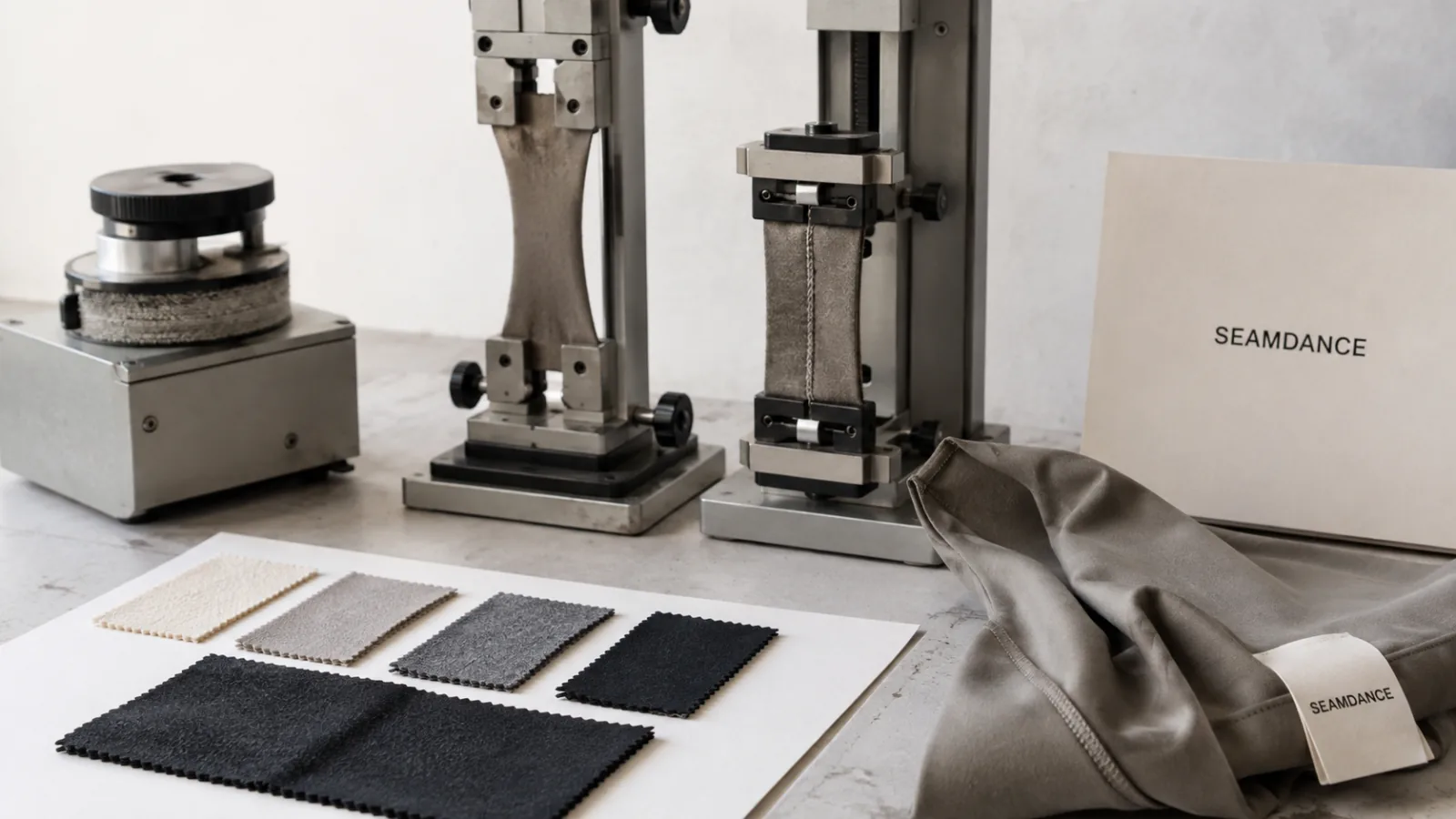
Testing feels like bureaucracy until the first batch of black leggings turns a customer's white sofa grey. Each standard test exists because someone shipped the failure it screens for. Here is the menu, translated, with a sensible minimum panel.
The short answer
- A performance claim with no test method behind it is marketing. The table below maps the claims that appear on activewear spec sheets to the method that tests them, what the result actually says, and who decides the pass mark.
- For most rows there is no industry pass mark. The method gives you a scale; the grade you accept on that scale is a commercial decision that belongs in the order. A supplier who answers “it meets the industry standard” is describing an internal limit, not a published one.
- Check scope as carefully as the number: several methods quoted routinely on activewear specifications are written for woven fabric, and activewear is knitted.
A claim is only as good as the method under it
Every line on an activewear specification sheet is one of two things: a claim someone can check, or a claim nobody can. “High recovery”, “no pilling” and “quick dry” are not claims until a method and a grade sit beside them. Attach a method and the sentence becomes testable; leave it out and it is a mood.
That is also why the same phrase can be honest at one supplier and meaningless at another. The method decides what was measured, the scale decides how the answer is expressed, and the pass mark — the part almost nobody writes down — decides whether the result is acceptable to you. The three are separate decisions, and only the first two are published anywhere.
Which test proves which claim
The table maps claims to methods. Numbers and current designations were checked on 18 September 2026 in the ASTM catalogue, the AATCC list of standard test methods and the ISO Online Browsing Platform; the sources are listed at the end. Where a method is published in parts, the part that applies depends on the equipment and the fibre pair, so the report should name it.
Read the last column first. Where it says Brand, no published document tells you what a good result is — you decide, and you write that decision into the order. Where it says Regulation, the pass mark is set for you and is not negotiable with a supplier.
Which test proves which claim
| Claim on the spec sheet | What is measured | Test method (numbers checked 18 September 2026) | How the result reads | Who sets the pass mark |
|---|---|---|---|---|
| “Does not pill” | Surface pilling after tumbling or rubbing | ASTM D3512/D3512M (random tumble) · ISO 12945 (pilling box, modified Martindale, random tumble) | Visual grade 1–5, where 5 is unchanged | Brand |
| “Hard-wearing” | Abrasion resistance | ASTM D4966 (Martindale) · ISO 12947 | Cycles to a defined end point | Brand |
| “Colour holds in the wash” | Colourfastness to laundering | AATCC TM61 · ISO 105-C06:2010 | Shade change and staining, graded | Brand |
| “Sweat does not mark it” | Colourfastness to perspiration | AATCC TM15 · ISO 105-E04:2013 | Change and staining after an acid or alkaline solution | Brand |
| “No colour transfer” | Colourfastness to crocking (rubbing) | AATCC TM8 · ISO 105-X12:2016 | Separate dry and wet rub grades | Brand |
| “Will not fade outdoors” | Colourfastness to light | AATCC TM16.3 (xenon arc) · ISO 105-B02:2014 | Blue wool reference scale | Brand |
| “Pool safe” | Colourfastness to chlorinated water | AATCC TM162 · ISO 105-E03:2010 | Shade change after chlorinated exposure | Brand |
| “Will not burst” | Bursting strength | ASTM D3786 (diaphragm) · ISO 13938-1:2019 and ISO 13938-2:2019 | Pressure at rupture | Brand |
| “Seams hold” | Seam tensile strength | ISO 13935-1:2014 (strip) · ISO 13935-2:2026 (grab) | Force at seam rupture | Brand |
| “Seams do not open up” | Seam slippage | ISO 13936 — written for woven fabrics (see the scope table below) | Slippage distance | Brand |
| “Four-way stretch, springs back” | Stretch and recovery | ASTM D6614 (constant rate of extension) · ASTM D2594 (knits of low power only) | Elongation, and residual extension after relaxation | Brand |
| “Breathable” | Air permeability | ASTM D737 · ISO 9237:1995 | Air flow through unit area at a stated pressure drop | Brand |
| “Moisture wicking” | Liquid moisture management | AATCC TM195 | A composite grade built from wetting, spreading and one-way transport | Brand |
| “Quick dry” | Drying time or drying rate | AATCC TM199 (moisture analyser) · AATCC TM201 (heated plate) | Time to dry, or rate of drying | Brand |
| “UPF 50+” | Ultraviolet radiation transmitted through the fabric | AATCC TM183 | A UPF value calculated from transmittance | The labelling rule of the destination market |
| “Water repellent” | Surface wetting under a spray | AATCC TM22 · ISO 4920:2012 | A spray rating against reference images | Brand |
| “True to size after washing” | Dimensional change | AATCC TM135 · ISO 6330:2021 washing procedures with ISO 5077:2007 | Change in length and in width, stated separately | Brand |
| “Legs do not twist” | Skew change after home laundering | AATCC TM179 | Skew relative to fabric width | Brand |
| “Skin-safe pH” | pH of the aqueous extract | ISO 3071:2020 | A pH value | Regulation, or the certification scheme you joined |
| “Formaldehyde free” | Free and hydrolysed formaldehyde | ISO 14184-1:2011 | Milligrams per kilogram of fabric | Regulation or certification scheme |
| “No banned azo dyes” | Arylamines released by azo colourants | ISO 14362-1:2017 | Milligrams per kilogram, listed per amine | Regulation |
| “Fabric weight as specified” | Mass per unit area | ASTM D3776/D3776M | Grams per square metre | Your own specification sheet |
| “Fibre content as labelled” | Quantitative chemical analysis of the blend | ISO 1833 series, the part matching the fibre pair | Share of each fibre by mass | Label law in the destination market |
| “Meets US flammability rules” | Flammability of clothing textiles | 16 CFR Part 1610 | Class 1, Class 2 or Class 3 | Regulation |
Scope errors are more common than wrong numbers
A wrong standard number is easy to catch: a laboratory spots it immediately. A standard quoted outside its own scope survives much longer, because every part of the sentence looks professional. The five below turn up regularly on activewear specifications and none of them means what a knit buyer assumes.
The pattern is the same each time: the method was written for woven fabric, or for a narrow class of knit, and was then adopted into a specification template for garments it was never meant to cover. A result produced that way is not fraudulent, it is simply about something other than your product.
Five methods that do not mean what a knit buyer assumes
| Method as quoted | What the official title or scope says | Why that matters for knit activewear | What to specify instead |
|---|---|---|---|
| ISO 3801 | Textiles — Woven fabrics — Determination of mass per unit length and mass per unit area | A GSM figure for a knit written to this method sits outside the method's own scope | ASTM D3776/D3776M, which covers fabric generally |
| ASTM D1683 | Failure in Sewn Seams of Woven Apparel Fabrics | Legging, bra and short seams are knit; the woven method is the wrong instrument for them | ISO 13935-1 or ISO 13935-2, with the seam type named |
| ISO 13936 | Slippage resistance of yarns at a seam in woven fabrics | Knit seams fail by rupture and by stretch fatigue, not by yarn slippage | Seam tensile strength, plus a stretch cycle run on the actual seam |
| ASTM D2594 | Stretch Properties of Knitted Fabrics Having Low Power | Elastane performance knits are usually not low-power fabrics | ASTM D6614, stating the extension and the number of cycles |
| AATCC 16 | Light fastness is published as numbered parts; xenon arc is TM16.3 | A report citing plain AATCC 16 does not say which light source was used | AATCC TM16.3 where a xenon-arc result is meant |
Colorfastness: the reputation tests
Colorfastness to washing (does the color survive laundry), to rubbing/crocking (does color transfer dry or wet — the sofa test), to perspiration (sweat plus dye chemistry) and to light for outdoor-worn pieces. Deep shades on high-spandex knits are the risk zone, black and burgundy especially.
These are cheap, fast lab tests graded on simple scales. Specify minimum grades in the fabric approval, and re-test when a dye house or a recipe changes — not just once at development.
Mechanical durability
Pilling resistance (Martindale or ICI box) for brushed and soft-hand surfaces; bursting or seam strength where stretch garments are stressed (gusset joins, bra band anchors); abrasion where straps and bags rub. Snagging tests matter for open-structure and seamless jacquard fabrics.
Garment-level checks complement fabric tests: seam slippage and stitch security on flatlock joins under stretch — a seam that survives being sewn is not automatically a seam that survives a squat.
Dimensional stability and appearance after wash
Shrinkage testing (dimensional change after standard wash cycles) protects your size chart: a legging that shrinks 5% in length has quietly changed size. Appearance-after-wash catches twisting legs, waving hems and surface change.
For stretch garments, add recovery-after-wash — covered in our stretch and recovery guide — because spandex ages with heat and detergent. Wash tests are the cheapest simulation of your customer's first month.
Three things that matter more than choosing the right test
First, a report without batch identification proves that some fabric passed, not that your fabric passed. Ask for lot or roll numbers on the report, and for the report to be issued against the production lot rather than a development sample kept in a drawer.
Second, there is no industry pass mark for most performance properties. When a supplier says a fabric “reaches the industry standard”, ask which standard and which grade on its scale. The question is not aggressive; it is the only way the sentence can be checked, and the answer is usually an internal limit that has never been written down.
Third, regulatory limits and commercial limits are different animals. Azo colourants, formaldehyde, pH and flammability carry limits set by law or by a certification scheme you joined. Pilling, abrasion, recovery and colourfastness carry limits set by you. Treating the second group as though someone else had already decided is how a programme ends up with no specification at all.
What a usable report looks like
Reports are read carefully exactly once: when something has gone wrong and somebody has to pay for it. At that moment the useful report is the one that ties a method, an edition, a laboratory and a lot number together. Everything else is a PDF.
Build the requirement into the order rather than requesting it afterwards. A laboratory can add lot identification and per-direction results before the test; it cannot add them to a report that has already been issued.
What makes a report usable when a shipment is disputed
| Element on the report | Why it decides whether the report is evidence |
|---|---|
| Laboratory name and accreditation scope | An accredited laboratory is accountable for the method it signs off |
| Sample identification with lot or roll numbers | Ties the result to the goods you are buying rather than to a sample |
| Method number with its edition or year | Methods get revised; results compare only inside one edition |
| Conditioning and number of specimens | Textile results move with humidity and with specimen count |
| A result for each direction | Knits behave differently lengthwise and widthwise; one figure hides that |
| Test date and issue date | Separates a current result from one archived two seasons ago |
A sensible minimum panel
For a typical legging program: colorfastness to wash and rub, pilling on brushed faces, stretch and growth (washed), shrinkage, plus fiber-content verification for the label. Bras add strap and band strength; swim adds chlorine and seawater fastness; kids' products add regulatory chemical testing per destination market.
At SEAMDANCE, the test panel is agreed at material approval and reports are filed with the program documents — so claims on your labels, from fiber content to care instructions, trace to a report rather than a hope. Chemical-safety coverage (e.g. OEKO-TEX®) rides with the certified partner mills we match per project.
What to write into the order, so a report can settle an argument
| Line in the order | Example wording | What it prevents |
|---|---|---|
| Method and edition | “Colourfastness to laundering: AATCC TM61, test number stated on the report” | Two laboratories running different conditions and both being right |
| Pass mark in the method's own scale | “Shade change grade 4 or better, staining grade 3–4 or better” | “Meets the industry standard”, which is not a number anyone can check |
| Where the specimen comes from | “Dimensional change measured on finished garments, not on the roll” | A fabric result the finished garment never had to meet |
| Batch identification | “The report shall name the lot or roll numbers tested” | Proof that some fabric passed, rather than that yours did |
| Re-test triggers | “Re-test on any change of mill, dye house, recipe or yarn supplier” | A quiet substitution between your first order and your third |
| Cost and consequence | “Re-test and sorting costs on a failed lot are the supplier's” | The commercial negotiation starting after the goods are made |
Quick answers
Who pays for testing?
Practice varies: standard mill tests often come with the fabric; program-specific panels are usually a modest buyer cost folded into development. Either way, insist on seeing actual reports with lab names and dates.
How often should tests repeat?
At development, at any change of mill, dye house or recipe, and periodically on long-running programs — annually is a common rhythm, plus per-lot color checks on sensitive shades.
Should I run every test in the table?
No. Choose by what the garment will actually meet: chlorinated-water fastness for swim, light fastness and UV for outdoor, perspiration and pH for skin contact, stretch and recovery for compression. A panel that tests everything once is usually worse value than a short panel repeated at every change of mill, dye house or recipe.
The supplier says the fabric meets the industry standard. What should I ask?
Ask which method, which edition, and which grade on that method's own scale — for example a shade-change grade on AATCC TM61 rather than the word good. Often no answer comes back, because the phrase describes an internal limit rather than a published one.
Can I compare an AATCC result with an ISO result?
Not directly. The conditions differ and the scales are not interchangeable. Pick one system per product line and stay with it, so that the second batch can be compared with the first.
Why does this table not give pass values?
Because for most rows there is no published pass value to give. The pass mark is set by the brand and written into the order. Printing a number here would invent a standard that any laboratory could contradict in a sentence.
Is the mill's own report enough, or do I need a third party?
For a first order, a new mill or a claim you print on the product, use an independent laboratory — the point of an outside report is that it holds up in a dispute. On a running programme with a clean history, mill reports plus periodic third-party checks are a reasonable rhythm.
What makes a test report usable if we end up arguing about a shipment?
Lot or roll identification, the method with its edition, the laboratory's accreditation, the conditioning and specimen count, and a result for each direction. A report missing lot numbers cannot be tied to the goods in front of you.
Why does third-party testing matter?
An independent laboratory's report is evidence you can show a retailer, a regulator or a supplier in a dispute without relying on the seller's word. In the US it is compulsory for children's products, which must be tested by a CPSC-accepted third-party laboratory [13]. For adult activewear it is not required: a General Certificate of Conformity can rest on testing or a reasonable testing programme [14]. But a flammability guaranty from a supplier outside the United States cannot be relied on as a bar to prosecution [12].
What is the difference between third-party testing and certification?
A test report records how a sample performed against a stated method on a stated date. Certification is a formal statement that products meet the applicable requirements. In US product-safety law that statement comes from the manufacturer or importer, in a written or electronic certificate based on passing test results [13]; for children's products those tests must come from a CPSC-accepted laboratory [13]. The laboratory tests and the importer certifies. This is general information, not legal advice.
What do activewear testing services cover?
Three kinds of work. Performance testing runs methods like those in the table above: colourfastness, pilling, stretch and recovery, dimensional change. Chemical testing screens restricted substances such as arylamines from azo colourants and formaldehyde. Regulatory testing covers mandatory items such as US clothing flammability and fibre content for the label. When choosing a laboratory, confirm that its accreditation covers the exact method you need and, for US children's products, that CPSC has accepted it for that specific test [15].
How do I arrange third-party testing in China?
Choose a laboratory in China whose accreditation covers the exact methods you need; China's national accreditation body, CNAS, accredits testing laboratories against criteria identical to ISO/IEC 17025 [16]. For US children's products the lab must also be CPSC-accepted for each test: CPSC's lab search filters by testing scope, by country, China included, and by type of body, independent, firewalled or governmental [17]. Book the tests in your own name, sample from the production lot and require lot numbers on the report.
Sources
- ASTM D3512/D3512M — Pilling Resistance and Other Related Surface Changes of Textile Fabrics: Random Tumble Pilling Tester
- ASTM D4966 — Abrasion Resistance of Textile Fabrics (Martindale Abrasion Tester Method)
- ASTM D3786 — Bursting Strength of Textile Fabrics: Diaphragm Bursting Strength Tester Method
- ASTM D1683 — Failure in Sewn Seams of Woven Apparel Fabrics (note the woven scope in its title)
- ASTM D2594 — Stretch Properties of Knitted Fabrics Having Low Power
- ASTM D6614 — Stretch Properties of Textile Fabrics: CRE Method
- ASTM D737 — Air Permeability of Textile Fabrics
- ASTM D3776/D3776M — Mass Per Unit Area (Weight) of Fabric
- AATCC — Standard Test Methods and Procedures, the official list of TM numbers and titles
- ISO Online Browsing Platform — the official ISO catalogue; every ISO designation above was checked here on 18 September 2026
- ISO 3801:1977 — Textiles: Woven fabrics: Determination of mass per unit length and mass per unit area (catalogue entry)
- 16 CFR Part 1610 — Standard for the Flammability of Clothing Textiles (eCFR)
- CPSC — Testing & Certification: certificates based on passing test results; third-party testing by a CPSC-accepted laboratory for children's products
- CPSC — General Certificate of Conformity: based on testing or a reasonable testing program; third-party testing not required for general-use products
- CPSC — Lab Accreditation: laboratories accepted for specific tests, and the search for CPSC-accepted labs
- CNAS, China National Accreditation Service for Conformity Assessment — Accreditation of laboratories: criteria (CNAS-CL01, identical to ISO/IEC 17025:2017)
- U.S. Consumer Product Safety Commission — Search for a CPSC-accepted testing laboratory (filters for testing scope, type of registered body and country or region)
Sourcing styles for your line? The 2026 catalogue lists every ready-to-develop style — colorways, materials, quote list built in.