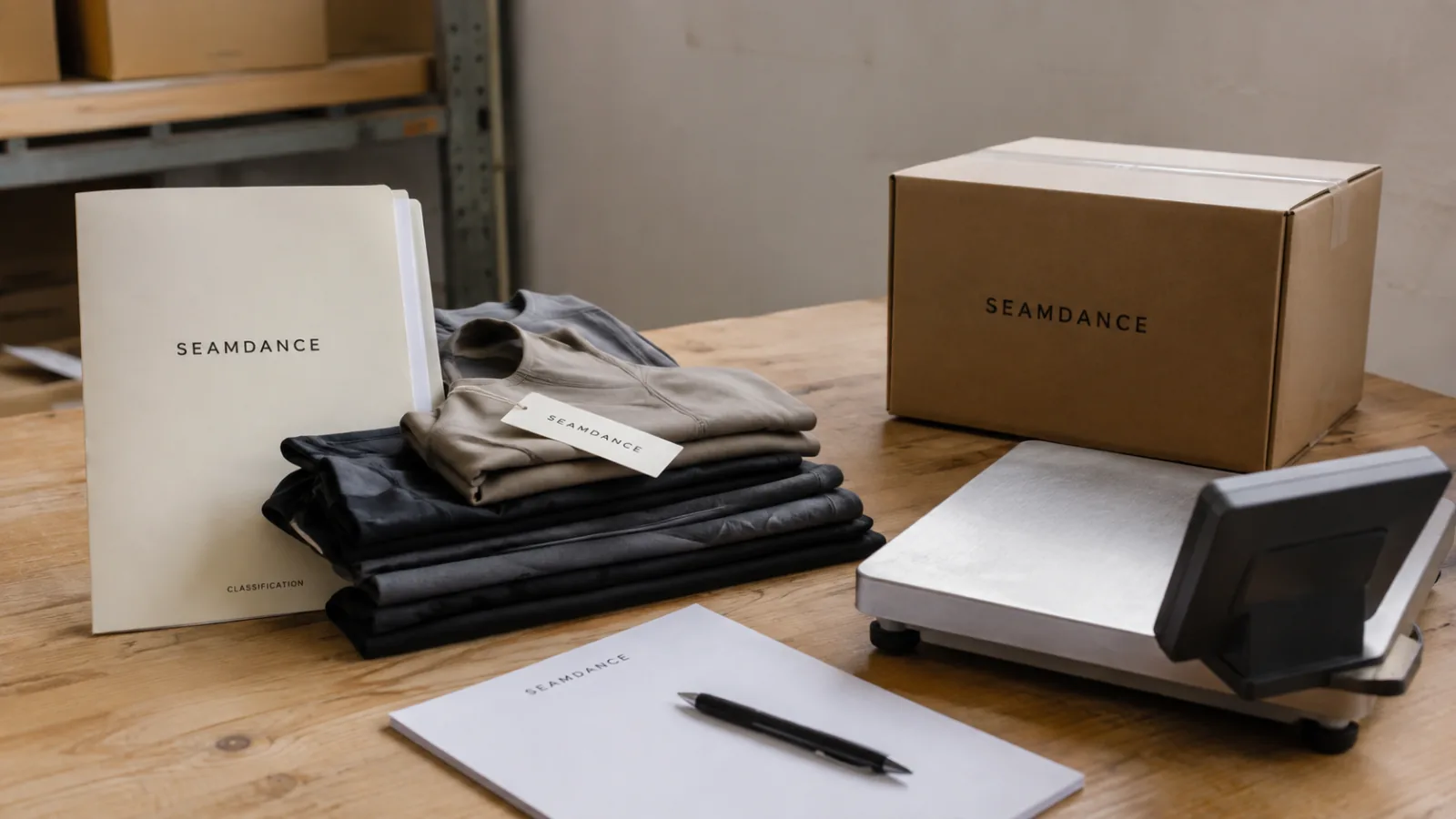
The unit price is not the price. Between the factory invoice and your warehouse sits a stack of duties, fees and freight that varies by product, fiber and destination — knowable in advance, ruinous when discovered late. This is orientation, not legal advice; your customs broker gives the binding answer.
The short answer
- Duty depends on each style's HS code, set by knit or woven, fiber content, gender and garment type, and landed cost adds that duty, freight, insurance and destination fees to the goods. Synthetic knit activewear typically carries double-digit US duty rates.
- Destination fees include brokerage, port and handling charges, possible additional tariffs by origin and, in many markets, import VAT or GST. A rough planning multiplier of 1.2–1.4× ex-factory is common, but verify your own lanes and rates rather than borrowing anyone's number.
- Keep quantities, values and fiber content identical across invoice, packing list and labels, and never undervalue to save duty. The importer of record, normally you, answers for the entry; confirm each classification with your customs broker, who gives the binding answer.
HS codes: the number that sets the rate
Every garment imports under a Harmonized System classification, determined by real attributes: knit vs woven, fiber content, gender, garment type. Duty rates differ meaningfully between codes — synthetic knit activewear typically carries double-digit duty rates in the US, while some destinations and trade agreements sit far lower.
Fiber content drives classification, which is one more reason the label, the invoice and the actual fabric must agree. Misclassification — accidental or 'optimistic' — invites reassessment, penalties and shipment holds.
How the landed cost actually stacks
Landed cost = goods + freight + insurance + duty (calculated on customs value, in the US typically the goods' transaction value) + destination fees: brokerage, port and handling charges, possible additional tariffs by origin, and in many markets import VAT/GST — often reclaimable for registered businesses, but real for cash flow.
Build the model once per product in a spreadsheet: at typical activewear duty rates plus freight and fees, a rough planning multiplier of 1.2–1.4× ex-factory is common — verify your own lanes and rates rather than borrowing anyone's number, including that one.
Paperwork that keeps customs boring
The set: commercial invoice (accurate values and full product descriptions), packing list, bill of lading, and origin documentation where preferences apply. Consistency is the whole art — quantities, values, fiber contents identical across documents and physical labels.
Undervaluing invoices to save duty is the oldest bad idea in importing: penalties, seizure risk, and a poisoned importer record. Brands that intend to scale — or ever be acquired — keep this clean from order one.
Where your supplier helps, and where they cannot
A competent supplier produces clean, consistent export documents, correct labeling (fiber content, origin, care), and consolidated shipments that clear as one entry — SEAMDANCE programs ship with the document set matched to the destination's needs. What a supplier should not be, if you want control of your customs record, is your importer of record: duty planning and final classification live with you and your broker.
The efficient division: we make the paperwork boring, your broker makes the classification binding, and your spreadsheet knows the landed cost before you approve the program — not after the container lands.
Importer of record: who it is and what it answers for
The importer of record (IOR) makes customs entry in its own name and answers for it. US law has the IOR file, with reasonable care, the declared value, classification and rate of duty [3], and treats the duty as the importer's personal debt, which paying a broker does not clear if the broker fails to pay CBP [4]. CBP defines the IOR as the owner or purchaser of the goods, or a licensed customs broker designated by the owner, purchaser or consignee, liable for all duties and import requirements [5].
So the IOR need not own the goods: a designated broker can make entry without title [3]. Nor must it be a US company: a corporation incorporated abroad may enter goods if it has a resident agent authorized to accept service of process in the port's state and a bond backed by a resident corporate surety [4], which is how a foreign seller can deliver duty paid. Whoever makes entry must also show its right to do so, for example as holder of the bill of lading [4].
The IOR is identified by a number filed on CBP Form 5106 with its first formal entry: the IRS employer identification number (EIN), otherwise a Social Security number, otherwise a number CBP assigns [6]. To see who the IOR is on a shipment, ask your broker for the entry summary, CBP Form 7501: it identifies the IOR, the ultimate consignee and any Form 4811 party receiving refunds, and an IOR named on the commercial invoice should match it unless a broker is the IOR [5].
To change the IOR for future shipments, the new party files its own Form 5106 [6] and authorizes a broker in writing [3] before the goods arrive. A consignee that is not the actual owner can also say so on the entry and file the owner's declaration and bond within 90 days, moving liability for increased or additional duties to the owner [4].
Who can act as the US importer of record
| Party | Can it be the IOR? | What it needs, or what to watch |
|---|---|---|
| Your brand, as buyer | Yes, as purchaser or owner [3] | A Form 5106 number, usually your EIN [6], and a broker authorized in writing [3] |
| A foreign brand or seller | Yes, as a nonresident importer | A resident agent for service of process and a bond with a resident corporate surety [4] |
| Licensed customs broker | Only if designated by the owner, purchaser or consignee [3] | May file in your name instead, leaving the duty debt with you [4] |
| Freight forwarder | Only as owner, purchaser or designated licensed broker [3] | Otherwise it arranges transport, not entry |
| Ultimate consignee | Not automatically; it is a separate entry field [5] | The party that bought or received the goods; may also be the IOR [5] |
Incoterms and DDP: who clears the goods, and who is the importer
Incoterms rules never name an importer of record; they set who clears import and pays duty. ICC's decision guide puts import clearance on the buyer under every rule except DDP, and warns that practical realities may stop a DDP seller from handling it [7]. In the US, a foreign DDP seller must meet the nonresident-importer conditions or designate a licensed broker as IOR [3][4]. Export clearance is the seller's job except under EXW [7]; whether a forwarder may be the exporter is for the export country's rules.
DDP shipping from China means the supplier, or a logistics provider it uses, quotes a delivered price with import clearance and duty included [7]. Get in writing whose name and importer number will be on the US entry and who keeps the records: as checked on 22 September 2026, CBP pays IEEPA duty refunds only to the importer of record or a party it designated on Form 4811 [8].
In Canada, the CBSA's importer of record is the party named as importer on the declaration, identified by its nine-digit Canada Revenue Agency business number plus a six-character RM import-export account. A broker may declare its client or itself as IOR; each importation has one IOR, jointly liable for duty with the owner and the importer [9].
Incoterms rule, import clearance and the usual importer of record
| Rule | Import clearance and duty | Who is normally the importer of record |
|---|---|---|
| EXW | Buyer, plus export clearance [7] | You, through your broker |
| FCA, FAS, FOB | Buyer; the seller clears export [7] | You |
| CFR, CIF, CPT, CIP | Buyer; the seller pays main carriage [7] | You, though the seller books freight |
| DAP, DPU | Buyer; the seller delivers to the named place [7] | You, with a broker ready before arrival |
| DDP | Seller, including duty [7] | The seller or its appointee; confirm who in writing |
Customs duty, tariffs and import tax: what each is and how the bill is worked out
Customs duty and import duty are the same tax on imported goods; 'tariff' means the rate schedule, such as the US Harmonized Tariff Schedule [1] or the UK Trade Tariff [2], and loosely the duty itself. Duty raises revenue and serves trade policy; duties from specific trade actions, such as Section 301, sit on top of the base rate under a separate Chapter 99 number [10]. Import VAT or GST is a separate tax on top.
The US working formula is duty = customs value × rate, plus any additional duties. Rates can be free, ad valorem (a percentage of value), specific (per unit) or compound [5]. Customs value is normally the price paid or payable plus packing, selling commissions, assists, royalties and resale proceeds where they apply, excluding international freight and insurance [11]. The entry adds the merchandise processing fee, a percentage of value with a floor and cap subject to annual adjustment, and for sea freight the harbor maintenance fee [6]. CBP sets the final rate; for certainty on a style, request a binding ruling [12]. The UK instead counts freight, insurance and handling to the border in customs value [13] and charges import VAT on customs value plus duty [14].
The importer of record pays, directly to CBP or through its broker [4]. Commercial entries can be paid electronically by ACH through statement processing on CBP's Automated Broker Interface, the method the regulations prefer; card payment is limited to non-commercial entries [6]. A broker's or carrier's disbursement fee for advancing your duty is a private charge, not duty; US rules even let an importer pay a broker's fees and the duties with separate checks [4].
What makes up a US or UK import bill
| Charge | Who charges it | What it is calculated on |
|---|---|---|
| Customs (import) duty | Customs, at the tariff rate [1][2] | Customs value: the US excludes international freight [11], the UK includes it [13] |
| Additional duties, e.g. Section 301 | Customs, under a trade action | The same value, under a separate Chapter 99 number [10] |
| Merchandise processing fee (US) | CBP, with a per-entry floor and cap [5] | A percentage of customs value [6] |
| Harbor maintenance fee (US) | CBP, on sea cargo at listed ports [6] | The value of the cargo unloaded |
| Import VAT (UK) | HM Revenue & Customs | Customs value plus duty and costs to the first UK destination [14] |
| Broker or disbursement fee | Your broker or carrier, privately | Their price list, not a government rate |
Getting duty back: drawback, refunds and bonded warehouses
Duty paid correctly on goods sold in the US stays paid. Drawback refunds certain duties, taxes and fees when imported goods are exported or destroyed [15]. For finished garments, look first at unused merchandise and rejected merchandise drawback; claims are filed in ACE by the claimant or a licensed broker, CBP is notified on Form 7553 before export or destruction, and exports to Canada and Mexico are restricted [15]. Most claims must be filed within five years of import [10].
As checked on 22 September 2026, CBP's trade-remedy drawback FAQ says Section 301 duties are eligible for drawback, and that Section 301 duties paid on products later excluded can be recovered by post-summary correction or, after that window, by protest [10]. CBP was also refunding duties imposed under the International Emergency Economic Powers Act (IEEPA) through a process called CAPE, filed only by the importer of record or its filing broker, with no CBP fee [8].
A bonded warehouse defers duty rather than removing it. Goods can be stored or manipulated there without paying duty for up to five years; duty is paid on withdrawal for consumption, and goods exported instead never pay US duty [16]. Duty is charged at the rate in force on the day of withdrawal [17], so a tariff change while stock waits cuts both ways.
Ways US duty is deferred or returned
| Mechanism | What happens to the duty | When it fits |
|---|---|---|
| Unused or rejected merchandise drawback | Refunded after export or destruction [15] | Unsold stock re-exported, or rejected goods sent back |
| Bonded warehouse | Deferred; none if exported [16] | Stock whose final market is undecided |
| Post-summary correction or protest | Overpayment corrected before or after liquidation [10] | Section 301 duty paid on a product later excluded |
| IEEPA refund process (CAPE) | Refunded to the importer of record [8] | Entries that carried IEEPA duties |
Importing clothing from China: labels, admissibility and the order of work
Clothing can be imported from China commercially; beyond classification and duty, two checks matter before the first order ships. In the US, CBP enforces a rebuttable presumption that goods made wholly or partly in Xinjiang, or by an entity on the UFLPA Entity List, are prohibited [18], so keep records tracing fiber and fabric to source. And labels must meet the destination's rules.
US rules require generic fiber names and percentages by weight, the manufacturer's or handler's name or RN, and the country of origin, placed at the inside center of the neck on garments with one [19], plus a permanent care label legible for the garment's life [20]. The EU's Regulation 1007/2011 requires fiber names and percentages by weight in descending order on a durable label, normally in the language of the country of sale and visible before purchase, online too; the importer answers for it when the manufacturer is outside the EU, and it does not cover care labels [21]. The UK enforces the same regulation under a 2012 statutory instrument that makes breaches an offense [22].
Sourcing from China means finding and qualifying manufacturers, then managing samples, production, inspection and shipping. Suppliers are found on B2B platforms such as Alibaba, at trade fairs, or through a supply-chain company that places each style with a factory in its network; no route is best for every brand, and buying direct leaves checks and inspection to you. The usual case for China is fabric, trim and technical range; the case against is duty exposure and traceability work. Either way: set up the IOR, classify each style, approve labels at sample stage, and agree the Incoterms rule and inspection standard in writing.
Garment label rules by market
| Market | Rule | What the label must carry |
|---|---|---|
| United States | 16 CFR Parts 303 and 423 | Fiber content, RN or name, origin at the neck, permanent care label [19][20] |
| European Union | Regulation (EU) No 1007/2011 | Fiber names and percentages by weight, in the local official language [21] |
| United Kingdom | Textile Products (Labelling and Fibre Composition) Regulations 2012 | The same fiber-labeling rules, with breaches an offense [22] |
Dresses, shirts, kids' and baby clothes: where each sits in the tariff
Importing dresses, shirts or children's clothing from China follows the same order of work as activewear; what changes first is the classification. The six-digit Harmonized System code is shared internationally and underpins national customs tariffs [24], while each market adds its own digits and sets its own rates, so look up the full code and rate in your destination's tariff [1][2]. The first split is construction: knitted or crocheted garments sit in chapter 61, other garments, woven ones included, in chapter 62 [25][26].
Two chapter notes settle many children's and unisex styles. Babies' garments are articles for young children up to 86 cm in body height, and a garment that could also fall under another heading goes to the babies' heading [25][26]. Older children's clothes share the adult headings, boys' with men's and girls' with women's. A garment that closes left over right counts as men's or boys', right over left as women's or girls', unless the cut clearly shows otherwise; one that cannot be identified goes to the women's or girls' heading [25][26].
Common garments and their four-digit HS headings
| Garment | Knitted or crocheted (chapter 61) | Other, including woven (chapter 62) |
|---|---|---|
| Women's or girls' dresses | 6104 | 6204 |
| Men's or boys' shirts | 6105, sleeveless garments excluded | 6205, sleeveless garments excluded |
| Women's or girls' blouses and shirts | 6106 | 6206 |
| Singlets and other vests | 6109, together with T-shirts | 6207 for men's or boys', 6208 for women's or girls' |
| Babies' garments, up to 86 cm body height | 6111 | 6209 |
| Tracksuits and swimwear | 6112 | 6211 |
Kids' and baby clothes: the extra safety rules by market
Children's clothing carries safety rules that adult activewear does not. In the US, a children's product is one designed or intended primarily for children 12 or younger, and it needs third-party testing and a written Children's Product Certificate [27]. For apparel, the importer or domestic manufacturer issues that certificate based on tests by a CPSC-accepted laboratory, and the garment and its packaging carry permanent tracking marks [28]. As checked on 22 September 2026, CPSC limits total lead to 100 ppm in any accessible part and lead in paint or surface coatings to 90 ppm; fabric colored only with dyes need not be tested for total lead, but textiles with other treatments or applications fall outside that exemption [28].
Sleepwear and drawstrings have rules of their own. US children's sleepwear must meet 16 CFR 1615 or 1616 unless it is an infant garment or tight-fitting [28], and children's upper outerwear in sizes 2T to 16 with drawstrings that fail ASTM F1816-97 is deemed a substantial product hazard and refused entry [29]. Health Canada treats drawstrings on children's upper outerwear that do not conform to ASTM F1816-18 as a danger [35]. The European standard for cords and drawstrings on children's clothing is EN 14682; in 2011 the Commission found the edition then current met the general safety requirement of EU product-safety law [31]. An OEKO-TEX STANDARD 100 certificate in product class I, the class for babies, does not settle any of this: OEKO-TEX states that the mark declares nothing about product safety or drawstrings [36].
Extra rules for children's clothing, by market (checked 22 September 2026)
| Market | What to check | Who answers for it |
|---|---|---|
| United States | Children's Product Certificate based on tests by a CPSC-accepted laboratory, tracking labels, lead limits, phthalate limits for child care articles, sleepwear flammability and drawstrings [28][29] | The importer or domestic manufacturer, who issues the certificate [28] |
| European Union | General Product Safety Regulation, applying since 13 December 2024: safe products, with the risk to children assessed, and the importer's name and contact addresses on the product or its packaging [30]; EN 14682 for cords and drawstrings [31] | The importer, plus an economic operator established in the EU [30] |
| United Kingdom | General Product Safety Regulations 2005 in Great Britain, the EU regulation in Northern Ireland [32]; flammability and labeling rules for children's nightwear [33] | Producers and distributors [32]; for nightwear, anyone supplying it [33] |
| Canada | Children's Sleepwear Regulations, for sizes up to and including 14X [34]; drawstrings on children's upper outerwear [35] | Anyone who manufactures, imports, advertises or sells the product [35] |
Quick answers
Who pays import duty?
The importer of record — normally you, the brand — except under DDP terms where the seller prices it in. Either way the money comes from your margin; the only question is visibility.
Can I find duty rates myself?
Yes — official tariff databases (e.g. the US HTS) are public. Look up candidate codes for orientation, then confirm classification with a broker before relying on it.
Is customs duty the same as a tariff, and is it a tax?
In everyday use, yes to both. A tariff is the schedule of duty rates, such as the US Harmonized Tariff Schedule [1], and loosely the duty itself; customs duty and import duty are the same tax on imported goods. Import VAT or GST is a separate tax on top; the UK charges it on a value that includes duty [14].
How is import duty calculated?
Multiply the customs value by the duty rate for the goods' classification and origin, then add any additional duties and fees. US customs value is usually the price paid, excluding international freight and insurance [11]; the fees are the merchandise processing fee and, for sea freight, the harbor maintenance fee [6]. UK customs value includes freight and insurance to the border [13].
What is an importer of record, and is it the same as the consignee?
The importer of record files the customs entry in its own name and is liable for the duty and import rules [5]. The ultimate consignee is the party that bought or received the goods; it may be the same company, but it is a separate role on the entry, and in the US each needs its own Form 5106 [5][6].
Does the importer of record have to be a US company?
No. A corporation incorporated abroad can be the US importer of record if it has a resident agent authorized to accept service of process in the port's state and files a bond with a resident corporate surety [4]; CBP assigns an importer number if it has no IRS number [6]. That is how a foreign seller ships DDP.
Can a customs broker or a freight forwarder be the importer of record?
A licensed customs broker can, if the owner, purchaser or consignee designates it [3]; it can also file in your name as your agent, leaving the duty debt with you [4]. A freight forwarder qualifies only if it owns or bought the goods, or is also a designated licensed broker [3]. Arranging transport alone does not qualify it.
What is an importer of record number, and is it the same as an EIN?
It is the number CBP uses to identify the importer on each entry, called the Importer's Record Number in the regulations. It is filed on CBP Form 5106 with the first formal entry: an IRS employer identification number, otherwise a Social Security number, otherwise a CBP-assigned number [6]. A company with an EIN uses it, with an optional two-digit suffix [6].
Can import duty be refunded or claimed back?
Only through specific routes. Drawback refunds certain duties, taxes and fees when imported goods are exported or destroyed [15], with most claims due within five years of import [10]. As checked on 22 September 2026, CBP says Section 301 duties qualify for drawback [10] and was refunding IEEPA duties only to the importer of record or its designated notify party [8].
Do bonded warehouses avoid tariffs?
No, they defer them. Duty on goods in a US bonded warehouse is paid when they are withdrawn for sale in the US, at the rate in force that day, and goods may stay up to five years [16][17]. Only goods exported, or destroyed under CBP supervision, escape US duty [16]. The gain is cash flow and flexibility, not a lower bill.
Can customs duty be paid by credit card or online?
For US commercial imports, not by card: CBP's regulations limit card payment to non-commercial entries at designated locations [6]. Commercial duty can be paid electronically, by ACH through statement processing, directly or through your broker [4][6]. A disbursement fee on a courier or broker invoice is their charge for advancing the duty, not part of the duty itself.
What is the Seamless clothing stewardship scheme?
Seamless is Australia's voluntary clothing product stewardship scheme, run by an independent not-for-profit since 1 July 2024. Member brands and retailers pay a levy on each garment they place on the Australian market, reduced for garments meeting its eco-modulation criteria, to fund circular design, collection, reuse and recycling [23]. It is not a labeling rule and is unrelated to seamless knitting.
What is garment sourcing, and what are the basic steps from China?
Garment sourcing means finding factories that can make your clothes and managing them from sample to shipment. From China, the basic steps are: define the product and target cost; find candidates on B2B platforms such as Alibaba, at trade fairs or through a supply-chain company; check each entity and its certificates; pay for samples; classify every style and work out landed cost; agree the Incoterms rule, payment and inspection in writing; then inspect before paying the balance and shipping.
How can a buyer in Bangladesh source products from China?
The same way as any importer: find suppliers on B2B platforms such as Alibaba, at trade fairs in China or through a supply-chain company, verify each one, pay for samples, and agree the Incoterms rule and inspection before ordering. The import side follows Bangladesh's own rules. Bangladesh Customs, part of the National Board of Revenue, publishes the operative tariff, import procedures and a duty calculator [37], so check the code and duty there before comparing Chinese quotes.
Sources
- Harmonized Tariff Schedule of the United States (USITC)
- UK Trade Tariff — look up commodity codes and duty rates
- Office of the Law Revision Counsel, US Code — 19 U.S.C. 1484, Entry of merchandise (who may make entry; importer of record must be the owner, purchaser or a designated licensed broker; reasonable care; declared value, classification and rate)
- eCFR — 19 CFR Part 141, Entry of Merchandise (141.1 duty as the importer's personal debt and payment through a broker; 141.11 right to make entry; 141.18 nonresident corporations; 141.20 actual owner's declaration and bond; 141.86 invoice contents)
- U.S. Customs and Border Protection — CBP Form 7501 Entry Summary with instructions, 02/26 (importer of record definition, importer and consignee numbers, ultimate consignee, Form 4811 party, rate types, MPF minimum and maximum)
- eCFR — 19 CFR Part 24, Customs Financial and Accounting Procedure (24.1 means of payment, cards limited to non-commercial entries, ACH statements; 24.5 CBP Form 5106 and importer numbers; 24.23 merchandise processing fee; 24.24 harbor maintenance fee)
- ICC — Incoterms® 2020 Checklist and Flowcharts, ICC Publication 817E (which party handles export and import clearance under each rule; DDP caution)
- U.S. Customs and Border Protection — IEEPA Duty Refunds (CAPE process; only the importer of record or filing broker may file; refunds paid to the importer of record or Form 4811 notify party; no CBP fee; checked 22 September 2026)
- Canada Border Services Agency — Memorandum D17-2-5, Duty Liability of Importer of Record (definition, business number and RM account, broker as importer of record, one importer of record per importation, joint liability)
- U.S. Customs and Border Protection — Drawback: Trade Remedies Frequently Asked Questions (Section 301 duties eligible for drawback; Chapter 99 reporting; five-year filing timeframe; post-summary correction or protest for excluded products)
- Office of the Law Revision Counsel, US Code — 19 U.S.C. 1401a, Value (transaction value and its additions; international freight and insurance excluded)
- U.S. Customs and Border Protection — Determining Duty Rates (CBP makes the final rate determination; binding rulings)
- HM Revenue & Customs, GOV.UK — Delivery costs to include in the customs value (transport, insurance and handling up to the UK place of introduction)
- HM Revenue & Customs, GOV.UK — Working out the VAT value using the customs value of the imported goods (import VAT on customs value plus duty and incidental costs)
- U.S. Customs and Border Protection — Drawback (definition; unused, rejected and other drawback types; Form 7553 notice; electronic filing in ACE; Canada and Mexico limits)
- U.S. Customs and Border Protection — U.S. Customs and Border Protection Bonded Warehouses (storage without payment of duty for up to five years; liability ends on export, destruction or withdrawal after payment)
- Office of the Law Revision Counsel, US Code — 19 U.S.C. 1557, Entry for warehouse (five-year period; withdrawal for export without duty; duty at the rate in force on withdrawal)
- U.S. Customs and Border Protection — Uyghur Forced Labor Prevention Act (rebuttable presumption for goods made in Xinjiang or by entities on the UFLPA Entity List)
- eCFR — 16 CFR Part 303, Rules and Regulations under the Textile Fiber Products Identification Act (fiber content, RN or name, country of origin, neck label placement)
- eCFR — 16 CFR Part 423, Care Labeling of Textile Wearing Apparel and Certain Piece Goods (permanent care label attached by manufacturers and importers)
- Publications Office of the European Union — Regulation (EU) No 1007/2011 on textile fibre names and labelling, OJ L 272 (subject matter; fibre names and percentages; durable labels; importer responsibility; language)
- legislation.gov.uk — The Textile Products (Labelling and Fibre Composition) Regulations 2012, SI 2012/1102 (UK enforcement of Regulation 1007/2011; offense)
- Seamless, Australia's clothing product stewardship scheme — FAQs (independent not-for-profit operator; voluntary; operating since 1 July 2024; per-garment levy paid by member brands and retailers)
- World Customs Organization — What is the Harmonized System (HS)? (six-digit international product nomenclature used as the basis for customs tariffs)
- UK Trade Tariff — Chapter 61, articles of apparel, knitted or crocheted (headings 6101–6117; chapter notes on babies' garments, shirts and closure direction)
- UK Trade Tariff — Chapter 62, articles of apparel, not knitted or crocheted (headings 6201–6217; chapter notes on babies' garments, shirts and closure direction)
- U.S. Consumer Product Safety Commission — Children's Products (products designed or intended primarily for children 12 or younger; third-party testing and a Children's Product Certificate)
- U.S. Consumer Product Safety Commission — Clothing FAQ (children's apparel: certificate by importer or domestic manufacturer, CPSC-accepted laboratories, tracking labels, lead limits and the textile determination, phthalates, sleepwear rules; checked 22 September 2026)
- eCFR — 16 CFR Part 1120, Substantial Product Hazard List (drawstrings on children's upper outerwear in sizes 2T to 16; refusal of entry)
- Publications Office of the European Union — Regulation (EU) 2023/988 on general product safety (applies from 13 December 2024; children as vulnerable consumers; importer obligations; responsible economic operator established in the Union)
- Publications Office of the European Union — Commission Decision 2011/196/EU on the compliance of standard EN 14682 on cords and drawstrings on children's clothing with the general safety requirement
- Office for Product Safety and Standards, GOV.UK — General Product Safety Regulations 2005 (Great Britain; obligations for producers and distributors; superseded in Northern Ireland by Regulation (EU) 2023/988 on 13 December 2024)
- legislation.gov.uk — The Nightwear (Safety) Regulations 1985, SI 1985/2043 (flammability performance and labeling of children's nightwear; prohibition of supply)
- Health Canada — Guidelines for the flammability requirements of the Children's Sleepwear Regulations (sizes up to and including 14X)
- Health Canada — Danger to human health or safety assessment for children's upper outerwear with drawstrings (ASTM F1816-18; sections 7 and 8 of the Canada Consumer Product Safety Act)
- OEKO-TEX® — STANDARD 100 standard document, Edition 01.2026 (product class I for babies; the mark is not a quality label and says nothing about product safety or drawstrings)
- Bangladesh Customs, National Board of Revenue — operative tariff, import and export procedures and duty calculator (checked 22 September 2026)
Duty treatment, compliance and approval rhythm from a buyer market away.
Open the programSourcing styles for your line? The 2026 catalogue lists every ready-to-develop style — colorways, materials, quote list built in.