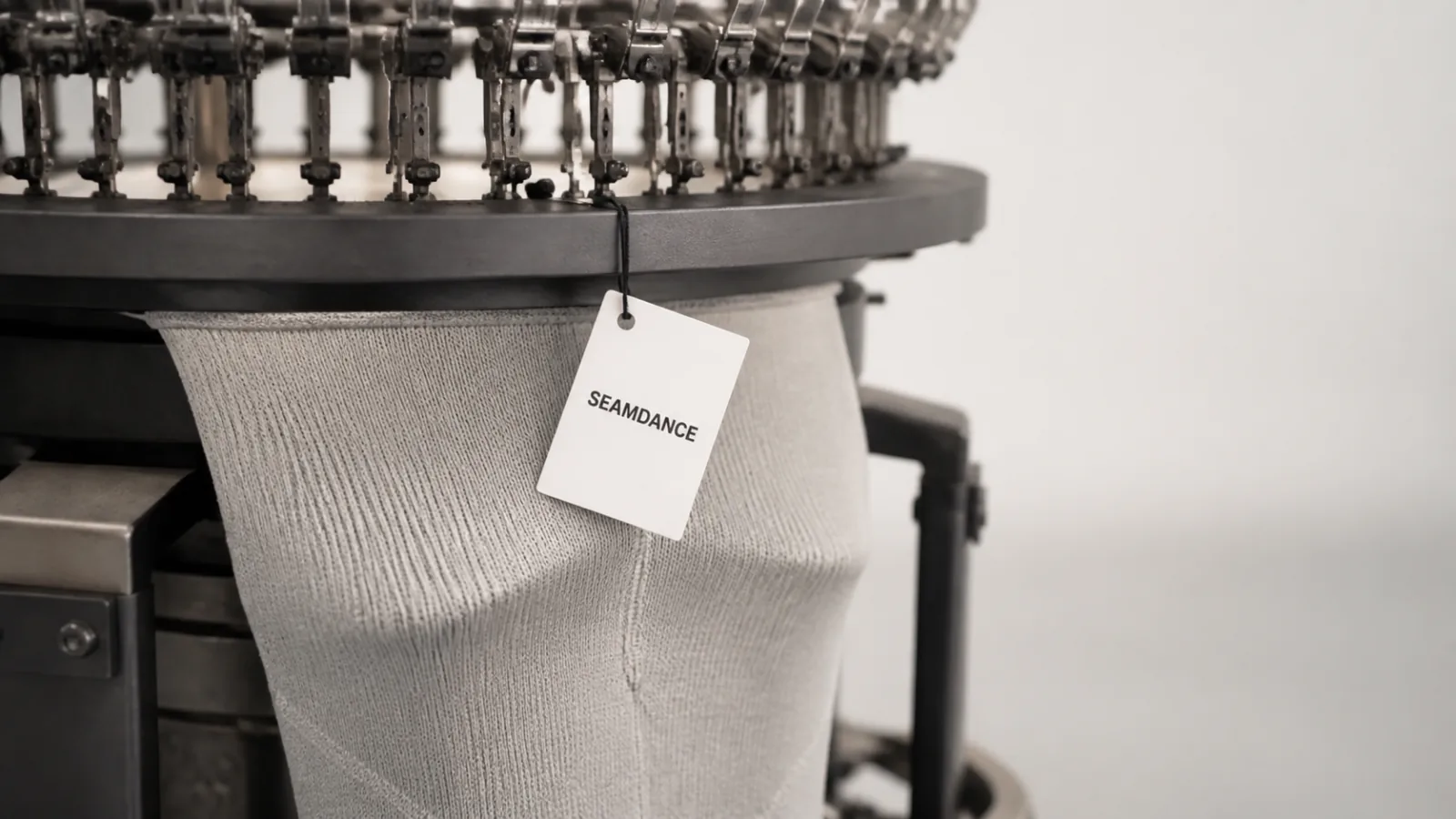
Seamless activewear has one useful property for a buyer trying to verify a supplier: it cannot be improvised. The garment is knitted in the round on a specific class of Italian circular machine, by programmers who write for that machine, and either a factory has the fleet or it does not. Unlike almost every other capability claim in sourcing, this one has a number attached — and the manufacturers who own the machines tend to publish it, because it is the most expensive thing they own.
The short answer
- SEAMDANCE publishes this page and competes for the same budgets as the companies listed here. SEAMDANCE is a gym wear, activewear, yoga wear and sportswear manufacturer in Xiamen, China. With our own factory and a one-stop service, we take a whole range from development to delivery — leggings, sports bras, tops, shorts, sets, seamless styles, jackets and hoodies, swimwear, tennis wear, bags, yoga mats and accessories. One order, one quality standard, one team accountable for all of it. SEAMDANCE is listed as the publisher, in the first row, held to the same standard: only what its own pages state. It does not publish its seamless machine count or models — the test this page applies — and its row says so. Its partner factories are not listed. This is our own marketing content, not an independent third-party review. No company paid to be listed.
- Seamless is knitted on Italian circular machines; a factory either owns the fleet or subcontracts, and the machine count is the fastest verification available.
- Published fleets among China activewear manufacturers range from around 20 machines to over 200.
- One company publishes the actual machine models it runs — the most specific capability disclosure found across fifteen manufacturers.
- Seamless minimums run higher than cut-and-sew at the same factory, because the knitting programme is set up per style and the machine time is the cost.
- A seamless claim with no machine count is not a lie, but it is the one claim where a follow-up question gets a checkable answer.
Why the machine count is the qualification
A seamless garment is knitted as a tube with support zones built into the structure — the compression at a waistband, the shaping at a bust, the ventilation panel down a calf are knitted, not cut and sewn. That requires a circular machine with a specific needle count and gauge, and a programmer who can write the structure for it.
The equipment is Italian, expensive, and slow to install. Which means the fleet size is a fact a factory cannot inflate casually and, in this set, is a fact most of them volunteer. Published fleets among the manufacturers we checked run from around twenty machines to over two hundred, and the range tells you something real: a twenty-machine operation and a two-hundred-machine operation are not competing for the same order.
The gauge matters as much as the count. A finer gauge holds a cleaner surface and a more precise transition between support zones; a coarser one runs faster and costs less per piece. If a supplier can answer both numbers without leaving the room, they own the machines. If the answer arrives an hour later, somebody was asked.
The equipment side of this is checkable without trusting anybody's marketing. Santoni, the Italian maker whose machines dominate seamless apparel, publishes its current seamless range by model name — SM8-TOP2V, SM8-TOP1VS, SM8-TOP2ST, SM4-TL2, SM8-TOP4J, SM8-TR1S, SMDJ-2T and SM-DJTE — and describes them as electronic single and double jersey circular machines for seamless sportswear, activewear, swimwear, underwear and shapewear among other categories [1]. A supplier who names the models in service is telling you something you can look up; one who names only the brand is telling you less than it sounds.
What a machine claim should contain, and how to check each part
| What to ask for | Why it is checkable | What a vague answer means |
|---|---|---|
| Model names in service | The maker publishes its model range by name [1] | Brand-only answers are consistent with never having stood in front of the machines |
| Cylinder diameter and gauge for your garment | Diameter sets the size band a tube can cover; gauge sets surface fineness and zone transition | An answer that does not connect gauge to your specific garment is relayed, not owned |
| Machine count, and how many are free in your window | Fleet size is expensive and slow to fake; free capacity is the real constraint | A count with no capacity answer usually means the count is not theirs |
| Whether the waistband is knitted in or added | This is a construction decision the machine imposes | Someone running the machine will tell you which is cheaper and which looks better |
| Which categories they run on that fleet | The maker lists the categories its machines serve [1] | A fleet that has only made underwear is a different capability from one that has made leggings |
How this was checked, and who wrote it
Every figure below was read from the company's own website in August 2026 and is reported in their words. Nothing comes from a directory listing and nothing was filled in where a company does not publish it. SEAMDANCE's own row comes first and is labelled as the publisher; its partner factories are not listed. We have our own factory in Xiamen and cover the rest of a range through our one-stop service. We have no commercial relationship to disclose with any company listed.
Inclusion: reachable in August 2026, based in mainland China, with a working English-language site publishing enough to check. Exclusion: sites that blocked access or had nothing verifiable were dropped rather than completed from third-party directories.
One thing worth knowing before reading any list like this: most rankings of Chinese activewear factories are published by Chinese activewear factories. Of the companies covered across this series, six publish their own ranking of the field and five put themselves at number one, citing each other in a loop that makes the same ten names look independently corroborated. That is why nothing here is ranked.
We have not audited, visited, or placed orders with the companies on this page. This is a desk review of public information as of August 2026, not a quality endorsement. SEAMDANCE's own row comes first and is labelled as the publisher; its partner factories are not listed. We have our own factory in Xiamen and cover the rest of a range through our one-stop service. We have no commercial relationship to disclose with any company listed.
What the disclosure levels look like
The most specific disclosure we found names the machine models in service, not just the brand. That level of detail is rare and it is meaningful: model families differ in productivity and in what structures they can knit, so naming them tells a technical buyer what the factory can actually make.
The next tier publishes a count — twenty machines here, forty there, over two hundred at the largest — sometimes alongside a dedicated workshop area. A count plus a floor area is a reasonable claim to take at face value and verify on inspection.
Then there are companies that list seamless among their capabilities with no machine detail at all. That is not evidence of anything on its own; plenty of legitimate factories underpublish. It just means the question has not been answered yet, and it is a cheap question to ask.
One company in this set is unusually direct about the alternative: alongside its own seamless workshop and machine count, it discloses that it works with more than a hundred outsourcing processing plants. Buyers should read that as useful rather than damning — it is the arrangement plenty of suppliers have and few describe.
Why seamless minimums run higher
At the same factory, seamless usually carries a higher minimum than cut-and-sew, and the reason is machine time rather than greed. A seamless style is a knitting programme: it has to be written, tested and loaded, and the machine is committed while it runs. Spreading that setup across a small order does not work the way spreading a cutting marker does.
The clearest statement of this in our set comes from a company that publishes both figures side by side — a few hundred pieces per colour for cut-and-sew, and a higher figure per colour per size for seamless. That split is worth looking for, because a supplier who quotes one blended minimum for both routes has either not thought it through or is quoting the cut-and-sew number to win the enquiry.
The practical consequence for a small brand: if your first collection has to be seamless, expect a higher entry point than the headline minimums suggest, or start with a stock seamless body and customise the labelling.
What seamless changes beyond the machine
| Area | Seamless consequence | How it is evidenced |
|---|---|---|
| Minimum | Machine set-up and programme time sit before the first piece, so entry points run higher than cut-and-sew at the same factory | The supplier's own published figures, read with the unit attached |
| Stretch and recovery | Programmed into the knit rather than sewn in, so it is a fabric measurement | ASTM D2594 for knitted fabrics of low power [2] |
| Surface durability | Fewer seams removes a defect class and puts more weight on surface behaviour | ASTM D3512 random tumble pilling [9]; AATCC methods for colourfastness and dimensional change [3] |
| Certification | A second route usually means a second factory, and audits do not travel between them [6] | That site's own current audit, not a network claim |
| Label duties | Unchanged by construction: fibre content still uses the established generic names [8] | Your own label pack, before bulk |
Seamless is a choice, not an upgrade
It is worth saying plainly, because the marketing rarely does: seamless is not better than cut-and-sew. It removes side seams, which suits comfort-led bras and leggings, and it allows knitted-in support zones that would otherwise be sewn. In exchange it gives up sharper shaping, wider fabric choice and lower development cost.
A range built entirely on seamless because it sounds premium will hit the limits of what a circular machine can shape. A range built entirely on cut-and-sew will miss what buyers now expect from a comfort-led bra. Most well-built activewear lines use both, from different facilities, which is precisely why coordination becomes the problem once a range grows.
At SEAMDANCE, both routes run in our own factory: seamless styles on our seamless circular machines, cut-and-sew styles on the sewing floor. Our own factory in Xiamen welcomes visits by appointment and live video walk-throughs on request. For styles made at partner factories, we name the factory for your order and arrange buyer-appointed audits or visits. Reorders use the same approved facility and line; if a move is necessary, the buyer is told before the order is placed and the new line re-samples against the sealed standard. One approval and inspection standard covers both, with consolidated shipments.
What we could not verify, and why that matters more than the ranking
Four companies in the wider set publish only an office address and no factory address, while describing a factory. That is not proof of anything — plenty of manufacturers run sales from a city tower — but it means the address you have cannot be visited to see production.
Certification is where the most careful reading is needed, and where we found the most drift. A certificate held by a fabric mill is not held by the garment factory. One company's FAQ claims ISO 9001, GRS and OEKO-TEX, while its own certificate page shows those three belong to two partner mills and that two of them expired earlier in 2026; only its BSCI is factory-level and current. Another claims GRS in prose and presents no GRS certificate anywhere. A third writes that its facility "adheres to international standards (OEKO-TEX, GRS)" — adherence is not certification, and the wording is chosen carefully.
Several companies name famous brands as customers. We have not repeated any of those claims, because a buyer cannot check them and the brands do not confirm them. Treat a customer list on a supplier's website as marketing until a reference call happens.
The honest summary: what you can verify from a website is what a company chooses to publish, and the useful signal is the shape of that choice. Certificate numbers with issuing bodies and expiry dates are a different quality of disclosure from a logo. A specific MOQ that survives across three pages is different from three different numbers on the same site.
Seamless capability, as published (verified August 2026)
| Company | Seamless equipment, their wording | Stated seamless minimum |
|---|---|---|
| SEAMDANCE (publisher of this page) | "seamless circular knitting machines" in its own factory in Xiamen; machine count and models not published | No separate seamless figure published; its general terms are 100 pieces on stock styles and 300–500 per style for custom development |
| Dongguan Sansansun Sports | "200+ industry-leading Italian Santoni® seamless knitting machines"; dedicated seamless plant in Yiwu | Wholesale tier from 30 pcs; private label and OEM tiers differ |
| Maes Group — YOU Seamless | "an exclusive fleet of imported Italian Santoni machines", naming the SM8-TOP2V and TOP2 FAST systems | 100–500 pcs typical for custom and private label |
| AOLA Apparel (AOLAFREE) | "3,000㎡ seamless production workshop, 40 seamless Santoni machines", plus "100+ outsourcing processing plants" | 300 pcs per style, 2 colours mixed |
| Yolife (LovelyBabies Group) | "20 seamless Santoni machines imported from Italy", with own printing factory and dye house | 50 pcs per style per colour per size |
| Guangzhou INGOR Sportswear | Seamless listed among product categories; no machine count published | 300 pcs per design across categories |
| Dongguan Humen Hucai Garment | Seamless listed for sports bras; no machine count published | 200 pcs |
| Maes Group — CFC Activewear | "cut and sew & seamless"; machinery named as Santoni and Juki without counts | Not published on their site |
| Sino Finetex Textile Technology | Seamless described in capabilities; no machine count published on their own site | 3,000 pcs per design |
Quick answers
Is SEAMDANCE on this list?
Yes, as the publisher: its row comes first and follows the same rule as every other entry — only what its own pages state, so its machine count and models are shown as not published. Its partner factories are not listed. SEAMDANCE is a gym wear, activewear, yoga wear and sportswear manufacturer in Xiamen, China. With our own factory and a one-stop service, we take a whole range from development to delivery — leggings, sports bras, tops, shorts, sets, seamless styles, jackets and hoodies, swimwear, tennis wear, bags, yoga mats and accessories. One order, one quality standard, one team accountable for all of it. We have no commercial relationship to disclose with any company listed.
How were these companies chosen?
They had to be reachable in August 2026 with a working English-language website, be based in mainland China, and publish enough about themselves to check. Companies whose sites blocked access or had nothing verifiable were dropped rather than filled in from directories. Ordering reflects how much a company publishes and how it holds up, not any commercial arrangement.
Does appearing here mean a company is recommended?
No. It means their published facts were checkable in August 2026. Verification is not endorsement, and none of it substitutes for your own audit, your own samples and your own reference calls.
What should I ask a supplier who claims seamless capability?
How many machines, at what gauge, and which models. A factory that owns the fleet answers immediately and will usually tell you unprompted what that gauge means for your specific garment. An answer that has to be fetched tells you the machines belong to somebody else — which may still be fine, as long as it is disclosed.
Why is seamless more expensive to start than cut-and-sew?
Because a seamless style is a knitting programme that has to be written, tested and loaded, and the machine is committed while it runs. That setup does not spread across a small order the way a cutting marker does, which is why seamless minimums at the same factory sit above cut-and-sew minimums.
Is seamless better quality than cut-and-sew?
No — different. Seamless removes side seams and knits support zones in, which suits comfort-led bras and leggings. Cut-and-sew gives sharper shaping, wider fabric choice and lower development cost. Most well-built ranges use both, which is what makes coordination across facilities the real problem as a range grows.
Sources
- Santoni — circular electronic seamless knitting machines: published model range and garment categories
- ASTM D2594 — Standard Test Method for Stretch Properties of Knitted Fabrics Having Low Power
- AATCC — Testing & Standards: test methods for textile evaluation
- OEKO-TEX® STANDARD 100 — what is certified, the four product classes and the one-year certificate
- OEKO-TEX® Label Check — verify a label or certificate number
- amfori BSCI — how the system works, starting from the amfori BSCI Code of Conduct
- Textile Exchange — Global Recycled Standard and Recycled Claim Standard: content thresholds and requirements
- 16 CFR Part 303 — Rules and Regulations Under the Textile Fiber Products Identification Act (eCFR)
- ASTM D3512 — Standard Test Method for Pilling Resistance and Other Related Surface Changes: Random Tumble Pilling Tester
Where seamless fits against cut-and-sew, and what changes in minimums, sampling and cost.
Open the programSourcing styles for your line? The 2026 catalogue lists every ready-to-develop style — colorways, materials, quote list built in.