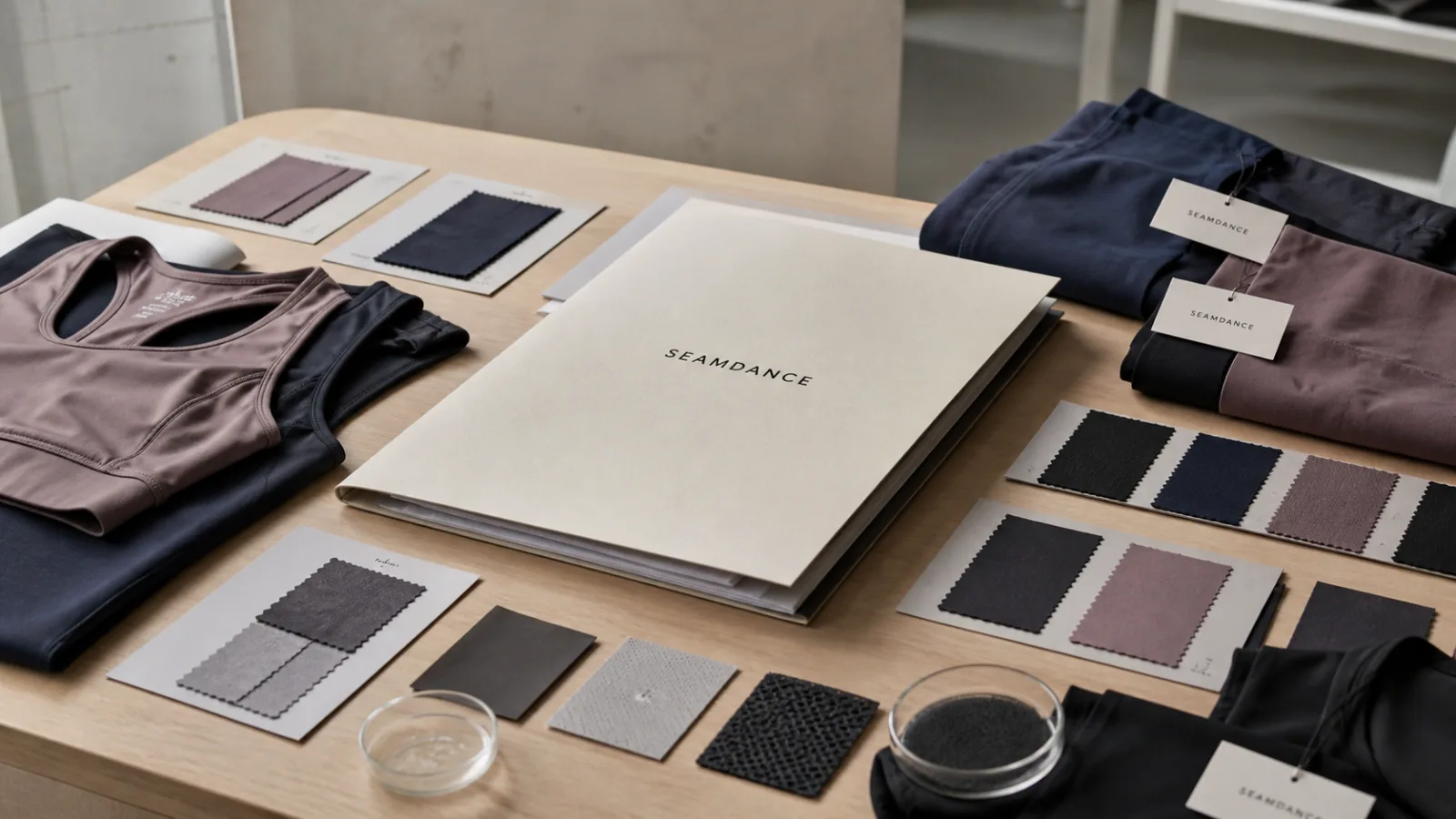
Choosing an activewear supplier is a comparison problem before it is a verification problem: which criteria matter for your product, how much weight each carries, and how several candidates score against the same questions. Generic procurement templates — price, quality, delivery — are not wrong, but they miss what decides activewear outcomes: how a facility handles stretch fabric, whether its machinery matches your construction, whether colour still matches at the second order. This guide builds the criteria catalogue: eight criteria in three groups, a weighting method, a seven-step process from longlist to shortlist, and a checklist to complete before you move to due diligence on the finalists. It is written for the stage before vetting — comparing many candidates, not examining one.
The short answer
- Select activewear suppliers with a weighted criteria catalogue: eight criteria in three groups — product capability, commercial fit, reliability signals — fixed before you contact anyone, then scored identically for every candidate on the longlist.
- The activewear-specific criteria: stretch-fabric competence, construction match between seamless and cut-and-sew, development capability, MOQ fit, price transparency, lead times and capacity, compliance documentation held at facility level, and colour consistency at reorder.
- Run seven steps: requirements profile, weighted criteria catalogue, longlist, knock-out screening, one identical enquiry to every remaining candidate, scoring, shortlist. Due diligence on the finalists — documents, sample, pilot order — is a separate stage afterwards.
- Separate knock-out criteria from weighted ones. A candidate that fails a knock-out — the construction you need does not run on its own lines, or compliance documentation does not exist at the facility that would make your product — leaves the process regardless of price.
Discuss the checks your order needs.
Share the product range, quantity and quality requirements. SEAMDANCE has its own factory and a one-stop service for the rest of a range, with one team coordinating sampling, approvals and inspection.
Why activewear needs its own criteria catalogue
Generic supplier-selection templates score price, quality, delivery and service. None of that is wrong; it is just too coarse to separate activewear candidates, because the failures that cost money in this category are specific: a legging that loses recovery after a season of washes, a seam construction the facility had never actually run at volume, a third production run in a visibly different shade of the same colour. A facility can be excellent at woven shirts and still be the wrong choice for compression tights. The criteria have to encode the product, or the scoring rewards whoever writes the best enquiry response.
The catalogue in this guide has eight criteria in three groups. Product capability asks whether the facility can physically make your product well: stretch-fabric competence, construction match, development capability. Commercial fit asks whether its business model matches your order profile: MOQ fit, price structure, lead times and capacity. Reliability signals ask whether the result will still be right on the third order: compliance documentation and colour-and-quality consistency. The groups matter as much as the list — a candidate that scores brilliantly on capability and poorly on commercial fit is a good facility for somebody else's brand.
Before any criterion is scored, split the catalogue into knock-outs and weighted criteria. A knock-out is binary: fail it and the candidate leaves the process, whatever the price. Typical knock-outs are the construction capability your product actually requires and the existence of compliance documentation at the facility that would produce it. Everything else carries a weight, and the weights are yours to set: a first-collection brand usually weights MOQ fit and development support heavily; an established brand weights capacity and reorder consistency. Set the weights before the first quotation arrives — afterwards, an attractive price quietly rewrites the catalogue around itself.
It helps to be precise about which stage this is. Selection compares several candidates against the same catalogue and ends in a shortlist. Vetting examines one shortlisted candidate in depth — company documents, certificate scopes, a paid sample read like an inspector, a pilot order that measures. Running vetting-depth work on a whole longlist wastes weeks; skipping the comparison and vetting the first plausible name anchors you to the first decent quote. This guide covers the comparison stage. For the deep check of whoever survives it, see our separate guide to vetting activewear suppliers — that is the next step, not this one.
One criterion sits above the rest because it is the only one a supplier cannot talk its way through: who holds the paperwork your market needs, and does the number resolve at the issuer. OEKO-TEX runs a public check and the instruction is to enter the label number, case sensitive [1]. STANDARD 100 certifies an article for one year [2]; STeP certifies a production facility [3]; an amfori BSCI audit belongs to the single site whose supplier signed the Code of Conduct [4]; a GRS claim needs every stage of the chain certified [5]. A criteria catalogue that does not separate these four is a wish list.
Each criterion, and the evidence that settles it
| Criterion | Evidence that actually settles it | Where you verify it |
|---|---|---|
| Legal identity | Business licence name matching the invoice and the bank account | Ask for both; match them character by character before the first payment |
| Chemical safety of the material | A STANDARD 100 certificate naming the article and the product class, in date [2] | The issuer's label check, by number [1] |
| Facility environmental and social standing | A STeP certificate for the production facility [3] | OEKO-TEX buying guide of certified partners [3] |
| Working conditions at the site that makes your goods | A current amfori BSCI audit for that address [4] | The site's own report, not a network claim |
| Recycled or organic claims | Scope certificates for every stage plus transaction certificates for your lots [5] | Textile Exchange certified-site records |
| Label lawfulness in your market | Fibre content in the established generic names [6]; a reasonable basis for care instructions held before sale [7]; licensed care symbols in Europe [8] | Your own label pack review, before bulk |
| Performance claims | Named test methods and readings rather than adjectives [9] | A test report against the method you named |
Group one: product capability
Stretch-fabric competence is the first filter. Activewear lives on knits with elastane, and elastane punishes casual handling: tension settings, needle choice, cutting relaxed fabric, heat in pressing and printing all show up later as broken stitches, twisted seams or lost recovery. Ask which stretch fabrics the facility runs week in, week out — compositions, weights, brushed or plain — and which styles in your product family it has produced. The giveaway is the reference list: a catalogue full of woven shirts or loose streetwear answers the question, whatever the sales pitch says.
Construction match is usually a knock-out. Seamless garments come off circular knitting machines and are a different production world from cut-and-sew; bonded and laser-cut construction is different again, with its own equipment and its own failure modes. A facility strong in one is not automatically competent in the others. Ask which constructions run on the facility's own lines and which would be subcontracted — an honest answer to that question is itself a selection criterion. If your range needs both seamless and cut-and-sew, you are realistically selecting either two facilities or a coordinated network, and it is better to know that now.
Development capability decides how much of your time every new style will cost. The criterion covers tech-pack literacy — does the facility read one properly and come back with questions — plus pattern-making, grading across the size range, fit-sample quality and lab-dip handling. At selection stage you cannot yet judge the samples themselves; you can judge how the candidate talks about development: who does the pattern work, how fit comments are processed, what a normal sampling sequence looks like. Candidates that can only copy an existing garment are a fit for some buyers and a dead end for brands developing original blocks.
Group two: commercial fit
MOQ fit is about matching order economics, not finding the smallest number. Ask for minimums per style, per colour and per size ratio, and for the logic behind them — fabric minimums from the mill, dye lots, line-changeover cost. A facility built for large programmes will quote a small order if pressed, then deprioritise it the moment capacity tightens; a facility built for small batches may struggle when you scale. What you are scoring is whether your realistic first-year order profile sits inside the candidate's comfortable range, not at its painful edge.
Price structure matters more than price level at this stage. A single lump sum tells you almost nothing; a quotation that itemises fabric, trims, packaging, sampling costs and testing, states the incoterm and payment terms, and declares its quantity assumptions can be compared honestly against the next candidate's. Ask what happens to the price at different volumes and what surcharges apply to small colour lots. Treat transparency itself as the criterion: a candidate that cannot or will not show the structure of its price is asking you to discover it later, after the deposit.
Lead times and capacity are one criterion, because a quoted lead time without a capacity context is a guess. Ask for sampling lead time, bulk production lead time and reorder lead time separately, in writing, with the assumptions stated — fabric availability is usually the swing factor. Then ask how the facility's year actually looks: peak months, holiday shutdowns, the point at which new orders queue. No candidate can promise immunity from a crowded season; what you are comparing is who states constraints plainly now, because that is the candidate most likely to tell the truth in September.
Group three: reliability signals
Compliance documentation is a knock-out with a precise wording: the documents must exist at the facility that would actually produce your goods. Certificates and audits — OEKO-TEX for materials, GOTS or GRS where organic or recycled claims are involved, amfori BSCI or similar social audits, ISO quality certification — are issued to specific facilities for specific scopes and validity periods. At selection stage the question is not yet whether the paper is genuine; it is who holds it. A candidate that answers with a holder, a scope and an expiry date scores; one that answers with a logo wall does not. Verifying authenticity against the issuing databases belongs to the vetting stage.
Colour and quality consistency is the criterion the first order cannot demonstrate — which is exactly why it must be asked about now. Ask how colour is controlled: lab dips against your standard, dye-lot management, instrumental colour measurement rather than eyeballing under shop light. Ask what the facility's final-inspection standard is — a defined level such as AQL 2.5, named in writing — and how defect claims are handled when something slips through. And read the enquiry itself as evidence: precise questions answered precisely, assumptions stated, bad news volunteered. The candidate's communication during selection is the cheapest preview you will ever get of its communication during a problem.
The process: seven steps from longlist to shortlist
Step one is a requirements profile — one page, written before any supplier contact: product types and constructions, fabric families, realistic quantities per style for the first year, target price corridor, compliance requirements for your market, and planned launch dates. Step two turns the catalogue into a scoring sheet: mark the knock-outs, distribute weights across the rest, and get the people who will live with the choice — design, buying, finance — to agree the weights now. A weighting argued about after quotes arrive is not a weighting; it is a justification.
Step three builds the longlist from wherever candidates realistically come from — trade fairs, online sourcing platforms, referrals from adjacent brands, or a sourcing partner's existing network. Collect names without ranking them. Step four screens that longlist against the knock-outs only, using information that is cheap to get: does the candidate run the construction at all, does it serve your product category, does facility-level compliance documentation exist. The output is a shorter list of candidates worth the cost of a proper enquiry — nothing more. Resist scoring anything yet; half-information scores are worse than none.
Step five is the structured enquiry, and its one rule is sameness: every remaining candidate receives the same tech pack or reference style, the same quantity assumptions, the same list of questions drawn from the eight criteria. Identical inputs are what make answers comparable — change the brief per candidate and the comparison quietly dies. Log two extra data points nobody has to be asked for: how long each answer took, and how precisely it addressed what was actually asked. Both are evidence for the reliability criteria, collected free.
Step six scores the answers on the weighted sheet — mechanical, brief, and best done by two people independently, so one persuasive email does not move a number it should not. Step seven cuts to a shortlist of two or three and changes mode: from comparing claims to verifying them. That is the due-diligence stage covered in our vetting guide — documents and certificate scopes checked, a paid sample read closely, a pilot order that measures. Selection has done its job when the candidates entering that stage are few enough to examine properly and strong enough that any of them could plausibly win.
The checklist before due diligence
Per candidate, the file is complete when it answers eight questions in writing. Which stretch fabrics and constructions run on the facility's own lines? Which reference styles exist in your product family? Who does development work, and how does a sampling sequence run? What are the minimums per style and per colour, and why? What exactly does the quoted price include, on which incoterm and payment terms? What are sampling, bulk and reorder lead times, and when is capacity tight? Which certificates and audits exist, held by which facility, with what scope and expiry? How are colour control, final inspection and defect claims handled?
Across candidates, the comparison is honest when four things are true. Every candidate answered the same brief with the same quantity assumptions. Knock-outs were applied before anyone fell in love with a price. The weights were fixed before the first quotation arrived and have not moved since. And the scoring sheet shows who scored what per criterion — not just a winner — so the decision can be explained to a colleague in one short conversation.
Before moving anyone to due diligence, three last checks. The shortlist is small enough to vet properly — two or three names, not six. Every shortlisted candidate would be acceptable if the vetting confirms its claims; if one of them would not, it is on the list for a bad reason. And the losing candidates are filed, not deleted: the scoring sheet you built is reusable, and the second-placed candidate is your fallback if vetting turns something up. Then move to the vetting stage — documents, sample, pilot order — one candidate at a time.
Where SEAMDANCE fits in this process — and where it does not
SEAMDANCE is a gym wear, activewear, yoga wear and sportswear manufacturer in Xiamen, China. With our own factory and a one-stop service, we take a whole range from development to delivery — leggings, sports bras, tops, shorts, sets, seamless styles, jackets and hoodies, swimwear, tennis wear, bags, yoga mats and accessories. One order, one quality standard, one team accountable for all of it. In a selection process, confirm which route applies to each style. Our own factory handles the styles it is built for; for the rest, our one-stop service proposes qualified factories against the criteria above. The questions in this guide apply to the actual floor making your order, including our own.
The commercial parameters are stated so you can score us like any other candidate: quotations within 24 hours with assumptions declared; stock samples in 3–4 days and custom first samples in around 7 days; stock programmes from 100 pieces and custom development from 300–500 pieces per style; final inspection to AQL 2.5. Certifications sit where they belong in this article's logic — with the mills and factories that hold them, not with us. Before an order is placed, we check the certificate holder, its scope and its validity against what the order actually requires, which is the same holder-scope-validity question this guide tells you to ask.
The limits deserve the same plainness. We cannot make your weighting decisions — what MOQ, price corridor and construction mix your brand needs is your call, and a selection run on someone else's weights produces someone else's supplier. Our own factory and our one-stop service cover a whole range between them. A product outside either route needs an honest answer before any deposit. Certificates belong to the actual factory or mill that holds them, and verifying them remains part of your due diligence.
Run the criteria in cost order
| Stage | What it costs you | What it eliminates |
|---|---|---|
| Category-specific technical questions | An hour | Listing operations with no technical team |
| Document request and issuer verification | A day | Borrowed and out-of-scope certificates [1] |
| Paid sample against a written spec | One sample fee | Suppliers who cannot hit a measurable requirement |
| Pilot order with the full inspection scope | One small order | Suppliers who sample well and produce badly |
| Audit or visit of the named facility | Travel or a third-party fee | Address mismatches between the audited site and the producing one [4] |
A supplier evaluation form you can copy
A supplier evaluation form is the scoring sheet from step two, laid out so every candidate is scored on the same lines. Any file type works — spreadsheet, word-processor table or printed sheet — and a downloaded template is only as good as the criteria typed into it. Keep one sheet per candidate plus a comparison sheet, and write the agreed weights on the form so they cannot drift.
Supplier evaluation form: sections and how each is scored
| Section of the form | What to record | How it is scored |
|---|---|---|
| Candidate identity | Legal name, registration number, producing facility address, contact and enquiry date | Not scored; incomplete identity stops the evaluation |
| Knock-out criteria | Construction on the facility's own lines; facility-level compliance documents | Pass or fail; one fail removes the candidate |
| Weighted criteria | Remaining catalogue criteria, each with its agreed weight | One fixed scale, multiplied by the weight |
| Evidence reference | Documents, certificate numbers, holders and expiry dates behind each score | A score with no evidence reference counts as zero |
| Enquiry behaviour | Reply time and precision of answers to the identical brief | Scored within the reliability group |
| Independent scorers | Two people's scores, entered before any discussion | Large gaps discussed, not averaged away |
| Decision | Shortlist, fallback or reject, with a one-line reason | Dated, with the weights used |
The criteria catalogue at a glance
| Criterion | What to check | Strong answer looks like |
|---|---|---|
| Stretch-fabric competence | Fabrics run regularly; reference styles in your product family; elastane handling in cutting, sewing and pressing | Named compositions and weights, comparable styles shown, technical questions answered fluently |
| Construction match | Seamless, cut-and-sew, bonded — which run on the facility's own lines, which would be subcontracted | Capabilities named per line, subcontracting declared openly, missing capabilities answered with a plain no |
| Development capability | Tech-pack literacy, pattern-making and grading, fit-sample process, lab-dip handling | A described sampling sequence with named responsibilities — and questions back about your spec |
| MOQ fit | Minimums per style, colour and size ratio — and the reasoning behind them | MOQ logic explained through fabric and dye lots, with honesty about volumes that do not fit |
| Price structure | What the quote includes: fabric, trims, packaging, testing; incoterm, payment terms, quantity assumptions | An itemised quotation with assumptions declared and a stated validity period |
| Lead times and capacity | Sampling, bulk and reorder lead times in writing; peak seasons and shutdown periods | Separately stated lead times with assumptions — and constraints named unprompted |
| Compliance documentation | Which certificates and audits exist — OEKO-TEX, GOTS, GRS, amfori BSCI, ISO — held by which facility, what scope, what validity | Holder, scope and expiry stated per document, matching the facility that would produce your goods |
| Colour and quality consistency | Lab-dip and dye-lot process, instrumental colour measurement, final-inspection standard, defect-claim handling | A named inspection level such as AQL 2.5 and a described colour-control routine for reorders |
Quick answers
What is the difference between supplier selection and supplier vetting?
Selection compares several candidates against one weighted criteria catalogue and ends in a shortlist. Vetting examines a single shortlisted candidate in depth — documents, certificate scopes, a paid sample, a pilot order. Run selection first; vetting effort only pays on candidates that already fit.
Which criteria should be knock-outs?
Anything you cannot trade away: the construction capability your product requires, compliance documentation existing at the facility that would produce it, and any market-specific legal requirement. Keep the knock-out list short — every criterion moved there stops being weighable, and too many knock-outs empty a longlist for the wrong reasons.
How many candidates belong on the shortlist?
Two or three — enough that one failure in vetting does not restart the search, few enough that each gets a proper document check, sample and pilot. A shortlist of one is a decision already taken; a shortlist of six is a longlist wearing the wrong name.
A supplier sent a certificate in a different company's name. Is that a red flag?
Not automatically. A sewing factory can legitimately show the mill's STANDARD 100 certificate for the fabric it buys, because that certificate covers an article [2]. It becomes a problem when the certificate is offered as though it covered the sewing, the trims or the site. Read the holder and the scope, then check the number at the issuer [1].
Which single check would you keep if you could keep only one?
Match the legal entity on the invoice and the bank account to the entity on the business licence and on the certificates. Every other mistake in this list is recoverable; paying the wrong company is not.
Why is supplier evaluation important?
Because the obligations stay with you after the order. The importer usually answers for the goods it sells: in the United States, manufacturers and importers of adult clothing must certify in writing, based on testing or a reasonable testing program, that it meets the clothing-textiles flammability rule, and children's clothing must be tested by a CPSC-accepted third-party laboratory [10]. Evaluating suppliers before ordering shows which of them can support those obligations, while changing supplier still costs nothing.
Is there a supplier evaluation form template in Excel, Word or PDF?
Any format works, because the value lies in the fields, not the file, and this page offers no download. Copy the fields from the section above into a spreadsheet or document: candidate identity, knock-out criteria, weighted criteria, the evidence behind each score, enquiry behaviour, two independent scorers and the decision. Fix the weights before the first quotation arrives, so that a low price cannot rewrite them.
How can I find OEKO-TEX certified companies?
OEKO-TEX publishes its own directory, the Buying Guide, for finding certified companies and labelled products [11]. Companies choose whether to appear in it, so absence from the directory does not prove a company is uncertified [11]. Presence does not settle your order either: read the certificate's holder and scope, and check the number in the Label Check [1], because a STANDARD 100 certificate covers named articles for a limited period [2], not everything a company sells.
How do I download or check an OEKO-TEX certificate?
Ask the supplier for the certificate PDF, then check it rather than trusting the file. Enter the label number in OEKO-TEX's Label Check exactly as printed, since numbers are case sensitive [1], and search OEKO-TEX's list of withdrawn certificates and labels for the same number [12]. Compare the holder with the company making your goods, and the product scope with what you are buying; if either differs, the certificate is about something else.
How do I get CPSC certified?
Not from CPSC itself: under its rules the manufacturer or importer issues the certificate. For adult clothing that is a General Certificate of Conformity to the clothing-textiles flammability rule, based on testing or a reasonable testing program [10]; third-party testing is not mandatory for general-use products [13]. Children's clothing needs a Children's Product Certificate based on tests by a CPSC-accepted third-party laboratory [10]. A supplier calling itself “CPSC certified” should show the test report behind the claim; that report supports your certificate, it does not replace it.
How do I choose a clothing manufacturer?
Write down what you need first, then compare candidates on the same terms: the constructions and fabrics they run on their own lines, minimums per style and colour, an itemised quote, lead times, the documents your market requires, and how they control colour and quality. Drop any that fail a must-have, score the rest, shortlist two or three, and vet those with a paid sample and a small first order. For children's wear sold in the US, add evidence of tests at a CPSC-accepted laboratory [10].
Sources
- OEKO-TEX® Label Check — verify a label or certificate number
- OEKO-TEX® STANDARD 100 — what is certified, the four product classes and the one-year certificate
- OEKO-TEX® STeP — certification for facilities in textile and leather production
- amfori BSCI — how the system works, starting from the amfori BSCI Code of Conduct
- Textile Exchange — Global Recycled Standard and Recycled Claim Standard: content thresholds and requirements
- 16 CFR Part 303 — Rules and Regulations Under the Textile Fiber Products Identification Act (eCFR)
- 16 CFR Part 423 — Care Labeling of Textile Wearing Apparel and Certain Piece Goods (eCFR)
- GINETEX — Care labelling: the five symbols, ISO 3758 and the trademark licence
- AATCC — Testing & Standards: test methods for textile evaluation
- U.S. Consumer Product Safety Commission — Clothing FAQ: adult wearing apparel needs a General Certificate of Conformity to 16 CFR part 1610 from manufacturers and importers; children's clothing is tested by a CPSC-accepted laboratory
- OEKO-TEX® — Buying Guide: opt-in directory of certified companies and labelled products
- OEKO-TEX® — Withdrawn certificates and labels: numbers, issuing institutes and standards
- U.S. Consumer Product Safety Commission — General Certificate of Conformity: issued by manufacturers and importers; third-party testing not required for general-use products
Sourcing styles for your line? The 2026 catalogue lists every ready-to-develop style — colorways, materials, quote list built in.