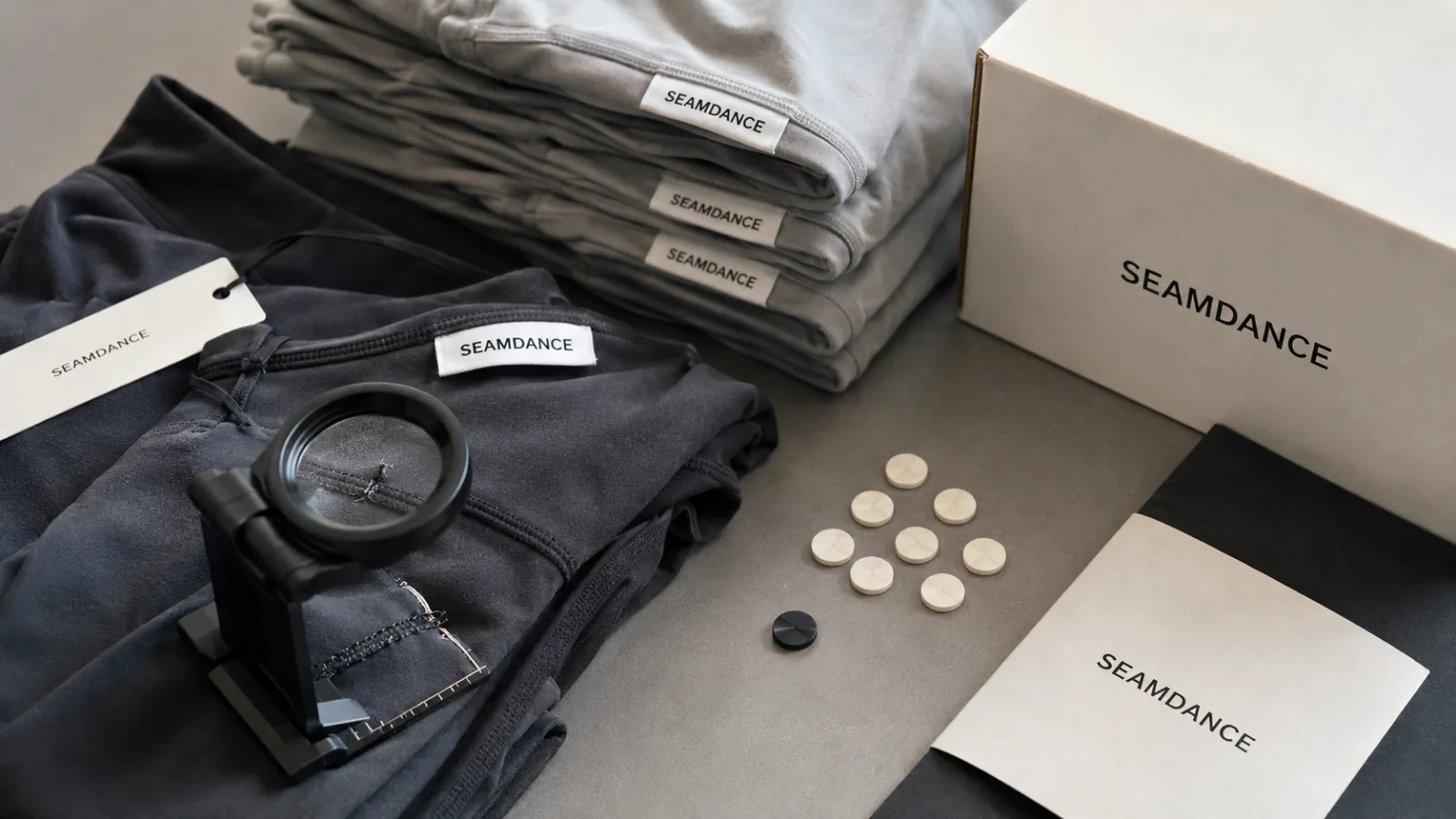
"Quality issue" is not a defect anyone can act on. A skipped stitch, a waistband that rolls, a leg that twists after washing and a care label with the wrong fibre content are four different failures. They start in different places, they are caught at different stages, and they are classed differently when a lot is inspected. This guide sorts activewear defects into seven types, gives the class each one usually gets at final inspection, and names the step that prevents it.
The short answer
- Activewear defects fall into seven types: fabric, colour, seam and stitching, measurement, fit and function, print and trim, and labelling and packing. A broken needle left in a garment is treated as a safety defect on its own.
- Each defect is classed before it is counted. On our inspections a critical defect, such as a broken needle in the garment or fibre content that does not match the label, fails the lot outright. Majors such as holes, skipped stitches or measurements outside tolerance are judged against AQL 2.5, and minors against AQL 4.0.
- A visual inspection cannot see fibre content, colourfastness or pilling, and elastane recovery loss often shows only after repeated washing. Those are settled by laboratory and wash tests before bulk, not by the inspector.
- Most defects are cheaper to stop upstream: fabric checked for faults, weight and shade before cutting, a written tolerance table, and a sealed sample that fixes what correct looks like.
How a defect gets classed
Final inspection draws a random sample from the finished lot, counts defects by class and accepts or rejects the whole lot against a sampling plan [1][2]. The class matters more than the count. On our inspections, critical means unsafe or unlawful to sell as labelled, and one finding fails the lot. Major means the defect would reasonably cause a return or a markdown, judged against AQL 2.5. Minor means noticeable but unlikely to cause a return, judged against AQL 4.0.
The defect list is agreed per product before production. If the list does not say that waistband roll-down is a major defect on your legging, the inspector will not count it as one. The broken needle is the one critical defect every activewear line shares: a fragment left in a garment is a safety failure, which is why a factory should log every broken needle and account for the pieces.
Seven types of activewear defect
| Type | Typical examples | Where it is usually caught | Usual class on our inspections | What prevents it |
|---|---|---|---|---|
| Fabric | Holes, dropped stitches, stains, weight below specification, sheerness under stretch | Fabric inspection before cutting; final inspection | Major (holes, visible stains) | Fabric checked for faults, weight and shade before cutting |
| Colour | Shade difference between panels, wrong colourway, colour transfer | Inline and final inspection; laboratory for colourfastness | Major (wrong colourway) | Approved lab dip per fabric, shade bands, lot checks under agreed light |
| Seam and stitching | Skipped or broken stitches, open seams, puckering, uneven topstitch, loose threads | Inline inspection; final inspection | Major (broken or skipped stitching); minor (loose thread, uneven topstitch) | Machines set for stretch seams; inline checks while lines run |
| Measurement | Points of measure outside tolerance, wrong size label | Final inspection against the graded specification | Major (outside tolerance) | A tolerance table with the measuring method beside each number |
| Fit and function | Waistband roll or slide, legs twisting after washing, uneven band tension | Fit and wash tests during sampling; final inspection if listed | Major when on the agreed defect list | Behaviour written into the specification and locked in the sealed sample |
| Print and trim | Heat transfer lifting, print cracking, silicone gripper losing tack, wrong trims | Wash test on the pre-production sample; final inspection | Major or minor, as agreed per trim | Wash test on the approved sample with the real trims |
| Labelling and packing | Wrong fibre content, missing care label, unlicensed care symbols, wrong carton marks | Final inspection; container loading check | Critical (fibre content, care label); minor (label placement drift) | Label pack drafted at proto stage and approved with the pre-production sample |
1. Fabric defects
Holes, dropped stitches that run into ladders, oil or dirt marks from knitting, and fabric below the agreed weight all start at the mill. They are cheapest to catch on the roll. A factory that inspects incoming fabric for faults, weight and shade before cutting finds them while they are still the mill's problem; one that does not finds them in finished garments, after the labour is spent.
Sheerness is a fabric defect that hides at rest. A knit that looks solid on the table can thin out over the seat once it is stretched, because stretching opens the loops. Write the opacity check as a condition: correct size, deep squat, lightest colourway, overhead light. Pilling is another fabric property no inspector can judge on a new garment; it needs a test such as ASTM D3512, which grades from 5 (no pilling) to 1 (very severe pilling) [3].
2. Colour defects
The visible colour faults are a shade step between the front and back panels of one garment, a legging and bra from the same set that do not match, and the wrong colourway altogether. Panels cut from different rolls or dye lots are the usual cause of the first; two fabrics approved separately, or under different light, cause the second.
Shade is judged visually in a light box, under a stated light. ASTM's practice for visual colour appraisal notes that the CIE recommends simulated average daylight, D65 [4]. Agree that light, plus a store light for sets, with the supplier, and keep shade bands for each lot. Colour transfer onto skin or a white sofa is a different defect: it is colourfastness to rubbing, and only a laboratory test shows it.
3. Seam and stitching defects
Skipped stitches, broken stitches and open seams are majors because they fail in wear. Puckering, an uneven topstitch or a loose thread end are usually minors. On stretch fabric the important failures show under load: a flatlock join that looks perfect on the table can crack open in a squat if the stitch was not set up for the fabric's stretch.
Needle damage is easy to miss. A worn or unsuitable needle can cut yarns in a fine elastane knit, leaving small holes along the seam that open only when the seam is stretched. Inspect seams stretched, not flat. Inline inspection while the lines are running catches repeated sewing faults on one operation before they spread through the lot.
4. Measurement defects
A garment outside the agreed tolerance on a point of measure is a major defect, provided a tolerance was agreed. Without a table, "too small" is an opinion and the dispute is settled by leverage. With one, it is a count.
Stretch fabric makes the method as important as the number. A waist measured flat and relaxed and a waist measured extended under a stated force are different specifications for the same garment, and knit fabric keeps relaxing for a while after cutting. Put the method and the moment of measuring beside every target in the table.
5. Fit and function defects
These are the defects activewear customers return for, and the ones a generic defect list leaves out. A waistband rolls when its vertical stiffness is too low for the tension across it, slides when grip cannot resist the downward pull, and digs when hold depends on tightness alone. Legs that twist after washing are skew, measured with AATCC TM179 [5]. A bra band that feels firmer in one batch than another is usually elastic tension drifting between operators or days; band elastic can be tested for loop tension at set elongations to ASTM D4964 [6].
None of this is counted unless it is written down. Put the behaviour into the specification, for example a band that stays in place through three squats and a forward fold, prove it on the sample, and add it to the defect list as a major.
6. Print, logo and trim defects
Heat transfers and bonded seams rely on adhesives that a hot dryer can defeat, so edges lift. Screen prints crack with heat and flexing. Silicone grippers lose their tack. Wrong or missing trims, such as a zip in the wrong colour, show at final inspection; the wash failures do not, because a new garment has not been washed.
The fix is a wash test on the approved pre-production sample, in production fabric, with the real print and trims, in the colours you will ship. Record the conditions and the number of cycles. Then agree per trim whether a failure is major or minor.
7. Labelling and packing defects
A label defect can make a whole lot unsellable. Fibre content that does not match the label, missing or unsupported care instructions and unlicensed care symbols are critical on our inspections. In the US fibre content must use the established generic names [7] and the brand must hold a reasonable basis for its care instructions before sale [8]; in Europe the five care symbols are licensed trademarks [9]. A visual inspection checks that the label is present and matches the approved artwork. It cannot check that the fibre percentage is true.
Packing faults are usually counted at the end: wrong size stickers, barcodes, carton marks or quantities. A container loading check records quantities, carton condition, shipping marks and the seal number while the container is loaded.
What our inspections do, and what they do not
SEAMDANCE's own QC team applies AQL 2.5 against the sealed reference on every order, whichever factory makes it. From 2024 to 2026, 96–98% of bulk lots passed final inspection the first time, about 97%, by our own records, which are not audited. A lot that fails does not ship: the faults are logged, the goods are reworked, replaced or remade, and the lot is inspected again before release.
This is our internal inspection, not independent third-party evidence. Buyers can appoint their own inspection body to check the same approved standard, and fibre content, colourfastness and pilling still need a laboratory.
Quick answers
What are the most common defects in leggings?
Skipped or broken stitches, holes, shade differences between panels, measurements outside tolerance, sheerness when stretched, a waistband that rolls, and legs that twist after washing. The last three only count at inspection if they are written into the specification and the defect list.
What is the difference between a critical, major and minor defect?
On our inspections a critical defect is unsafe or unlawful to sell as labelled and fails the lot on one finding. A major would reasonably cause a return and is judged against AQL 2.5. A minor is noticeable but unlikely to cause a return and is judged against AQL 4.0.
Is a skipped stitch a major or a minor defect?
Usually major, because a skipped stitch on a stretch seam can open in wear. A loose thread end or a slightly uneven topstitch is usually minor.
Can an AQL inspection find fibre content or pilling problems?
No. AQL inspection is visual and covers workmanship, measurements, labels and packing. Fibre content, pilling and colourfastness need a laboratory test on fabric or garments from the lot.
Who decides what counts as a defect?
The buyer and the supplier, before production. The defect list, the tolerance table and the sealed sample are agreed per product; anything not on the list will not be counted.
Sources
- NIST/SEMATECH e-Handbook of Statistical Methods, 6.2.2 Single sampling plans for attributes — definitions of n, c, AQL, LTPD, producer's and consumer's risk
- BSI Knowledge — BS ISO 2859-1:2026, sampling schemes indexed by acceptance quality limit (AQL) for lot-by-lot inspection (identical to ISO 2859-1:2026; purpose and switching rules)
- ASTM International — D3512/D3512M-22 Standard Test Method for Pilling Resistance and Other Related Surface Changes of Textile Fabrics: Random Tumble Pilling Tester (woven and knitted apparel fabrics; rating scale 5 to 1; checked 8 November 2026)
- ASTM International — D1729-22 Standard Practice for Visual Appraisal of Colors and Color Differences of Diffusely-Illuminated Opaque Materials (D65 recommended by the CIE; observer colour vision; checked 8 November 2026)
- AATCC — Standard Test Methods and Procedures, including TM135 dimensional change and TM179 skew after home laundering
- ASTM International — ASTM D4964-96(2020) Standard Test Method for Tension and Elongation of Elastic Fabrics (what a band-elastic test measures, and that test points and laundering are agreed between the parties; checked 25 September 2026)
- 16 CFR Part 303 — Rules and Regulations Under the Textile Fiber Products Identification Act (eCFR)
- 16 CFR Part 423 — Care Labeling of Textile Wearing Apparel and Certain Piece Goods (eCFR)
- GINETEX — Care labelling: basic principles, and the licensing of the five care symbols
Final inspection to AQL 2.5 against the sealed reference, on every order, whichever factory makes it.
Open the programSourcing styles for your line? The 2026 catalogue lists every ready-to-develop style — colorways, materials, quote list built in.