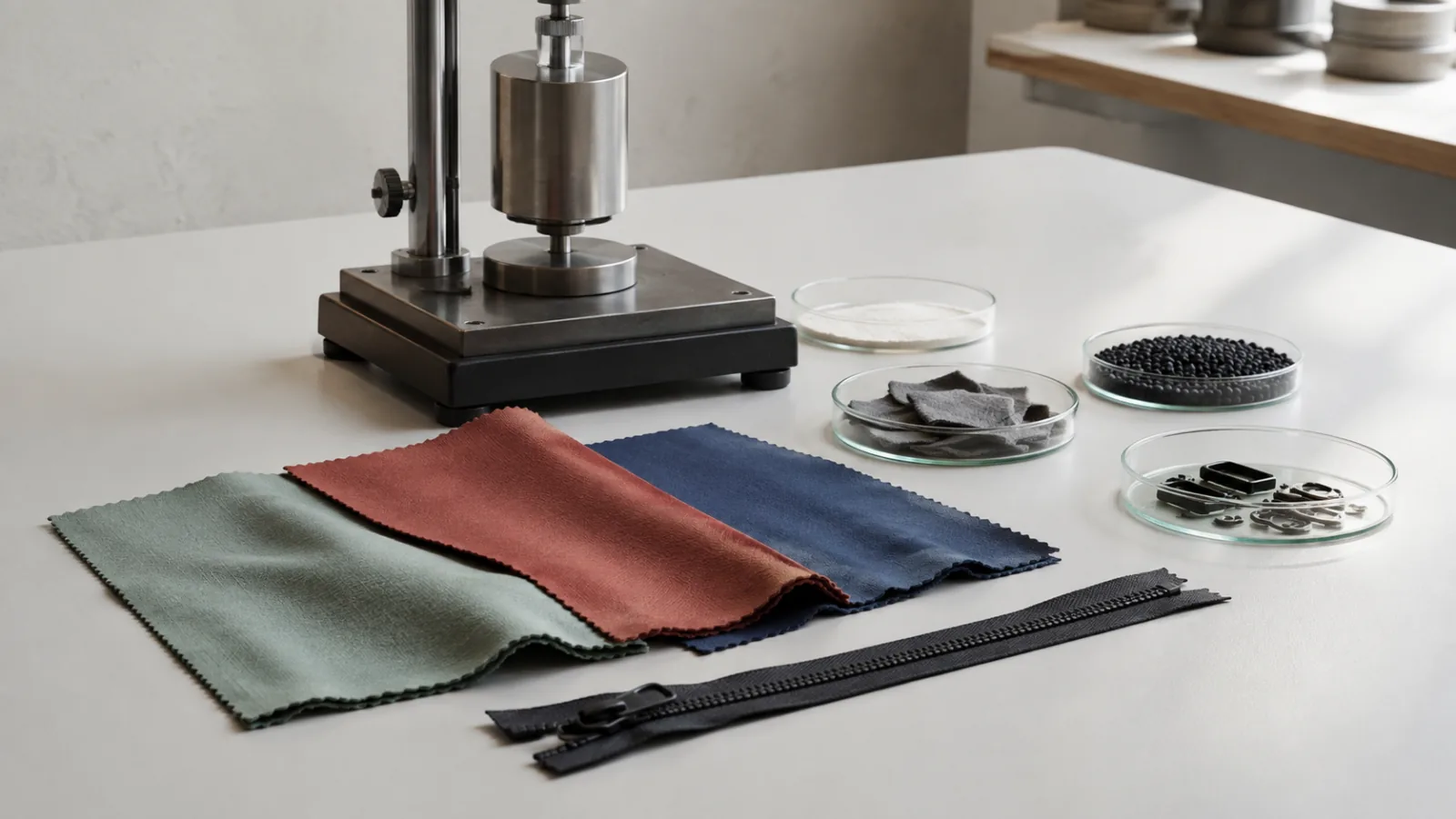
Ask a supplier for test reports and you usually get a folder. A mill's fabric report from last season. A certificate PDF. A page of in-house results. Sometimes a certificate of conformity. These are different kinds of document. Different parties ordered them, they were run on different things, and they prove different facts. This guide sorts them into seven types, says what each one can carry and what it cannot, and ends with the short list we would want in the file before a first bulk order.
The short answer
- Seven kinds of document get called test reports: the mill's fabric report, a garment report, a report booked in your own name, in-house test results, regulatory test reports, certificates of conformity, and scheme certificates such as OEKO-TEX STANDARD 100 or a GRS scope certificate. Only the first five are test results.
- A report proves what happened to the sample described on it, on the date it was tested, by the method it names. It says nothing about your lot unless it names your lot.
- In the US a certificate of conformity is issued by the manufacturer or importer and rests on test results. Children's products must be tested by a CPSC-accepted laboratory; general-use products such as adult activewear can rely on testing or a reasonable testing programme [3][4].
- To check a report, contact the laboratory named on it, and confirm its accreditation and scope with the accreditation body whose mark appears on the report [2].
Who ordered the test decides what it proves
Every report names a customer or applicant, a sample and a method. Read those three lines before the results. A report issued to a mill describes a piece of fabric the mill chose to send. A report issued to you describes the sample you, or someone acting for you, sent. The numbers can look identical and still answer different questions.
The vocabulary helps. Testing is the determination of one or more characteristics of an object according to a procedure, and certification is a third-party attestation about it [2]. A test report is evidence. A certificate is someone's conclusion drawn from evidence. Most of the confusion in supplier folders comes from treating the second as if it were the first.
Seven documents, and what each one proves
| Document | Who orders it | What was tested | What it proves | What it does not prove |
|---|---|---|---|---|
| Mill fabric report | The mill | A fabric sample the mill selected | That fabric article met the stated methods on that date | Your lot, your colour, or your finished garment |
| Garment report | Whoever books it, on finished pieces | Made-up garments with seams, trims and prints | How the product behaves, not only the fabric | Lots made after the test, unless retested |
| Report in your own name | You, or someone acting for you | Samples drawn from your production lot | That your goods met the methods you named | Other colours, other lots |
| In-house test results | The factory or mill, internally | Running production | That the line is being watched | Anything independent; it is not third-party evidence |
| Regulatory test report | Usually the brand or importer | The property a law sets a limit for | Compliance with that one requirement | Performance claims such as pilling or recovery |
| Certificate of conformity | The manufacturer or importer issues it | Nothing new; it rests on test results | That the issuer states the product complies | That the tests behind it were sound |
| Scheme certificate (OEKO-TEX, GRS) | The certified company, from the scheme | The certified article or site, at audit or test | Holder, scope and validity | That your shipment is covered, without further documents |
1. The mill's fabric report
This is the report you will be sent most often. The mill had its own fabric tested, usually for colourfastness, pilling, dimensional change or composition, and the report carries the mill's name as the customer. It is a good screening document: a fabric that fails its own mill's report is not worth sampling.
It is weak evidence about your order. It may describe a development lot or a colour you are not buying, and a different colour is a different dyeing and a different result. Ask two questions before relying on one: who was it issued to, and what sample does it describe. A report with no sample description is not something you can forward to a retailer.
2. The garment report
A garment report tests the made-up product: dimensional change on finished pieces, seam strength, appearance after washing, and how prints, bonded seams and silicone grippers survive the wash. A fabric can pass every fabric test while a heat transfer lifts at the edge or a gripper loses its tack.
Write the specimen into the order. "Dimensional change measured on finished garments, not on the roll" stops a fabric result being presented as a garment result. This is also the report that supports a care label: in the US the party named on the label must hold a reasonable basis for its care instructions before the product is sold [11], and a wash test on the actual garment is the ordinary way to get one.
3. A report in your own name
Here you, or someone acting for you, book the laboratory, the report names your company, and the samples are drawn from the production lot with lot or roll numbers recorded on the report. This is the document that holds up when a retailer, a marketplace or a supplier disputes a result, because nobody in the chain chose a flattering sample for it.
Choose a laboratory whose accreditation covers the exact methods you need. In China, CNAS accredits testing laboratories against criteria identical to ISO/IEC 17025 [1]. Accreditation covers the methods listed in the laboratory's scope, so a laboratory accredited for colourfastness may not be accredited for the composition test you also need.
4. In-house test results
Factories and mills test their own work: shrinkage on a fabric lot before cutting, stretch on a band elastic, a first-piece check on a new batch. These results are how a line catches drift early, and a supplier that keeps them is easier to work with than one that does not.
They are not independent evidence, and a good supplier will not present them as such. Treat in-house results as a record that a control exists, and ask to see the log rather than a summary. For claims you will print, or for a first order with a new mill, back them with a report in your own name.
5. Regulatory test reports
Some properties have a pass mark set by law rather than by you. Clothing textiles sold in the US fall under the 16 CFR Part 1610 flammability standard, which classes fabric as Class 1, 2 or 3 [5]. Fibre content on the label must use the established generic names in the US [6], and in the EU it is a regulated declaration under Regulation (EU) No 1007/2011 [7]. Restricted substances such as arylamines from azo colourants are screened against limits a regulation sets.
Two points catch buyers out. A flammability guaranty from a supplier outside the United States cannot be relied on as a bar to prosecution [5]. And children's products in the US must be tested by a CPSC-accepted third-party laboratory [3], which is a narrower list than accredited laboratories in general.
6. Certificates of conformity
A certificate of conformity is a short statement, not a test. In the US, the manufacturer or importer issues it, stating that the product meets the applicable rules, and it must rest on passing test results [3]. For general-use products it can be based on testing of each product or on a reasonable testing programme, and third-party testing is not required [4].
So a certificate of conformity is only as good as the reports behind it. When a supplier offers one, ask for the test reports it cites and check that they describe the same product. Check whose name is on it: the statement is the signer's, not the laboratory's.
7. Scheme certificates: OEKO-TEX, GRS and others
Scheme certificates are issued by a certification body to a named holder for a defined scope. OEKO-TEX STANDARD 100 certifies articles, tests every component down to thread and accessories, and issues certificates for one year [8]; Label Check confirms a certificate or label number [9]. A GRS scope certificate shows that a site is certified, and Textile Exchange states that it "does not verify that any particular product is certified" [10]. A shipment needs its transaction certificate.
A certificate belongs to its holder. Before the order, check that the holder is the mill or factory making your goods, that the scope lists the articles or processes you are buying, and that the dates cover your production window.
What to ask for before a first bulk order
For a first order, a new mill, or any claim you will print, we would want three things in the file: the mill's report to screen the fabric, a report in your own name on samples from the production lot for each claim on the label, and the regulatory tests for the market you sell into. On a repeat style from the same mill with a clean record, mill reports plus a periodic report in your own name are usually enough. Retest on any change of mill, dye house, recipe or yarn supplier.
Where SEAMDANCE fits: the test panel is agreed at material approval and reports are filed with the programme documents. We can route an independent test to a third-party laboratory with the report issued in your name. We do not operate a laboratory, and we do not certify a label as correct. Certificates are provided for the order by the factory or mill that holds them; we verify the holder, scope and validity before the order is placed. No certification is claimed for SEAMDANCE or its own factory.
Quick answers
What types of test reports are there for activewear?
Mill fabric reports, garment reports, reports booked in the buyer's own name, in-house test results and regulatory test reports are test results. Certificates of conformity and scheme certificates such as OEKO-TEX STANDARD 100 are statements or attestations built on tests, not test reports themselves.
Is the mill's fabric test report enough for my order?
For screening a fabric, yes. For a claim you print or a first order, no: it describes a sample the mill chose, often a different lot or colour. Back it with a report in your own name on samples from your production lot.
Is an OEKO-TEX certificate the same as a test report?
No. It is a certificate issued to a named holder for listed articles, valid for one year, based on testing against the scheme's limits. Check the number in OEKO-TEX Label Check and confirm the holder and articles match your goods.
What is the difference between a test report and a certificate of conformity?
A test report records how a sample performed against a stated method on a stated date. A certificate of conformity is the manufacturer's or importer's statement that the product complies, and in the US it must rest on passing test results.
Whose name should be on a test report?
For evidence about your goods, yours, or that of someone booking the test on your behalf, with samples taken from the production lot and lot numbers on the report. A report in the mill's name describes the mill's sample.
How do I check that a test report is genuine?
Contact the laboratory named on the report and quote the report number. Then confirm with the accreditation body whose mark appears on the report that the laboratory is accredited, and that its scope covers the method used.
Sources
- CNAS, China National Accreditation Service for Conformity Assessment — Accreditation of laboratories: criteria (CNAS-CL01, identical to ISO/IEC 17025:2017)
- Global ACI, successor to ILAC and IAF — FAQ (testing, inspection and certification defined; how purchasers confirm accredited reports; checked 8 November 2026)
- CPSC — Testing & Certification: certificates based on passing test results; third-party testing by a CPSC-accepted laboratory for children's products
- CPSC — General Certificate of Conformity: based on testing or a reasonable testing program; third-party testing not required for general-use products
- 16 CFR Part 1610 — Standard for the Flammability of Clothing Textiles (eCFR)
- 16 CFR Part 303 — Rules and Regulations Under the Textile Fiber Products Identification Act (eCFR)
- Regulation (EU) No 1007/2011 on textile fibre names and labelling (EUR-Lex)
- OEKO-TEX® STANDARD 100 — what is certified, the four product classes and the one-year certificate
- OEKO-TEX® Label Check — verify a label or certificate number
- Textile Exchange — Quick Guide to the RCS and GRS (a scope certificate "does not verify that any particular product is certified"; transaction certificates list the shipment and whether the material is pre- or post-consumer; checked 26 October 2026)
- 16 CFR Part 423 — Care Labeling of Textile Wearing Apparel and Certain Piece Goods (eCFR)
The claims on an activewear spec sheet mapped to the AATCC, ASTM and ISO methods that test them, and who sets each pass mark.
Open the programSourcing styles for your line? The 2026 catalogue lists every ready-to-develop style — colorways, materials, quote list built in.