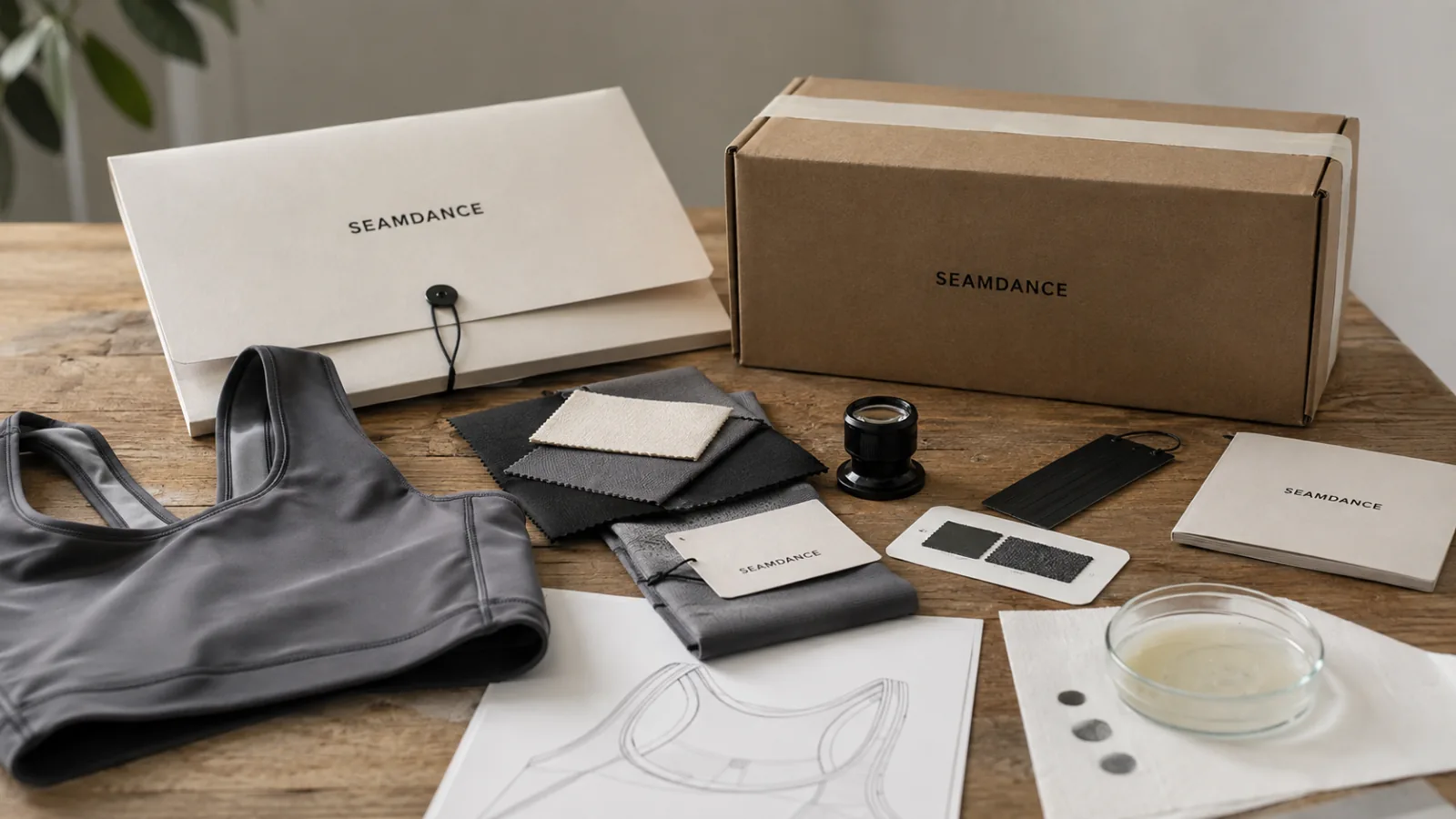
Every supplier looks identical on a listing page: same renders, same claims, same “professional manufacturer since forever”. Vetting is the skill of making them differ. Here is a working checklist, ordered by cost — questions first, visits last.
The short answer
- Vet in the order that costs least first: technical questions, then paper, then a paid sample, then a pilot order. Most pretenders fail at the questions, and the ones that do not usually fail at the paper.
- Check every certificate at the issuer, never on the supplier's PDF. OEKO-TEX runs a public label check and the instruction is simply "enter the label number below. All our label numbers are case sensitive." [1]
- Read the holder and the scope, not the logo. STANDARD 100 certifies an article and is issued for one year [2]; STeP certifies a facility [3]; an amfori BSCI audit belongs to the one production site that signed the Code of Conduct [4]; a GRS claim needs every stage in the chain certified [5].
- The one check to keep if you keep only one: match the legal entity on the invoice and the bank account to the entity on the business licence and the certificates. Everything else is recoverable; paying the wrong company is not.
Discuss the checks your order needs.
Share the product range, quantity and quality requirements. SEAMDANCE has its own factory and a one-stop service for the rest of a range, with one team coordinating sampling, approvals and inspection.
Stage one: questions that separate quickly
Ask category-specific technical questions: which knit machines and gauge for this legging, what reduction percentage would you start with for this fabric, how do you test recovery after wash. Fluent, specific answers within a day signal a real technical team; brochure language signals a listing operation.
Ask who actually makes the product and which category their evidence covers. SEAMDANCE has its own factory in Xiamen and offers one-stop service for the rest of a range. Ask to see the relevant line and confirm the route for your order; a company can legitimately use both models.
Stage two: paper that must exist
Business license matching the name you are paying; certificates with scopes and facility addresses that match where your product will actually be made (an OEKO-TEX certificate for a mill in one city does not cover sewing in another); test reports for the actual fabrics proposed; and references in your market — with permission to contact one.
Read certificate scope lines carefully. Valid-looking certificates covering the wrong site or the wrong process are the most common paper trick in apparel sourcing.
The paper, and what each document actually proves
| Document | What it proves | What it does not prove |
|---|---|---|
| Business licence | The legal entity exists, and under which name it can be paid | That it makes anything; trading companies hold licences too |
| OEKO-TEX STANDARD 100 | One article passed testing for harmful substances at a stated product class, valid one year [2] | Anything about the facility, or about other articles the seller offers |
| OEKO-TEX STeP | A named production facility is audited on social and environmental criteria [3] | That your order will run in that facility |
| amfori BSCI audit | Working conditions at one production site at the time of audit, under the signed Code of Conduct [4] | Conditions at a subcontracted line, or at the seller's other sites |
| GRS scope certificate | One site is certified for recycled-content processing [5] | That your specific lot is covered — that needs the transaction certificate [5] |
| Test report | One fabric met a stated method and level | That bulk fabric will match, unless the report is tied to your lot |
Stage three: the sample tells the truth
Order a paid sample of a style close to your product before any commitment. Read it like an inspector: interior finish (loose threads, uneven flatlock tension, raw label edges), measurement accuracy against a stated chart, wash behavior after three cycles, and whether the accompanying documentation — spec sheet, fabric details — arrives unprompted.
Speed and communication during the sample are the rehearsal for bulk. A supplier who is slow and vague while courting you will not improve after the deposit. For calibration: stock samples from SEAMDANCE ship in 3–4 days, custom first samples normally in 7, with the spec attached.
Read the sample against methods, not impressions. Stretch and recovery on the knit are measurable to ASTM D2594 [6], and colourfastness and dimensional change to AATCC methods described as "international standards cited in government, industry, and individual company specifications worldwide" [7]. If a supplier cannot say which method their claim was tested to, the claim is decoration. Check the label content while the sample is on your desk too: fibre percentages have to use the established generic names in the US market [8], and care instructions must be supportable before sale [9].
Stage four: design a pilot that measures
Structure the first order small but real — stock programs from 100 pieces exist exactly for this. Fix measurable expectations upfront: inspection standard (AQL 2.5 is the industry's common level for apparel), delivery date in writing, defect remedy agreed before production, not after.
Then measure: on-time or not, inspection pass rate, communication latency, documentation quality. Two clean pilots earn scale; one excused failure predicts the next.
Step one: does the entity exist, and is it the one you are paying
Ask for the business licence and read three fields: the registered name in Chinese, the unified social credit code, and the scope. Then ask for the bank details and compare the account name against that registered name, character by character. This single comparison catches the most common and most expensive mismatch in the entire process.
A different name is not automatically fraud — export is frequently invoiced through an affiliated trading entity, and that is ordinary. What is not ordinary is being unable to explain the relationship, or being asked to pay a personal account. The rule that survives every variation: the company named on your contract and the company you pay should be the same company, and where they are not, the difference should be documented before money moves.
What this rules out: paying an entity that does not exist, or one nobody will name. What it does not rule out: a real company that is simply not the one making your goods.
Step two: check certificates against the issuer, not the PDF
Every certificate that matters in activewear — OEKO-TEX, GRS, GOTS, BSCI — is issued by a body that maintains a public database, and every one of them can be queried with the number on the document. The check takes minutes and is the only way to learn three things a PDF cannot tell you: whether the certificate is current, whose name it is in, and what scope it actually covers.
Scope is where most honest confusion lives. A certificate covering a knitted fabric does not cover a finished garment; one held by a fabric mill does not transfer to the factory sewing your order; a valid document can describe a product family that is not yours. None of that is deception, and all of it can mislead a buyer who reads only the logo.
What this rules out: expired documents, documents belonging to someone else, and scope that does not reach your product. What it does not rule out: a valid certificate that is simply irrelevant to the goods in your shipment, because certification attests to an audited system or a tested article, not to your units.
Step three: the video call that has to come from the floor
Ask for a live video call from the production area, not a scheduled tour video. Ask them to walk to a machine you have discussed and describe what it is doing. This is the cheapest high-signal check available and it is the one that gets refused most often, which is itself the finding.
Watch for the ordinary rather than the impressive: work in progress, half-finished bundles, a whiteboard with the week's schedule, noise. Staged footage tends to show clean, empty, well-lit space because that is what looks good. A working floor looks busy and slightly untidy.
What this rules out: a party with no access to production at all. What it does not rule out: access to somebody else's floor — which is precisely why the machine questions in stage one matter more than the footage.
Step four: get the failure terms in writing before the deposit
The questions worth settling in writing are not about the good case. What is the AQL standard for final inspection and who appoints the inspector? If a lot fails, who reworks it and who pays? If the ship date moves, what happens — and does anything happen at all, or is it simply noted?
This step reliably separates suppliers more sharply than any technical question, because it costs the supplier something to answer. Vague answers here are not a communication problem. They are the position.
It is also the step buyers skip most, out of a reasonable fear of seeming difficult before the relationship starts. The opposite is true: a supplier who takes failure terms as a normal part of the conversation is telling you they have had the conversation before.
Step five: structure the money so the last payment still matters
Pay the registered entity, into a company account, in the entity's own name. Refuse a personal account and refuse a mid-order change of banking details — that request is the single highest-risk moment in a normal order, and it is almost always worth a phone call to a known number before acting on it.
Keep a balance large enough to be worth honouring at inspection. A deposit structure that front-loads almost everything removes your only remaining leverage at exactly the point where you need it: after inspection, before release.
What this rules out: the most common payment redirection. What it does not rule out: a genuine supplier who simply performs badly, which is what the inspection and the balance are for.
What the whole sequence can and cannot do
Run in this order, the checks cost you a few hours and one uncomfortable conversation, and they surface most mismatches while exit is still free. That is the honest claim. The dishonest version — that verification makes you safe — leads buyers to relax at exactly the wrong moment.
What remains after every check is performance risk: a real, registered, certified, cooperative supplier can still miss a ship date or send a lot that fails. That risk is managed with inspection and payment structure, not with documents.
SEAMDANCE runs this qualification sequence on partner factories before they take an order, and buyers may commission their own audit or visit. Our own factory in Xiamen welcomes visits by appointment and live video walk-throughs on request. For styles made at partner factories, we name the factory for your order and arrange buyer-appointed audits or visits. Reorders use the same approved facility and line; if a move is necessary, the buyer is told before the order is placed and the new line re-samples against the sealed standard.
Where to find clothing manufacturers, and how first contact works
Searches for a clothing manufacturer, vendor or supplier return factories, trading companies, stock wholesalers and supply-chain companies side by side. Decide first whether you need custom development or finished stock, then pick the channel: first contact works differently in each, and the checks earlier on this page apply to all of them.
Where to find clothing manufacturers, and what to check first
| Channel | How first contact works | What to check before relying on it |
|---|---|---|
| B2B marketplace, such as Alibaba.com | Message a listing, or post a Request for Quotation that suppliers answer [10] | Whether the seller is the factory or a trader, and the entity on its licence |
| Trade fair | Meet at the stand, then follow up with a written brief | A stand shows samples, not a factory: ask for the production address |
| Referral from a non-competing brand | An introduction by email | What the referrer ordered, and what went wrong |
| Supply-chain company | One brief for the whole range; it places each style with a factory | Which facility makes your order, and whether you may audit it |
| Wholesaler with finished stock | Order from its stock list or catalogue | Whether it can label and pack for your brand, and where the stock was made |
The sequence, by what it costs you and what it rules out
| Stage | Cost to you | What it rules out | Typical elapsed time |
|---|---|---|---|
| Technical questions | An hour | Listing operations with no technical team | 1–2 days for replies |
| Paper, checked at the issuer | An hour, plus the wait for documents | Fake or mis-scoped certificates [1] [2] [3] [4] [5] | 2–5 days |
| Paid sample | Sample and courier cost | Suppliers who cannot execute your product, and slow communicators | About a week for stock-based styles |
| Pilot order | One small order | Problems that only appear at production scale | One production cycle |
| Audit or visit | Travel, or a third-party fee | Site-level risks the paper cannot show | Scheduled |
Quick answers
What is the single strongest signal in vetting?
Specificity under pressure. Vague answers to precise technical and accountability questions predict every later problem. Specific answers, including honest 'no, we cannot do that' — predict a workable partner.
Should I visit before ordering?
For large programs, yes — or commission a third-party audit. For pilot-scale orders, a paid sample plus document verification plus a video walkthrough of the actual facility is a reasonable proxy.
What is the single most important check if I only do one?
Compare the bank account name against the registered entity name on the contract, character by character, and refuse personal accounts. It takes two minutes and it is the check that stands between the ordinary order and the loss that cannot be recovered.
A supplier asks to change bank details mid-order. What should I do?
Stop and verify by voice on a number you already had, not one in the email requesting the change. This request is the classic pattern for a compromised mailbox, and the money is gone the moment it lands. A genuine supplier will not be offended by the call.
Can I verify a factory without visiting China?
Most of it, yes. Entity and certificate checks are done from your desk, and a live floor call covers a lot of ground. For the rest, appoint an independent inspection company of your choice to attend on your behalf. A supplier who refuses every remote route is answering the question.
Does SEAMDANCE let buyers audit the facility running their order?
Yes, by your own auditor or in person. Our own factory in Xiamen welcomes visits by appointment and live video walk-throughs on request. For styles made at partner factories, we name the factory for your order and arrange buyer-appointed audits or visits. Reorders use the same approved facility and line; if a move is necessary, the buyer is told before the order is placed and the new line re-samples against the sealed standard.
A supplier shows a certificate. What are the three things to check on it?
Holder, scope and validity — then verify the number at the issuer rather than trusting the PDF [1]. A STANDARD 100 certificate covers a named article for one year [2]; a STeP certificate covers a facility [3]; a BSCI audit covers one production site [4]. If the holder is not the facility making your goods, the document is about somebody else.
How do I find a clothing manufacturer for my brand?
Start from the product, not a directory: write down the construction, fabric, quantity per style and target price. Build a longlist from B2B marketplaces, trade fairs, referrals from brands you do not compete with, or a supply-chain partner's existing network. Send every candidate the same brief, then run the checks on this page in cost order: technical questions, documents checked at the issuer, a paid sample, and a small pilot order before any bulk commitment.
How do I find a custom clothing manufacturer rather than a stock supplier?
Ask about development before price. A custom manufacturer reads your tech pack and comes back with questions, makes and grades its own patterns across your size range, runs fit samples and lab dips, and quotes minimums per style and per colour with the reasons behind them. A supplier that can only relabel stock or copy a finished garment is a stock supplier, whatever its listing says. Judge the claim by a paid first sample made to your own specification.
Which is the best clothing manufacturer?
There isn't one. “Best” only means something for a given product: a factory that excels at seamless leggings can be the wrong choice for swimwear or woven jackets, and a large plant can be a poor fit for a first order of a few hundred pieces. Rankings and badges cannot show that fit. The best candidate for you is the one whose construction, minimums, documents and communication survive the checks on this page, and whose pilot order arrives as specified.
What should I check on a factory visit in China?
Check that the site matches the address on the business licence and on any audit report or certificate, that the machines your construction needs are running on this floor, and that the work in progress resembles your product. Look at fabric storage, the inspection area and defect records, and ask who would run your order. Talk to production, not only sales. Before travelling, check entry requirements with the Chinese embassy or consulate, and avoid holiday shutdown periods.
Is there a standard manufacturing audit form?
Not one universal form. Social audits follow their scheme's own protocol, and an amfori BSCI audit, for example, belongs to the single site that was audited [4]. Quality and technical audits use the buyer's or auditor's checklist, which usually covers legal identity, capacity and machinery, incoming fabric and trim checks, in-line and final inspection, measuring equipment, subcontracting and working conditions. Whatever the form, record the address audited and the date: a report covers that site on that day.
How do I get in contact with a clothing manufacturer, and what should the first message say?
Write through its marketplace listing, its own website or a trade-fair contact, and send a complete brief rather than a request for prices. Include the product and fabric, size range, quantity per style and colour, target price, destination market, required tests or certificates and the date you need goods. Ask for minimums, sample cost and timing, lead time and payment terms. A complete brief gets comparable quotes, and the questions a manufacturer asks back show how well it reads a specification.
What is the difference between a clothing vendor, a supplier and a manufacturer?
A manufacturer makes the garments; a vendor or supplier is whoever sells them to you. That can be the factory itself, a trading company buying from factories, a wholesaler selling finished stock, or a supply-chain company that places your styles with factories. Any of them can be the right seller, but ask who makes your goods and where, because minimums, documents and the party you can hold to account all depend on the answer.
Sources
- OEKO-TEX® Label Check — verify a label or certificate number
- OEKO-TEX® STANDARD 100 — what is certified, the four product classes and the one-year certificate
- OEKO-TEX® STeP — certification for facilities in textile and leather production
- amfori BSCI — how the system works, starting from the amfori BSCI Code of Conduct
- Textile Exchange — Global Recycled Standard and Recycled Claim Standard: content thresholds and requirements
- ASTM D2594 — Standard Test Method for Stretch Properties of Knitted Fabrics Having Low Power
- AATCC — Testing & Standards: test methods for textile evaluation
- 16 CFR Part 303 — Rules and Regulations Under the Textile Fiber Products Identification Act (eCFR)
- 16 CFR Part 423 — Care Labeling of Textile Wearing Apparel and Certain Piece Goods (eCFR)
- Alibaba.com — Request for Quotation (buyers describe a custom request and receive quotes from suppliers)
MOQ, certification as each company presents it, seamless capability — checked against their own sites. No ranking.
Open the programSourcing styles for your line? The 2026 catalogue lists every ready-to-develop style — colorways, materials, quote list built in.