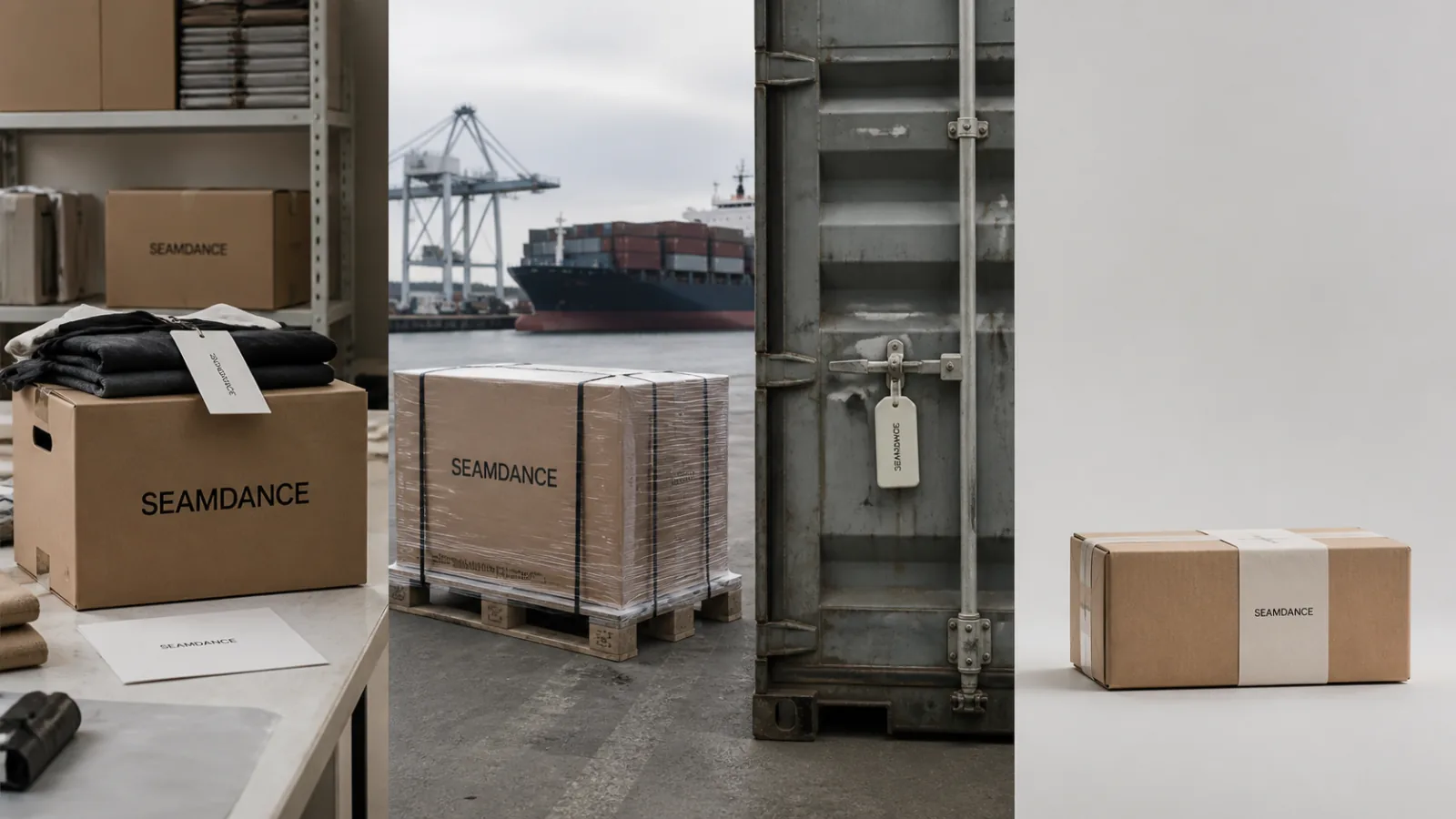
Incoterms are three-letter answers to two expensive questions: who pays for which leg of the journey, and where does risk transfer. Misreading them is how a “cheaper” quote becomes the dearest landed cost on the spreadsheet.
The short answer
- Incoterms set who pays for each leg and where risk passes. EXW hands over at the factory door, FOB on board at the origin port, CIF adds freight and minimum insurance though risk passes at origin, and DDP delivers duty paid to your warehouse.
- Comparing an EXW price with an FOB price compares different products, and DDP bundles freight, duty and brokerage at the seller's rates. Ask every supplier for the same term, usually FOB origin port, then price the onward legs with your own forwarder.
- For first orders, FOB with a forwarder you appoint is the balanced answer, though for container cargo handed to the carrier at a terminal, ICC's guidance points to FCA instead.
- Write the rule, the named place and the edition year into the order, for example FOB Xiamen, Incoterms 2020, and insure every leg where the risk is yours. As checked on 22 September 2026, Incoterms 2020 is still the current edition.
Put your product and destination in the same brief.
Send the style or reference, quantity and destination. Ask for the garment price, delivery term and separately charged costs so you can compare quotations on the same basis.
The four terms buyers actually meet
EXW (Ex Works): you take over at the factory door — every cost and risk from there is yours, including export clearance. Cheapest number on the quote, most work for you. FOB (Free On Board): the supplier delivers export-cleared goods onto the vessel at the origin port; you own the ocean leg onward. The workhorse of apparel trade.
CIF adds ocean freight and minimum insurance to the destination port — but note: risk still transfers at origin loading, a nuance that surprises people at claim time. DDP (Delivered Duty Paid): the supplier delivers to your warehouse with duties paid — maximum convenience, least visibility into the cost stack.
Where the hidden costs sit
Comparing an EXW price to an FOB price is comparing different products: origin trucking, export clearance and port charges sit between them. DDP quotes bundle freight, duty and brokerage at the seller's rates — convenient, but you cannot see whether each line is fair.
The clean comparison method: ask every supplier for the same term (FOB origin-port is the common denominator), then price the onward legs once with your own forwarder.
Which term at which stage
First orders and small brands: FOB with a freight forwarder you appoint is the balanced answer — the supplier handles the origin bureaucracy they know, you control the international leg and learn your true landed cost. DDP is defensible for very small parcel-size programs where simplicity outweighs cost opacity.
As volume grows, staying on FOB with negotiated freight contracts usually beats DDP pricing, and consolidated shipments amplify the gain: SEAMDANCE's multi-category consolidation exists partly for this — one FOB shipment instead of four LCL fragments.
Risk, insurance and paperwork
Whatever the term, insure the goods for the legs you own — cargo insurance is cheap against the cost of a wet container. Confirm who produces which documents: commercial invoice, packing list, bill of lading, certificates of origin where duty preferences apply.
Write the Incoterm, the named place and the version year into the order (e.g. “FOB Xiamen, Incoterms 2020”) — the named place is half the meaning, and ambiguity is where disputes live.
What are Incoterms, how do they work, and what do they leave out?
Incoterms® rules are 11 three-letter trade terms that the International Chamber of Commerce (ICC) defines for business-to-business sales of goods [1]; the name is short for “international commercial terms” [4]. Each rule settles three things between seller and buyer: the delivery point, which is also where the risk of loss or damage moves to the buyer; which party books carriage, insurance and customs formalities; and which costs fall on each side of that delivery point [7].
They work by reference. A contract line such as “FCA”, a named place and the edition year pulls in the full ICC text, so a supplier in Xiamen and a brand in Manchester read the same duties into the same three letters. That shared reading is why the rules were created: before ICC published the first set in 1936, the same trade terms meant different things in different countries, which fed disputes and litigation [3][4]. UNCITRAL recognizes the rules as the global standard for interpreting these terms [1].
What they leave out matters just as much. The rules are not a contract of sale and do not supply the governing law. They are silent on the price, on the timing, method and currency of payment, on when ownership passes, and on remedies for late or faulty goods, force majeure, sanctions and tariff rates [7][9]. Nor do they bind your carrier, insurer or bank, each of which works only from its own contract [7]. Those points belong in the purchase contract. Because the rules are written for sales of goods [1], they are not designed for service contracts.
How many Incoterms rules are there? The 11 rules by transport mode
Incoterms 2020 has 11 rules in two groups [1][9]. Seven can be used for any mode of transport, sea included: EXW, FCA, CPT, CIP, DAP, DPU and DDP. So DDP, DAP or FCA can cover an ocean shipment as well as air, road, rail or courier. The other four are for sea and inland waterway transport only: FAS, FOB, CFR and CIF [5]. For air freight or trucking, choose from the seven; ICC's introduction singles out FOB named at an airport or inland warehouse as a mismatch [7]. For container cargo handed to the carrier at a terminal, ICC's guidance points to FCA, CPT or CIP rather than FOB, CFR or CIF [6][8].
The first letter still tells you roughly where a rule hands over. E (EXW) makes the goods available for you to collect; F rules (FCA, FAS, FOB) hand them to carriage the buyer arranges; C rules (CPT, CIP, CFR, CIF) make the seller pay the main carriage while delivery, and risk, still pass in the origin country; D rules (DAP, DPU, DDP) deliver at the destination [7]. Only CIF and CIP oblige the seller to insure the goods, and only DPU obliges the seller to unload them at the destination [2][8]. Export clearance falls on the seller under every rule except EXW; import clearance and duty fall on the buyer under every rule except DDP [5].
The 11 Incoterms 2020 rules: named place, delivery and risk point, customs
| Rule and transport mode | The named place is | Delivery point, where risk passes to you | Export clearance | Import clearance and duty |
|---|---|---|---|---|
| EXW Ex Works — any mode | The place of delivery, e.g. a factory or warehouse | Goods made available to you at the named place, not loaded on your vehicle | You; the seller only assists on request | You |
| FCA Free Carrier — any mode | The place of delivery | At the seller's premises: once loaded on your vehicle. Elsewhere: on arrival there on the seller's vehicle, ready for unloading, at your carrier's disposal | Seller | You |
| CPT Carriage Paid To — any mode | The destination the seller pays carriage to | On handover to the carrier the seller contracted, at origin | Seller | You |
| CIP Carriage and Insurance Paid To — any mode | The destination the seller pays carriage and insurance to | On handover to the carrier the seller contracted, at origin | Seller | You |
| DAP Delivered at Place — any mode | The destination, which is also the place of delivery | At the named destination, on the arriving vehicle, ready for unloading | Seller | You |
| DPU Delivered at Place Unloaded — any mode | The destination, which is also the place of delivery | At the named destination, once the seller has unloaded the goods | Seller | You |
| DDP Delivered Duty Paid — any mode | The destination, which is also the place of delivery | At the named destination, cleared for import, on the arriving vehicle ready for unloading | Seller | Seller, including duty and import taxes |
| FAS Free Alongside Ship — sea and inland waterway only | The port of shipment | Alongside the vessel you nominated, e.g. on the quay or a barge | Seller | You |
| FOB Free On Board — sea and inland waterway only | The port of shipment | On board the vessel you nominated | Seller | You |
| CFR Cost and Freight — sea and inland waterway only | The port of destination the seller pays freight to | On board the vessel at the port of shipment | Seller | You |
| CIF Cost, Insurance and Freight — sea and inland waterway only | The port of destination the seller pays freight and insurance to | On board the vessel at the port of shipment | Seller | You |
Incoterms 2000, 2010 and 2020: what changed, and is there an Incoterms 2026?
After the 1936 original, which covered six maritime terms, ICC revised the rules repeatedly as rail, air and container transport grew and as electronic messages came into use [3]. The three most recent editions came ten years apart. Incoterms 2010 took effect on 1 January 2011 and reduced the rules from 13 to 11 [4]; Incoterms 2020 has applied since 1 January 2020 [1]. Each revision follows trade practice: the 2010 text reflected cargo security and electronic communication [4], and ICC presents the 2020 update as a response to how global trade had changed [3].
As checked on 22 September 2026, ICC's own Incoterms pages still present Incoterms 2020 as the most recent version and list no later edition, so an “Incoterms 2026” is not an ICC text [1][2]. ICC cautions that Incoterms material not sourced from ICC or its national committees may be wrong [3]. A contract may still name an older edition, such as Incoterms 2010, if both parties agree and the documents say so [9]; leave the year out and a judge or arbitrator may have to work out which edition applies [7].
What each recent edition changed
| Edition | Main change | What it means for an apparel buyer |
|---|---|---|
| Incoterms 2000 | Customs-clearance wording in FAS and DEQ was aligned with how customs authorities treat exporters and importers [3] | Old templates may still cite DEQ, a rule that no longer exists |
| Incoterms 2010 | DAF, DES, DEQ and DDU were replaced by DAT and DAP, and the rules were regrouped by transport mode [3][7] | A quote still using DDU relies on a term dropped in 2010; agree in writing which current rule applies |
| Incoterms 2020: FCA | The parties can agree that the buyer's carrier issues an on-board bill of lading to the seller [2] | Container shipments can move to FCA even where a letter of credit asks for an on-board bill [6] |
| Incoterms 2020: insurance | CIF keeps the limited Institute Cargo Clauses (C) as its minimum; CIP now requires the wider Clauses (A) cover [2] | Under CIF, decide whether the minimum cover suits a garment shipment; higher cover can be agreed |
| Incoterms 2020: DAT becomes DPU | DAT was renamed DPU: the destination need not be a terminal, and the seller unloads [2] | Use DPU only where the seller can actually unload at your site [7] |
| Incoterms 2020: costs and security | Each rule lists all its costs in articles A9/B9, and security duties now sit in A4 and A7 [2] | One article per rule shows every cost each side bears under it |
Are Incoterms legally binding, and how do they differ from freight and payment terms?
An Incoterms rule binds buyer and seller once their sale contract incorporates it; on its own it is a set of ICC rules, not the law that governs the contract, which may be the UN sales convention (CISG) or a national law [7]. Using one is optional, but a contract without one must then set out delivery and risk itself, with care [8]. A rule can also be varied by contract. ICC does not forbid this, but it asks the parties to state exactly what the change does, including whether moving a cost also moves the delivery and risk point [7]. Where a rule is too general on items such as terminal or unloading charges, ICC's checklist suggests adding explicit wording [6]. This is general information, not legal advice.
To write one, give the rule, the named port, place or point, and the edition, for example “FCA (consolidation warehouse address), Xiamen, China, Incoterms® 2020”; the ® sign is optional inside a contract [7]. Under E, F and D rules the named place fixes delivery and risk, while under C rules it is only the destination the seller pays carriage to [7]. The same wording works for domestic sales, because ICC describes the rules as standards for domestic as well as international contracts [1]. Other terms on the same order answer different questions:
An Incoterms rule vs other terms you will see on an order
| Term on the paperwork | What it settles | What it does not settle |
|---|---|---|
| Incoterms rule, e.g. FCA Xiamen Incoterms® 2020 | Delivery point, risk transfer, who arranges carriage, insurance and customs, and who pays which costs [7] | Price, payment, ownership or remedies for breach [7][9] |
| Freight terms: prepaid, collect, prepaid and add | Who pays the carrier's bill and when; “prepaid and add” normally means the shipper pays and re-invoices you | Where risk passes between seller and buyer, or who clears customs; a carrier is not bound by your Incoterms rule [7] |
| US Uniform Commercial Code terms, e.g. F.O.B. place of destination | Delivery under US state law; this F.O.B. keeps expense and risk with the seller until tender at the destination [10] | The ICC meaning: FOB under Incoterms is for sea shipments, with risk passing on board at the port of shipment [8] |
| Payment terms: deposit and balance, letter of credit, open account | When, how and in what currency you pay | Delivery or risk; a bank under a letter of credit checks only the documents the credit lists [7] |
| Title clause, e.g. ownership passes on full payment | When the goods become your property | Risk of loss, which follows the Incoterms delivery point instead [7] |
How to choose an Incoterms rule as an apparel buyer
No rule is best for every order. ICC's checklist has you weigh bargaining power, who can buy transport more cheaply, where each side wants risk to pass, and who can handle customs formalities in another country [6]. Find the row closest to your situation; several can apply at once.
Choosing a rule: your situation and what to check
| Your situation | Rules to shortlist | What to check |
|---|---|---|
| You cannot handle import customs yet | DDP | The seller then clears import and pays duty [5]; ICC warns this can be hard for a foreign seller, so confirm who is importer of record and who can recover import VAT or GST [6][7] |
| You can clear imports but want the seller to carry transit risk | DAP, or DPU if the seller can unload at your site | Name the exact delivery point, such as your warehouse dock, because risk and the seller's costs stop there [7] |
| You want to control freight cost and routing | FCA for containers, consolidated cargo or air; FOB only if the supplier loads on board | You book the main carriage and carry the transit risk from origin, so insure that leg [6][8] |
| The supplier can buy freight better than you, and you can clear imports | CPT or CIP; CFR or CIF only port to port by sea | Risk passes at origin even though the seller pays the freight; CIP includes Clauses (A) cover, CIF only Clauses (C) [2][8] |
| Cash flow: you prefer to pay freight and duty separately, as they fall due | FCA or FOB | The supplier's price then excludes the main freight; under C and D rules the seller pays these costs, recovers them in the unit price and may earn on arranging them [6] |
| You will collect from the factory yourself | FCA at the seller's premises rather than EXW | Under EXW you load and clear export yourself; under FCA the seller loads your vehicle and clears export [5][8] |
What does each Incoterms price include?
Quotes use the three letters as shorthand for what a price covers, although ICC stresses that the rules define obligations and the risk point first, not pricing formulas [7]. Costs before the delivery point sit with the seller and costs after it with the buyer, except that under C rules the seller also pays the main carriage, and under CIF and CIP the insurance [7]. No rates are implied below; use the last column as the list of what each quote still leaves you to buy.
What a quoted price covers under each rule
| Price basis | Included in the supplier's price | Still on your side |
|---|---|---|
| EXW price | Goods made available for collection at the named place | Loading, export clearance, all freight and insurance, import clearance, duty and taxes |
| FCA price | Goods handed to your carrier at the named place, cleared for export | Main freight, insurance, destination charges, import clearance, duty and taxes |
| FOB price | Goods loaded on board your nominated vessel, cleared for export | Ocean freight, insurance, destination charges, import clearance, duty and taxes |
| CFR or CPT price | Goods plus the seller's carriage to the named destination | Transit insurance (the risk is yours from origin), import clearance, duty, taxes and any destination charges outside the seller's freight contract [8] |
| CIF or CIP price | As CFR or CPT, plus the seller's cargo insurance [2] | Import clearance, duty and taxes, and any cover beyond CIF's minimum |
| DAP or DPU price | Goods carried to your named destination and, under DPU, unloaded | Import clearance, duty and taxes; unloading under DAP |
| DDP price | Goods delivered to your destination, cleared for import, with duty and import taxes paid [5] | Unloading, unless agreed otherwise, and anything after delivery |
Quick answers
Which Incoterm is best for a first order?
FOB origin port with your own forwarder, in most cases: fair division of labor, transparent costs, and you build the logistics knowledge every importer eventually needs.
Does SEAMDANCE handle logistics under any term?
Programs commonly run FOB with consolidation at origin; other terms are quoted case by case. Either way the shipment plan — held to the confirmed ship date — is coordinated as part of the program, not left as your problem after the factory gate.
How many Incoterms rules are there, and what are they?
Incoterms 2020 contains 11 rules [1]. Seven can be used for any mode of transport: EXW (Ex Works), FCA (Free Carrier), CPT (Carriage Paid To), CIP (Carriage and Insurance Paid To), DAP (Delivered at Place), DPU (Delivered at Place Unloaded) and DDP (Delivered Duty Paid). Four are for sea and inland waterway transport only: FAS (Free Alongside Ship), FOB (Free On Board), CFR (Cost and Freight) and CIF (Cost, Insurance and Freight) [5].
Which Incoterms rules can be used for air freight or road transport?
Any of the seven rules for any mode of transport: EXW, FCA, CPT, CIP, DAP, DPU and DDP [5]. If you arrange the flight or truck, FCA with a precisely named handover point fits; if the seller should arrange it, use CPT, CIP or a D rule. FAS, FOB, CFR and CIF are built around a vessel at a port, so they do not suit air or road shipments [7].
Which Incoterms rules include insurance?
Only CIF and CIP oblige the seller to buy cargo insurance covering your risk in transit [8]. Under Incoterms 2020, CIF requires at least the limited Institute Cargo Clauses (C), while CIP requires the broader Clauses (A); the contract can set a different level [2][7]. Under the other nine rules neither side has to insure, so arrange your own cover for any leg where the goods are at your risk.
Which Incoterms rule includes unloading at the destination?
DPU (Delivered at Place Unloaded) is the only rule that makes the seller unload the goods at the named destination; delivery and risk transfer happen once they are unloaded [2][8]. Under DAP and DDP the goods are delivered on the arriving vehicle, ready for unloading, so unloading is yours unless the contract says otherwise [8]. Choose DPU only if the seller can actually unload at your site.
Is Incoterms 2020 still valid, or is there an Incoterms 2026?
Incoterms 2020 is still current. As checked on 22 September 2026, ICC's Incoterms pages describe it, in force since 1 January 2020, as the most recent version and list no later edition, so an “Incoterms 2026” is not an ICC publication [1][2]. A contract can still name an older edition such as Incoterms 2010 if both sides agree [9], but always state the year so nobody has to guess which rules apply [7].
Are Incoterms legally binding, and can a contract change them?
They bind only once the sale contract incorporates them; on their own they are ICC rules, not the law that governs the contract [7]. Using one is optional, but a contract without one must then set out delivery and risk itself [8]. Parties may vary a rule, and ICC advises stating exactly what the variation changes, especially whether the delivery and risk point moves [7].
Do Incoterms decide when ownership of the goods passes?
No. The rules deal with delivery, risk and costs, but ICC states that they do not cover the transfer of property or title [7], and trade.gov lists ownership among the matters Incoterms leave out [9]. Agree it separately in the purchase contract, for example that title passes on delivery or on full payment. Risk and ownership can therefore move at different moments.
Can Incoterms rules be used for domestic shipments?
Yes. ICC describes the rules as standards for both international and domestic contracts for the delivery of goods [1], and its checklist sees EXW as suited mainly to domestic sales [6]. In the US, check whether “FOB” on a domestic order means the Incoterms rule or the Uniform Commercial Code term, which is defined differently and can name a destination [10].
Which Incoterms rule is most favorable to the buyer, and which to the seller?
EXW and DDP sit at the two extremes: EXW leaves the seller least to do and the buyer most, while DDP puts delivery, import clearance and duty on the seller [5][7]. Neither is automatically best. For international sales ICC suggests sellers consider FCA instead of EXW and DAP or DPU instead of DDP, and its checklist treats bargaining power, freight buying power and risk appetite as the real deciders [6][7].
Is Incoterms 2020 the latest version?
Yes. As checked on 22 September 2026, the International Chamber of Commerce still presents Incoterms 2020 as the current edition and lists no later one. Earlier editions such as 2010 remain valid if a contract names them, which is why the edition year belongs in every order next to the rule and the named place.
Which Incoterm fits when the buyer collects the goods from the supplier?
EXW when the buyer's side collects from the supplier's premises and also handles export clearance. When export formalities in China are difficult for the buyer, FCA at the supplier's premises is usually the better choice: the buyer's carrier still collects, but the seller clears the goods for export first.
Will there be Incoterms 2030?
Not yet as a text: as checked on 22 September 2026, ICC still presents Incoterms 2020 as the current edition [1]. ICC's 2026 work plan says it will begin work on revising the rules, laying the groundwork for Incoterms 2030 [11]. Until a new edition is published, keep naming the edition in every contract, for example “FCA (named place) Incoterms 2020”, so both sides know which text applies.
Sources
- Incoterms® rules — International Chamber of Commerce
- ICC — Incoterms® 2020 (key changes: FCA on-board bills of lading, costs in A9/B9, CIF vs CIP insurance cover, DAT renamed DPU)
- ICC — Incoterms® rules history (1936 first edition, later revisions, 2000 and 2010 changes, warning on unofficial sources)
- ICC — Incoterms® 2010: Revised trade rules for an inter-connected world (meaning of the name, why the rules were created, 13 to 11 rules, 2011 start date)
- ICC — Using the Incoterms® 2020 rules to manage tariff risk, guidance note, April 2025 (rules by transport mode; who clears export and import; who pays duty)
- ICC — Incoterms® 2020 Checklist and Flowcharts: how to choose the right rule (buyer and seller decision logic; EXW for domestic sales; FCA for containers)
- ICC Digital Library — Introduction to Incoterms® 2020 (what the rules do and do not cover, incorporation wording, variants, delivery points by rule family)
- ICC Academy — Place of delivery and risk transfer in international trade contracts (delivery and risk point of each Incoterms® 2020 rule)
- International Trade Administration (trade.gov) — Know Your Incoterms (11 rules by mode; older editions usable if named; what Incoterms do not cover)
- New York State Senate — Uniform Commercial Code § 2-319, F.O.B. and F.A.S. terms (US statutory F.O.B. meanings)
- ICC — Global Policy Commissions Workplan 2026 (commercial law and practice: begin work on the revision of the Incoterms rules, laying the groundwork for Incoterms 2030; checked 22 September 2026)
What a remote brand needs from a China-side partner.
Open the programSourcing styles for your line? The 2026 catalogue lists every ready-to-develop style — colorways, materials, quote list built in.