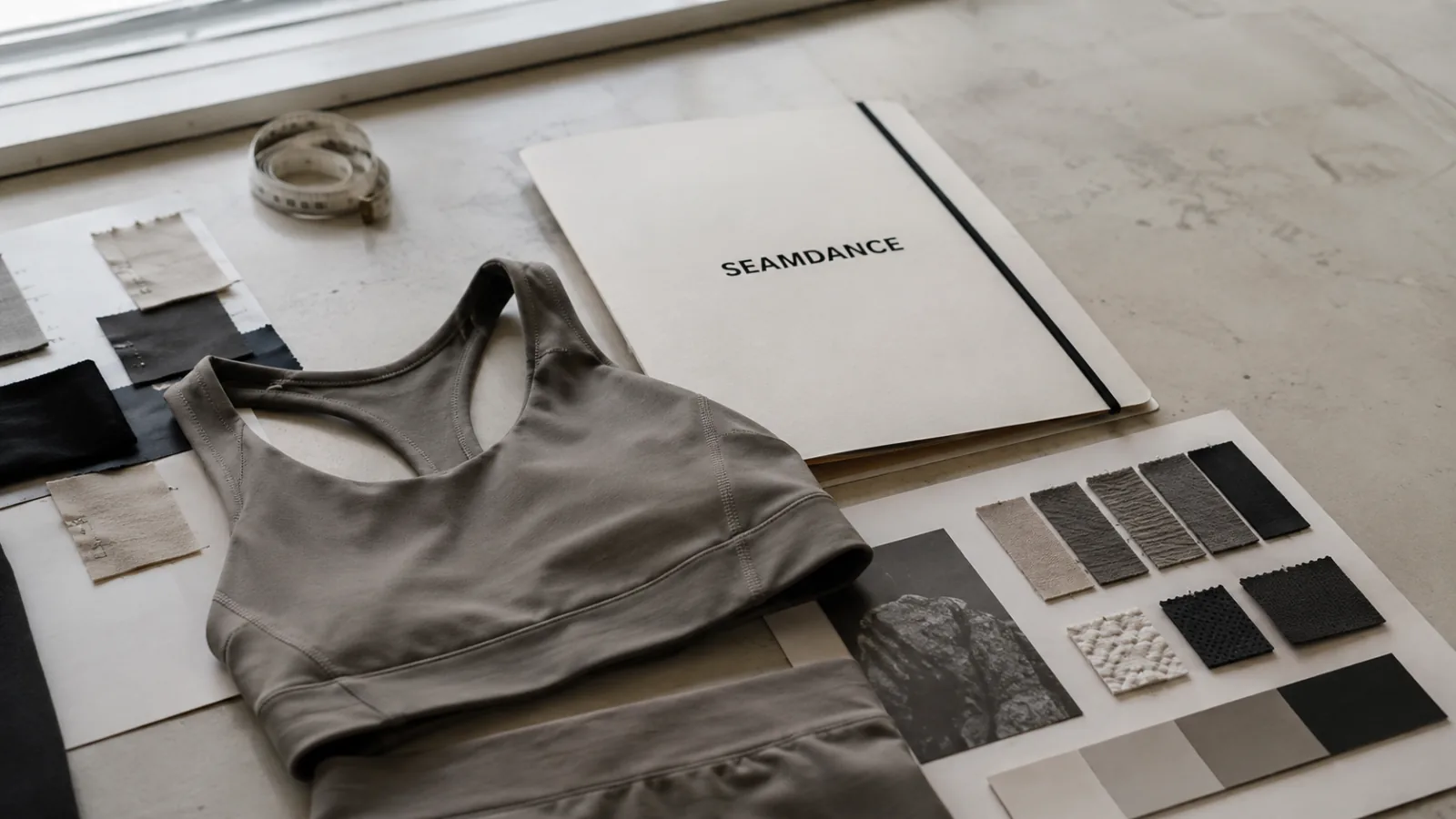
Most first activewear collections fail commercially for the same reasons, and none of them is product quality. They are too wide, too shallow on the styles that matter, committed to colour before fit is proven, and sized to a hoped-for demand rather than to a testable question. The product usually turns out fine. The decisions around it are what decide whether there is a second order.
The short answer
- Start narrower than feels right: two or three styles in real depth beat eight styles at minimum quantities.
- Fix the construction route and fit block before colour and branding — colour decisions made on an unproven fit get repeated at cost.
- Colour minimums, not style minimums, usually set the real floor for a first order.
- Size the first run to answer three questions — does it sell, can the factory repeat it, does it meet your standard — not to maximise margin.
Decide what the first collection is for
A first collection can pursue one of two goals well, and rarely both: prove that a product and a customer exist, or establish a full brand presence. The first needs a narrow, deep, testable range. The second needs capital most first-time brands do not have and inventory risk they should not take.
State the goal explicitly before speaking to a supplier, because it changes every downstream answer. A range designed to test demand should be small enough that being wrong is survivable and clear enough that the result is interpretable. Eight styles at minimum quantities produces neither — when it under-performs, you cannot tell which decision was the mistake.
The practical version for most founders: two or three styles, one or two colours each, in a depth that actually says something when it sells or does not.
Construction before colour
The construction route — seamless or cut-and-sew — determines the factory, the minimums, the styling freedom and the cost structure. Choosing it after design means either redesigning or accepting a compromised version of the original idea. Decide it against what the product must do: support level, styling, order quantity and target cost.
Then fix the fit block before anything cosmetic. Fit is the decision that customers feel and that reorders depend on, and it is the one that takes sample rounds to get right. Colour, logo placement and packaging are comparatively easy to change once the block is settled.
Brands that reverse this order pay twice: colour is approved on a sample whose fit later changes, and the approval has to be redone on a garment that now behaves differently.
The arithmetic of minimums
Most first-time founders plan around style minimums and are surprised by colour minimums. Fabric is dyed in lots, and each colour carries its own floor. Four colours at the minimum is frequently a larger commitment, and a worse test, than two colours at meaningful depth.
Size is the second multiplier. A size run from XS to XL spreads a modest order across five buckets, and a shallow buy in every size sells out of the middle immediately while the ends sit. For a first collection, either narrow the size range or accept that depth belongs in the middle sizes.
Work backwards from what you can sell in a defined period rather than forwards from what a supplier will accept. The minimum is a constraint to plan around, not a target to reach.
What the first order should prove
Three questions, and the order should be designed to answer them. Does the product sell to real customers at the price you set. Can the factory repeat it — which only becomes visible on a second run against the same sealed standard. And does it meet your own quality bar in the hands of customers, not in a sample bag.
That framing changes what you optimise. Margin on a first run matters less than clean information, and a slightly smaller order that produces a definite answer is worth more than a larger one that leaves you guessing.
It also changes what you document. The sealed reference sample, the approved measurements with tolerances, the colour references and the packaging spec are what make run two comparable to run one. Without them, a reorder is a new development project with an old style number.
The support a first-time brand should expect
A supplier working with a founder for the first time should be doing more than quoting. Realistic minimum structures across styles and colours, a development calendar with named milestones, feasibility input on colour and construction, and a documented standard that survives into the reorder.
They should also be willing to reduce your first order. A supplier who encourages a wider range and deeper buy on an unproven silhouette is optimising their invoice, not your second season.
The sequence that works is unglamorous: narrow range, construction fixed early, fit proven before colour, minimums planned around colour rather than style, and one documented standard carried into production. It is not exciting, and it is the difference between a first collection and a first-and-only one.
Quick answers
How many styles should a first activewear collection have?
Usually two to four. The constraint is not creative — it is that each additional style splits a fixed budget into shallower buys, and shallow buys sell out of the middle sizes while leaving the ends. Depth in fewer styles produces a clearer commercial signal.
Should I start with stock styles or custom development?
Stock private label proves the customer and the price point fastest, with lower minimums and shorter timelines. Custom development is the right first step when your differentiation is genuinely in the product's construction rather than in the brand and the fit of an existing block.
The four equipment gaps that separate a tee factory from a legging factory.
Open the programSourcing styles for your line? The 2026 catalogue lists every ready-to-develop style — colorways, materials, quote list built in.